Workplace Ergonomics
Risk Assessment (WERA)
52
Projects
1,200+
Professionals Trained
>95%
Client Satisfaction
1,200+
Professionals Trained
52
Projects
>95%
Client Satisfaction
Workplace Ergonomics Risk Assessment (WERA)
We offer proactive Workplace Ergonomic Risk Assessments designed to identify and manage ergonomic risks before they become costly incidents.
Our Workplace Risk Assessment targets high-risk operations, including work-at-height, confined spaces, lifting/transportation, and production lines, using structured methods and digital analysis to provide clear, actionable insights for hazard elimination and MOM/WSH compliance.
Key Features of Workplace Ergonomic Risk Assessment:
- Motion Analysis & Data Collection
Capturing real employee movements to identify unsafe patterns during Workplace Ergonomic Risk Assessment.
- Ergonomic Risk Data Analysis
Applying recognised assessment tools (REBA) to quantify risk exposure in your workplace.
- Comprehensive Reporting & Recommendations
Clear, actionable reports that support MOM/WSH compliance and internal audits.
Why Workplace Ergonomic Risk Assessment Matters:
Unsafe ergonomic practices often go unnoticed until injuries cause downtime, penalties, and lost productivity. Our Workplace Ergonomic Risk Assessment equips WSH leaders and officers with data to identify risks early, protect employees, ensure MOM/WSH compliance, and safeguard your bottom line.
Real Results for Your Workplace
From fewer incidents to healthier employees, here’s the impact you can expect.
Fewer
Incidents
Safer operations, less downtime.
Lower Absenteeism
Healthier, consistent workforce.
Stronger Compliance
Clear MOM/WSH-ready reports.
Engaged Employees
Healthier, more productive teams.
5 Easy Steps to Safer, Healthier Workplaces
Our streamlined Workplace Ergonomic Risk Assessment process delivers practical, measurable results:
01
Discovery & Site Walkthrough
We begin by visiting your facility to map your unique environment, employee roles, and specific safety challenges. This initial step ensures our Workplace Ergonomic Risk Assessment is fully customised to your industry, operations, and workforce needs.
02
Risk Assessment (WRA)
Our specialists then perform a detailed motion analysis, hazard identification, and ergonomic data collection across high-risk activities, including work at height, confined spaces, and production lines. This uncovers both obvious and subtle risks before they lead to incidents.
03
Ergonomics Evaluation
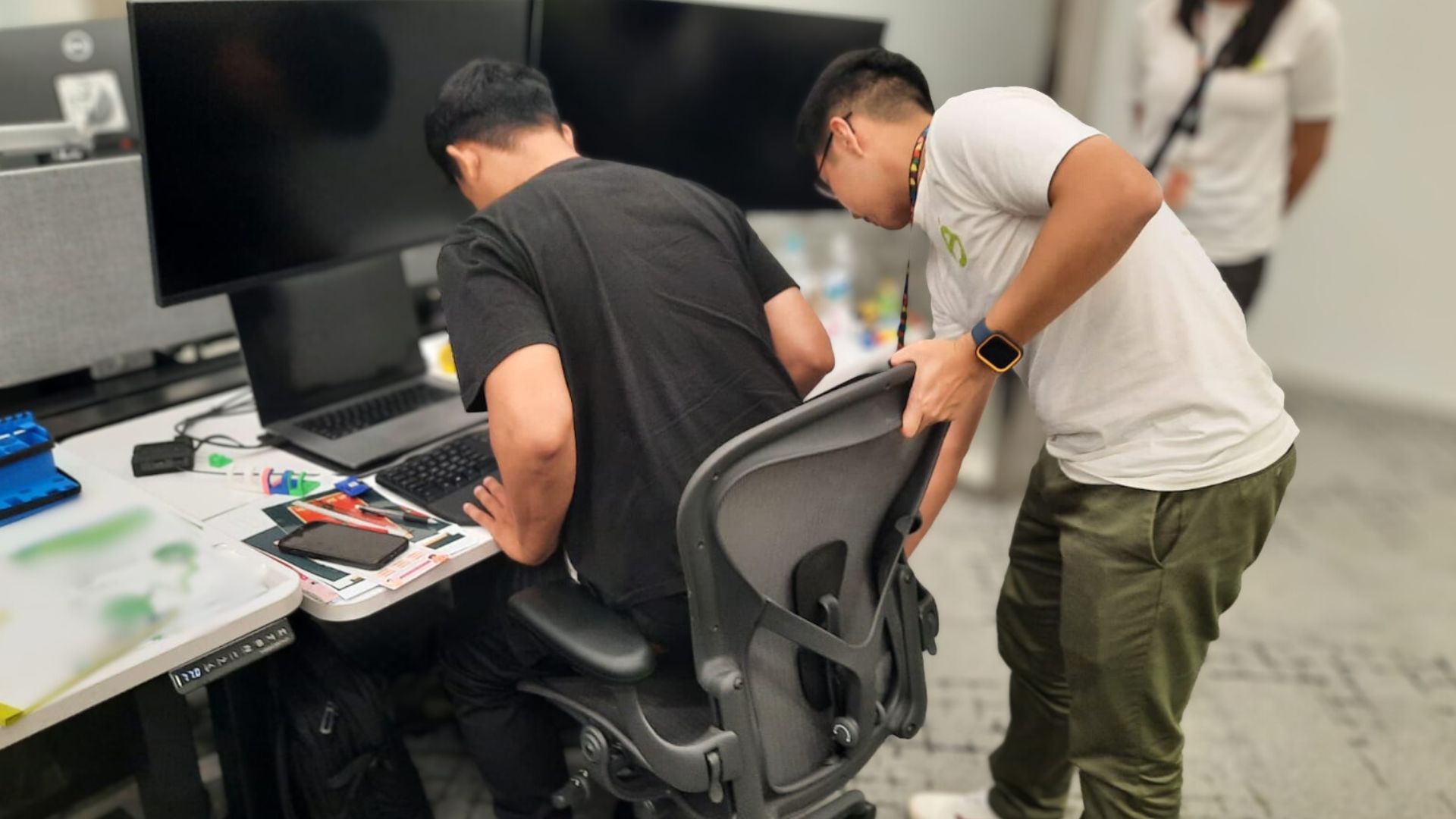
We thoroughly assess workstations, workflows, tools, and physical demands through hands-on observations, group workshops, and optional 1-on-1 physiotherapy consultations. We also provide employees with practical tools to reduce strain, improve posture, and prevent musculoskeletal injuries.
04
Tailored Recommendations
You will receive a comprehensive, executive-ready report with actionable recommendations, prioritised cost-effective controls, and clear implementation timelines. For example, adding a footstool to improve posture at workstations. They are designed to not just align with MOM/WSH regulations but boost employee wellbeing, productivity, and long-term ROI.
05
Ongoing Support
Beyond reports and recommendations, we deliver follow-up audits, performance monitoring, and continuous programme optimisation. This embeds ergonomic best practices into your culture, ensuring sustained MOM/WSH compliance, safer operations, and healthier employees year-round.
Trusted by Our Clients


What Our Clients Say
Hear directly from our satisfied partners.
The campaign itself is a really useful campaign. I think a lot of people don’t have a general awareness of the 3Rs – Reduce, Reuse and Recycle. I really enjoy playing around and finding out more about worm composting, and it’s something that I am curious to find out more about. I was not aware that soiled tissue paper can’t be recycled, so that’s a good learning point for me.
RAMESH KUMAR
Data Operations Technician
The safety campaign was highly effective in educating employees through interactive and engaging activities. Instead of passive learning, hands-on demonstrations and real-life scenarios made safety principles more relatable and memorable. Employees were more engaged, retained key safety practices better, and felt more confident applying them in their daily work. It was a great way to foster a strong safety culture in the workplace.
YVONNE THUNG
Workplace Safety Officer
I have some knee injuries myself. So, I find that the physiotherapy consultations are quite helpful. It teaches me which type of support I need in different situations to protect my knees. I learned about some daily health supplements for maintenance, or how to obtain nutrients from regular food and which knee guards I should wear during exercise. I feel that it is helpful to us.
RICHARD WANG
Data Operations Technician
Let's Connect!
Let’s empower your workplace with leading health and safety solutions together!