Written by Bryan Sim, Business Development, AnjouHealth
A Practical Guide for Employers and Employees
Workplace safety and health (WSH) in Singapore is often misunderstood.
Many organisations reduce it to safety posters, PPE, or a compliance checklist. Others only pay attention when an accident occurs or when a Ministry of Manpower (MOM) investigation begins.
From my experience working with organisations across Singapore, the truth is this:
Effective WSH isn’t about avoiding penalties, it’s about preventing harm before it happens.
If you searched “workplace safety and health Singapore”, you’re likely looking for a clear, practical explanation of how WSH works in Singapore, how it protects workers from injuries, illnesses, and long-term health risks, while supporting safe and productive operations.
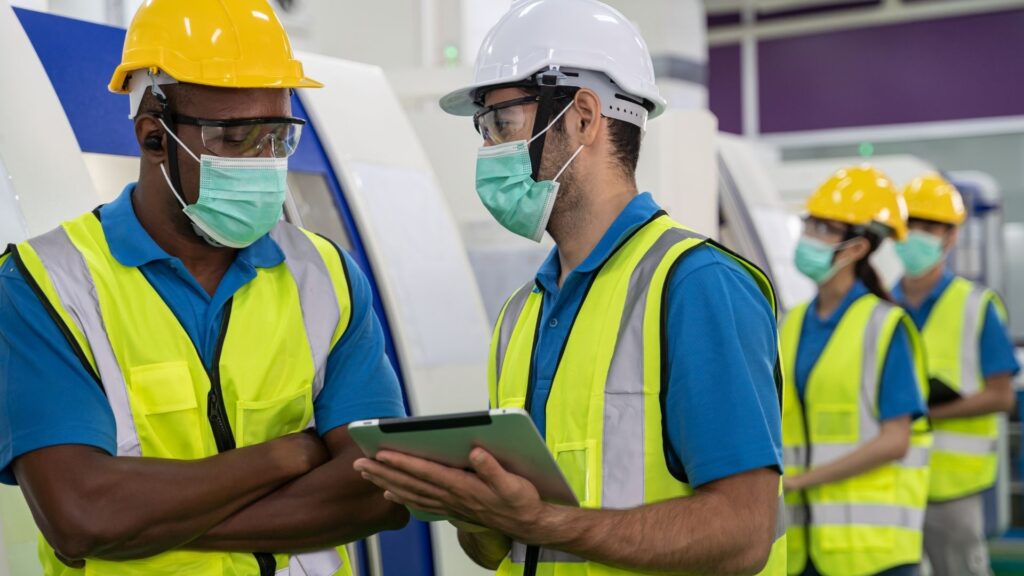
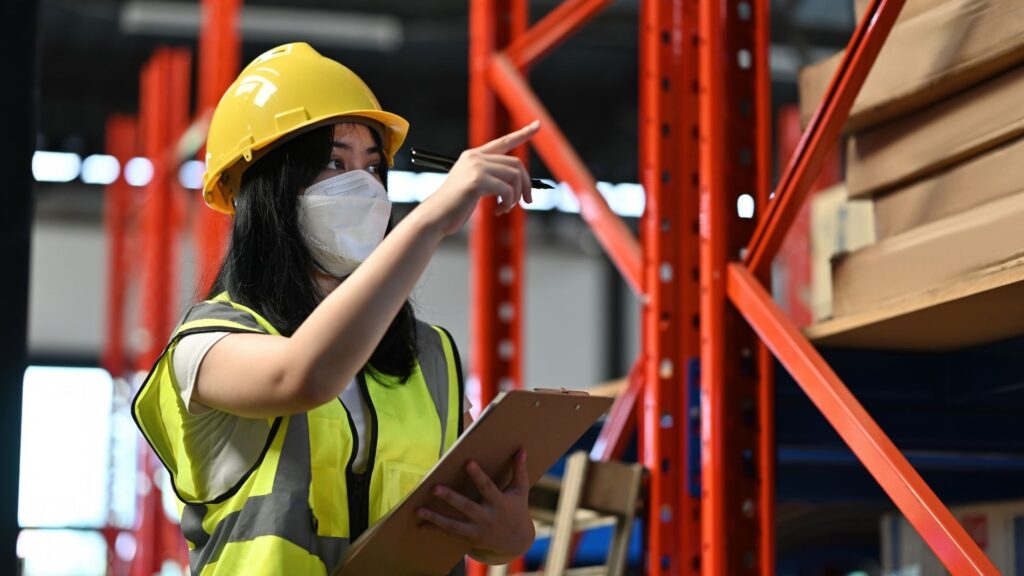
In Singapore, Workplace Safety and Health (WSH) applies across offices, factories, construction sites, and all other work environments. Governed by the Workplace Safety and Health Act and administered by MOM, the framework places strong emphasis on proactive risk management, rather than reacting after incidents occur.
This guide breaks down what workplace safety and health means in Singapore, the legal responsibilities involved, common workplace risks, and how organisations can implement WSH effectively in day-to-day operations.
What Is Workplace Safety and Health (WSH) in Singapore?

Workplace safety and health in Singapore refers to the policies, systems, and daily practices ensuring work is performed without harm to employees’ physical or mental well-being.
The cornerstone is the Workplace Safety and Health Act (WSH Act), which mandates employers to identify hazards, assess risks, and implement controls before incidents occur. This prevention-first approach applies universally, from office ergonomics to construction heights.
WSH covers:
- Physical safety (e.g. slips, trips, falls, machinery hazards)
- Health risks (e.g. musculoskeletal disorders, noise exposure)
- Ergonomic risks (e.g. poor workstation setup, repetitive strain)
- Environmental risks (e.g. heat stress, chemicals, poor ventilation)
- Responsibilities of stakeholders (e.g. employers, principals, occupiers, manufacturers or suppliers)
Simply put, WSH exists to ensure that work does not harm people.
Why Workplace Safety and Health Matters in Singapore

One of the biggest misconceptions I encounter is that workplace incidents are “unavoidable”.
They are not. According to Singapore workplace safety data, the majority of injuries and occupational illnesses are preventable when risks are identified early and managed properly.
When WSH is weak or reactive, organisations often see:
- Higher injury rates
- Increased absenteeism and presenteeism
- Lower productivity
- Rising insurance and compensation costs
- Regulatory scrutiny from MOM
On the other hand, organisations with strong WSH systems consistently experience:
- Fewer incidents and near misses
- Healthier, more engaged employees
- Better operational continuity
- Stronger employer branding
WSH is not a cost centre, it is a risk management and performance strategy.
What Does the WSH Act Require in Singapore?
Under the Workplace Safety and Health Act, employers have a legal duty of care to ensure the safety and health of their workers, as far as reasonably practicable.
This includes:
- Identifying workplace hazards
- Conducting risk assessments
- Implementing control measures
- Providing information, training, and supervision
- Reviewing risks regularly
Importantly, responsibility is shared.
Who Is Responsible Under WSH?
| Role | Responsibility |
| Employers | Provide a safe work environment, systems, and processes |
| Managers & Supervisors | Enforce safe practices and report hazards |
| Employees | Follow safety procedures and report risks |
| Contractors & Vendors | Ensure their work does not create risks |
WSH is not just “the safety officer’s job”. It is a collective responsibility. Best practice: Worker involvement via safety committees boosts effectiveness by 40%.
What Does Workplace Safety and Health Cover in Singapore?
Workplace safety and health in Singapore addresses four risk categories:
| Risk Category | Common Workplace Hazards in Singapore | Key Control Measures | Leading Indicators |
| Physical Safety | Falls from height, struck-by machinery, caught-in/between hazards, vehicle collisions | Work-at-height (WAH) permit systems, machine guarding, traffic management plans, safety barriers | Near-miss reports, safety inspections, barrier and equipment checks |
| Health (Occupational Health) | Chemical exposure, excessive noise (>85 dB), heat stress, biological agents | Exposure monitoring, local exhaust ventilation (LEV), job rotation, health surveillance and vaccination programmes | Air quality readings, audiometric trends, heat stress monitoring |
| Ergonomics | Work-related musculoskeletal disorders (WMSDs), poor posture, repetitive tasks, manual handling | Ergonomic workstation adjustments, manual handling risk assessments, task redesign, micro-breaks and job rotation | Employee discomfort surveys, early symptom reporting, medical and claim trends |
| Psychosocial | Excessive workload, fatigue, workplace harassment, poor supervision | Workload reviews, fatigue risk management, Employee Assistance Programmes (EAP), mental health awareness and support | Absenteeism patterns, engagement survey results, turnover and exit interview feedback |
Key insight: Health and ergonomic risks contribute to a large proportion of lost workdays in Singapore, yet they often develop gradually and are less visible than safety incidents. This makes early identification and proactive risk assessment critical.
Is Workplace Safety and Health Mandatory in Singapore?
Yes, WSH Act Section 12 requires “adequate instruction, information, training, and supervision.”
Non-Compliance Risks Under Singapore’s WSH Act
Failure to comply with Workplace Safety and Health (WSH) requirements can result in serious consequences, including:
- Fines of up to $500,000 for individuals and up to $1 million for corporate bodies
- Imprisonment of up to 2 years for serious or repeat offences
- Additional daily fines for continued non-compliance after an order is issued
These penalties reflect Singapore’s strong enforcement approach and underline the importance of proactive workplace safety and health management.
Proactive organizations exceed baseline, achieving:
- Incident reductions
- Lower WSHP premiums
- Better talent retention
Penalties Under the Workplace Safety and Health Act (Singapore)
| Offence Category | Individual | Corporate Body | Additional Consequences |
| General WSH offence (no specific penalty stated) | Up to S$200,000 (first conviction)Up to S$400,000 (repeat) | Up to S$500,000 (first conviction)Up to S$1 million (repeat) | Imprisonment up to 2 years, or both |
| Failure to comply with Remedial Order | Up to S$50,000 + daily fines | Up to S$50,000 + daily fines | Imprisonment up to 12 months, or both |
| Failure to comply with Stop-Work Order | Up to S$500,000 + daily fines | Up to S$500,000 + daily fines | Imprisonment up to 12 months, or both |
| Serious offence causing death or severe injury | Prosecution under WSH Act | Prosecution under WSH Act | Fines, imprisonment, or both (court-determined) |
How to Implement Workplace Safety and Health in Practice
5-step WSH cycle (MOM standard):
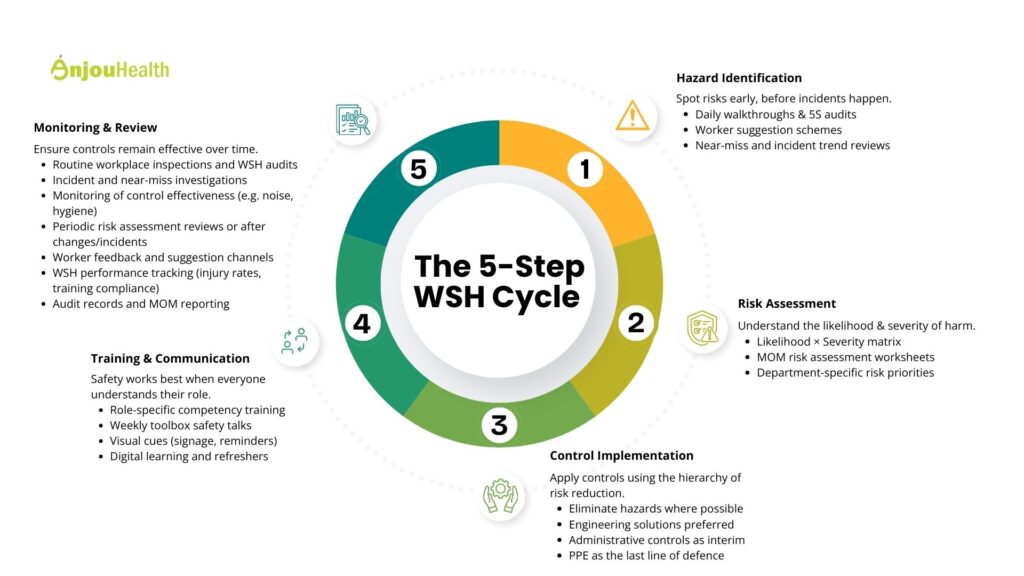
- Hazard Identification
- Daily walkthroughs (5S audits)
- Worker suggestion schemes
- Incident/near-miss analysis
- Risk Assessment
- Likelihood × Severity matrix
- MOM template worksheets
- Department-specific focus
- Control Implementation
- Hierarchy priority (Eliminate first)
- Engineering solutions preferred
- Administrative controls interim
- PPE absolute last resort
- Training & Communication
- Role-specific competency training
- Weekly toolbox safety talks
- Visual management (signage)
- Digital learning platforms
- Monitoring & Review
- Regular workplace inspections (daily supervisor walkthroughs, monthly WSH audits)
- Incident and near-miss investigations
- Control effectiveness testing (e.g., noise/hygiene monitoring)
- Risk assessment reviews (every 3 years or after changes/incidents)
- Worker feedback surveys and suggestion schemes
- WSH performance KPIs (injury rates, training compliance)
- Audit documentation and MOM reporting
Practical tools:
- Risk assessment templates (MOM website)
- Toolbox talks (weekly)
- Ergonomic checklists
- RTW programs (40% faster recovery)
Common WSH Gaps I See in Singapore Workplaces
Despite good intentions, many workplaces struggle with the same issues:
- Risk assessments done once and never reviewed
- Ergonomics ignored until staff complain of pain
- Training that is theoretical, not practical
- Safety rules that exist on paper but not in daily behaviour
These gaps often lead to slow-burn problems, discomfort, fatigue, reduced focus, long before injuries are reported.
How Ergonomics Fits Into Workplace Safety and Health

Ergonomics is a critical but often overlooked part of WSH.
Poor ergonomics does not usually cause dramatic accidents. Instead, it leads to:
- Neck, back, and shoulder pain
- Wrist and hand discomfort
- Chronic fatigue
- Reduced concentration
Over time, these issues can develop into WMSDs, which are among the most common occupational health problems in Singapore.
Proactive ergonomic assessments help organisations:
- Identify risk early
- Reduce discomfort
- Support productivity
- Prevent long-term injuries
How Often Should WSH Measures Be Reviewed?
WSH should be reviewed:
- When work processes change
- When new equipment is introduced
- When employees report discomfort or incidents
- After near misses or accidents
- Periodically as part of continuous improvement
If your workplace looks different today compared to a year ago, your risk assessment should reflect that.
Why Preventive WSH Works Better Than Reactive Fixes

In my professional experience, the most effective organisations are not the ones that respond fastest after an incident, they are the ones that prevent incidents from happening at all.
Preventive WSH:
- Costs less than injury management
- Builds trust with employees
- Creates safer work habits
- Reduces operational disruption
It shifts safety from a compliance exercise to a workplace culture.
Final Thoughts: WSH Is About People, Not Paperwork
Workplace safety and health in Singapore is not just about meeting MOM requirements.
It is about recognising that:
- People are your most valuable asset
- Injuries and illnesses are not “part of the job”
- Prevention is always better than treatment
When WSH is done well, it protects people, strengthens organisations, and creates workplaces where employees can perform at their best, safely.
Ready to Strengthen Workplace Safety and Health?

If you’re unsure whether your current workplace safety and health measures are effective or if you want to move beyond compliance to real prevention, reach out to us at AnjouHealth.
Book a call with us to explore how proactive WSH strategies, ergonomic assessments, and risk management can support a safer, healthier workplace.