

Written by Wesley Chee, Ergonomist at AnjouHealth and Physiotherapist at Physio & Sole Clinic
In The Blog:
- What Workplace Ergonomics Means
- Key Ergonomic Risks in Singapore Offices
- Ergonomic Risk Assessment Explained
- Employer Best Practices
- FAQs and Next Steps
What Is Workplace Ergonomics?
Workplace ergonomics is the practice of designing work tasks, workstations, tools, and environments to fit the worker, rather than forcing people to adapt to poorly designed work. It looks at how people sit, stand, move, lift, reach, and interact with their equipment throughout the day, with the aim of reducing physical strain and improving comfort and performance.
Key elements of workplace ergonomics include:
- Posture and body alignment during work
- Workstation layout (chair, desk, monitor, keyboard, mouse)
- Task demands (repetition, force, duration, pace)
- Work-recovery balance (breaks and variation)
- Individual factors (body size, previous injuries, fitness)
When these elements are not well matched, workers are more likely to develop discomfort and work-related musculoskeletal disorders (WRMSDs) over time.
Why Workplace Ergonomics Matters for Employers in Singapore
High burden of musculoskeletal problems
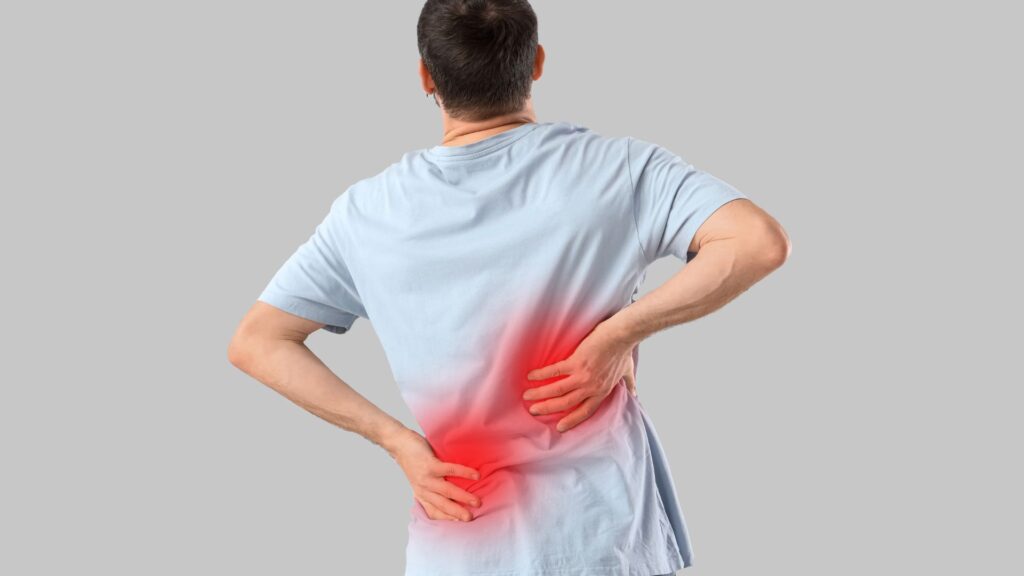
Poor workstation setup and repetitive movement patterns are common contributors to work-related musculoskeletal disorders (WMSDs). Workplace ergonomics programmes help organisations reduce these risks while supporting workplace safety compliance across Singapore.
In Singapore, work‑related musculoskeletal disorders are consistently among the top reported occupational diseases. Recent national data show hundreds of WRMSD cases recorded each year, with the back, neck, and shoulders most commonly affected, especially in sectors with intensive computer use and manual handling.
Local studies on office workers have found that more than 70% report pain in at least one body region (neck, shoulders, or low back), often linked to prolonged sitting and suboptimal workstation setups. This reflects the reality of many Singapore workplaces where long hours, high screen time, and tight deadlines are the norm.
Because of these risks, many organisations in Singapore proactively implement workplace ergonomics programmes and ergonomic risk assessments as part of their Workplace Safety and Health (WSH) strategy.
Impact of Poor Workplace Ergonomics on Productivity and Business Costs
Poor ergonomics is associated with:
- Increased absenteeism (sick leave for neck, back, shoulder, and arm pain)
- Presenteeism (staff are present but working at reduced capacity due to discomfort)
- Higher medical and insurance costs
- Reduced concentration, error rates, and slower task performance
When WRMSDs progress, they may also trigger work injury compensation claims and longer‑term restrictions on what affected staff can safely do.

How Workplace Ergonomics Supports WSH Compliance in Singapore
Under Singapore’s WSH framework, employers must take reasonably practicable measures to ensure the safety and health of employees at work, including managing ergonomic risks as part of risk assessment and risk control. WSHC’s Guidelines on Improving Ergonomics in the Workplace and related codes of practice emphasise that:
- Ergonomic hazards (e.g., awkward postures, repetitive tasks, heavy or frequent lifting) should be identified in risk assessments.
- Control measures should be implemented using a structured approach (elimination, engineering controls, administrative controls, training).
From a Singapore WSH perspective, ergonomics is therefore a core part of preventive risk management, not an optional comfort add‑on.
Common Ergonomic Risks in Singapore Offices and Display Screen Equipment (DSE) Work
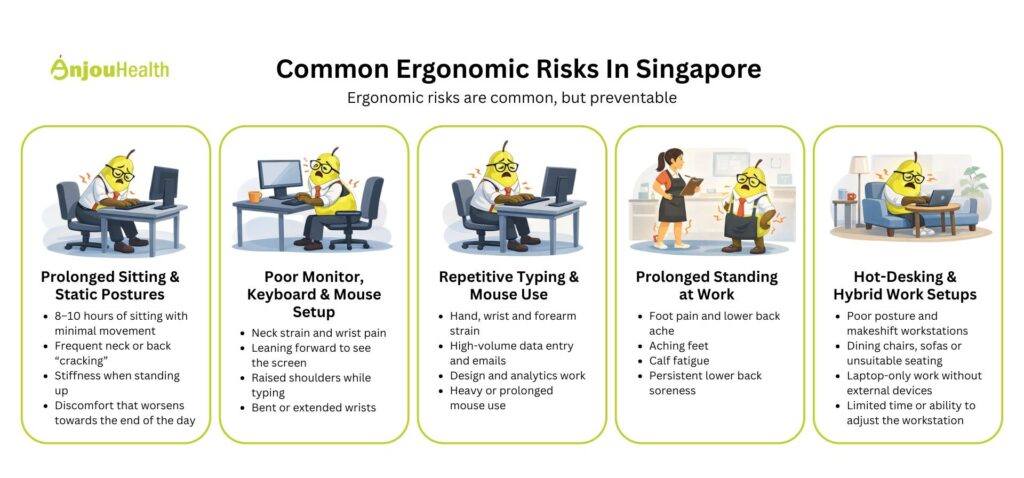
1. Prolonged Sitting and Static Postures
Office workers in Singapore often spend 8–10 hours a day seated, with long uninterrupted stretches at the computer. Prolonged sitting, particularly with rounded backs and forward head posture, increases load on the spine and neck, leading to stiffness and pain.
Typical red flags:
- Needing to “crack” the neck or back frequently
- Feeling stiff when standing up after sitting for a long time
- Discomfort that worsens towards the end of the day
2. Poor Monitor, Keyboard, and Mouse Position
When monitors are too low or too far, or when keyboards and mice are positioned too high or too wide, workers tend to lean forward, shrug their shoulders, or extend their wrists. Over time, this contributes to neck strain, shoulder tightness, and wrist/forearm discomfort.
3. Repetitive Typing and Mouse Use
High‑volume data entry, email work, and mouse‑intensive tasks (e.g., design, trading, analytics) create repetitive loading of small muscles and tendons in the hand, wrist, and forearm. Without adequate pauses or task variation, this increases the risk of overuse conditions.
4. Prolonged Standing and Customer‑Facing Roles
In retail, healthcare, manufacturing, and customer‑facing roles, staff may stand for long periods on hard floors. Common complaints include foot pain, calf fatigue, and low back ache, especially where there is limited opportunity to sit or change posture.
5. Hot‑Desking and Hybrid Work
Hot‑desking is common in Singapore offices, and many employees now split time between office and home. Hybrid arrangements introduce risks such as:
- Working from dining chairs, sofas, or beds
- Using laptops without an external keyboard/mouse, or monitor
- Minimal time or tools to adjust each hot‑desk to individual needs
These setups make it difficult to maintain a neutral posture and often increase neck and back strain.
Is Workplace Ergonomics Required by Law in Singapore?
Singapore does not have a single “ergonomics law”, but ergonomic risk management is embedded within broader WSH and risk‑management requirements.
Key points for employers:
- The WSH (Risk Management) Regulations require employers to identify and control all significant hazards, which include ergonomic factors such as manual handling, prolonged standing, and awkward postures.
- Codes of practice such as SS 514: Code of Practice for Office Ergonomics and SS 569: Code of Practice for Manual Handling provide practical guidance that regulators expect employers to follow as good practice.
- When WRMSDs become reportable occupational diseases, employers may face Work Injury Compensation liabilities if work factors significantly contributed to the condition.
In practice, this means that ignoring obvious ergonomic issues can be inconsistent with the employer’s duty of care under WSH laws, and may increase both legal and financial risk.
What Is an Ergonomic Assessment?
An ergonomic assessment is a structured review of how a worker interacts with their tasks, workstation, and environment, to identify risk factors and recommend improvements.
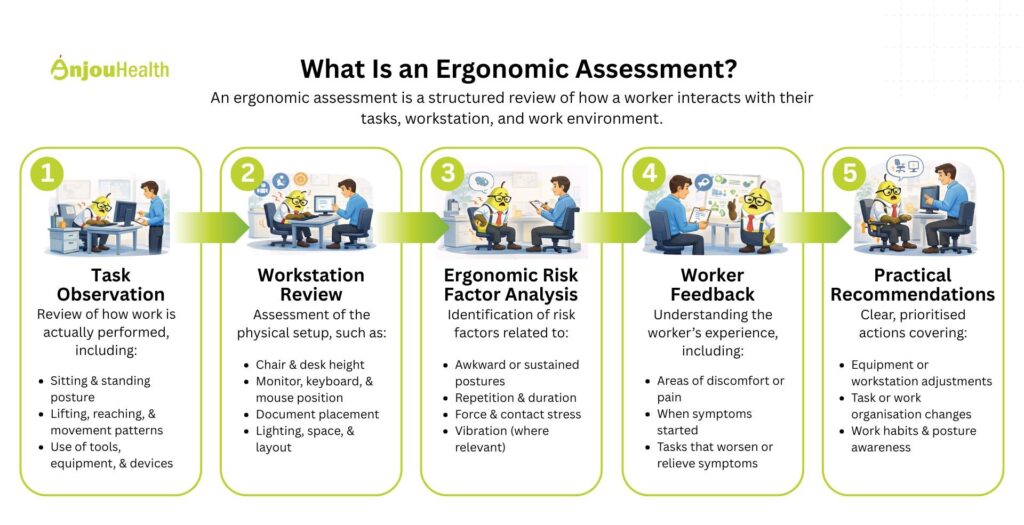
A typical workplace ergonomics assessment in Singapore often includes:
- Task observation: How the person sits, stands, lifts, reaches, and uses equipment during actual work.
- Workstation review: Chair, desk, monitor, keyboard, mouse, document position, lighting, and space.
- Risk factor analysis: Looking at posture, repetition, force, contact stress, vibration, and duration.
- Worker feedback: Symptoms, onset pattern, tasks that aggravate or relieve discomfort.
- Recommendations: Prioritised changes for equipment, workstation setup, work organisation, and personal habits.
Assessments can be:
- Individual (e.g., for an employee with recurring neck or back pain)
- Role‑based (e.g., call centre, helpdesk, trading floor, medical records team)
- Department or organisation‑wide as part of an ergonomic risk assessment programme.
In Singapore, ergonomic assessments are commonly carried out by trained ergonomists, physiotherapists, or WSH professionals with ergonomic training.
Who Should Conduct an Ergonomic Assessment in Singapore?
Best practice is to use professionals with formal training and experience in ergonomics and musculoskeletal health. This may include:
- Ergonomists with qualifications in human factors/ergonomics
- Physiotherapists or occupational therapists with workplace ergonomics and WRMSD expertise
- WSH professionals who have completed recognised ergonomics courses and use validated tools
Engaging appropriately trained professionals helps ensure that:
- Risk factors are properly identified and prioritised
- Recommendations are practical for Singapore workplaces and aligned with local WSH guidance
- Documentation can support internal WSH records, audits, and, where relevant, Work Injury Compensation (WIC) cases
Practical Ergonomic Controls for Singapore Workplaces
1. Workstation Setup (Office / DSE)
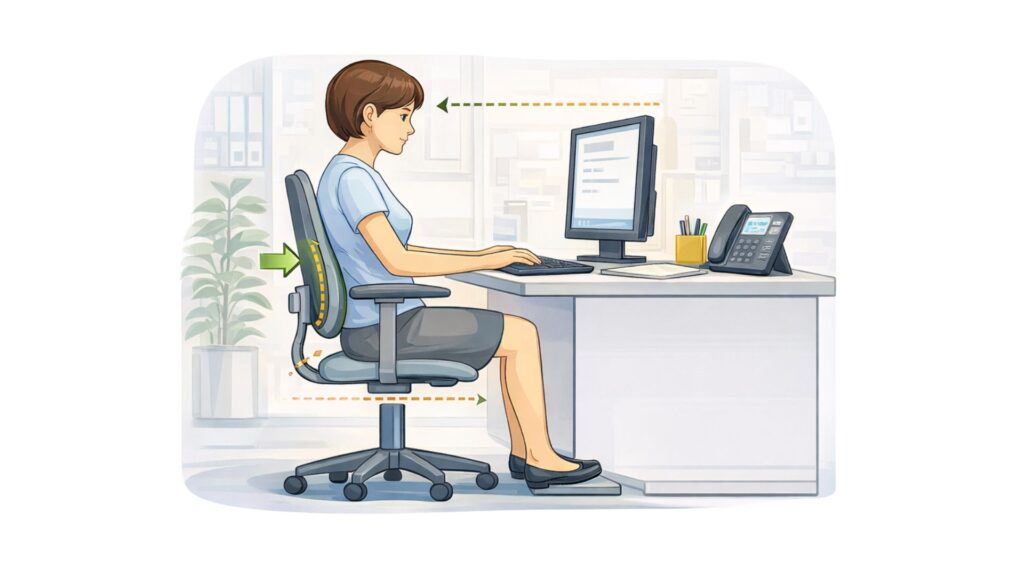
Drawing on SS 514 and WSHC guidelines, a basic office workstation should aim for:
- Feet flat on the floor or on a footrest, with thighs roughly horizontal
- Knees at about 90–100 degrees, hips level with or slightly above knees
- Back supported, with the chair’s lumbar support fitting the natural curve of the lower back
- Monitor at or slightly below eye level and about an arm’s length away
- Keyboard and mouse close to the edge of the desk, allowing elbows by the side and wrists in a neutral position
- Frequently used items (phone, documents) are within easy reach
2. Task and Work Design
WSH ergonomics guidance recommends combining workstation changes with work‑organisation strategies:
- Rotate tasks to reduce long periods of repetition or static posture
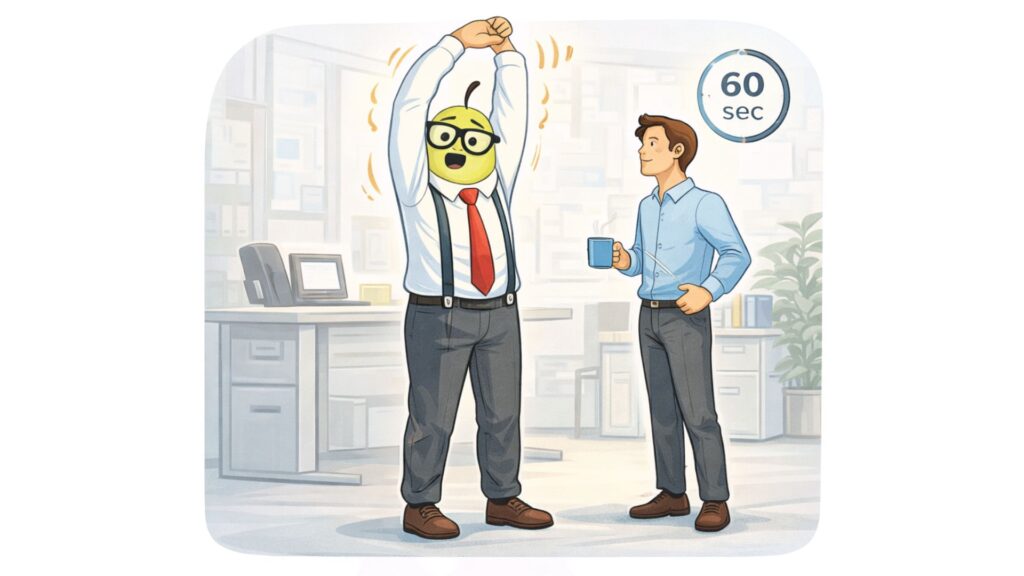
- Plan short “micro‑breaks” (30–60 seconds) every 30–60 minutes to stand, stretch, or reset posture
- Where possible, provide options to alternate between sitting and standing during the day
- Utilise the standing desk function if available at the workstation
- Limit extended overtime that prevents adequate rest and recovery
3. Education and Early Reporting
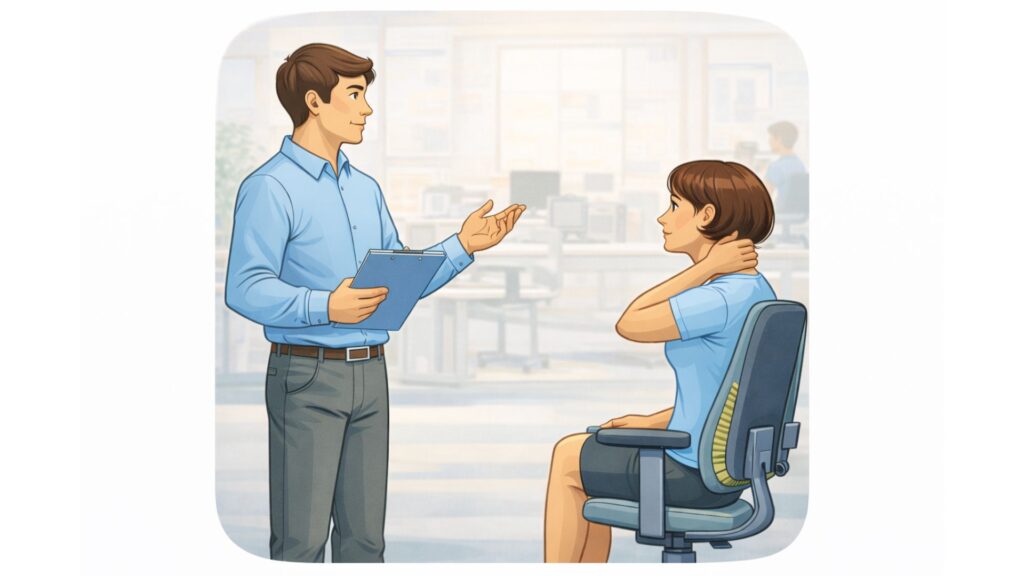
MOM and WSHC highlight education and early intervention as key for WRMSDs. Employers can:
- Provide short training on adjusting chairs, monitors, and peripherals
- Share simple stretching routines targeted at the neck, shoulders, wrists, and back
- Encourage staff to report early signs of discomfort rather than waiting until pain is severe
- Integrate ergonomic awareness into onboarding for new hires, especially for roles with heavy computer use
How Often Should Workplace Ergonomics Be Reviewed?
There is no fixed legal interval, but ergonomic risk should be reviewed:
- When employees report recurring discomfort or pain
- After any significant change to layout, equipment, staffing, or work processes
- When introducing hybrid work, hot‑desking, or new technology (e.g,. multiple screens)
- As part of periodic WSH risk assessments, especially in high DSE or manual‑handling roles
- When trends in WRMSDs, medical claims, or sick leave suggest underlying ergonomic issues
A Practical Ergonomics Review & Intervention Approach
For many office‑based organisations, a practical approach is:
- Baseline ergonomic risk review during regular WSH risk assessments
- Targeted ergonomic interventions (e.g. workstation adjustments, task redesign, manual handling controls) when risks or symptoms are identified
- Individual assessments for employees reporting discomfort or in higher-risk roles
- Follow-up reviews to confirm interventions are effective and sustained
- Periodic refresher training and spot checks to ensure good ergonomic practices are maintained over time
Does Ergonomics Reduce Workplace Injuries?

International and local evidence show that ergonomic interventions can reduce WRMSD symptoms, improve comfort, and lower injury rates. Improvements such as workstation redesign, better manual‑handling methods, task variation, and staff training are associated with:
- Fewer reported cases of back, neck, and shoulder pain
- Reduced need for medical treatment and physiotherapy
- Lower workers’ compensation and injury‑related costs
- Better perceived health and job satisfaction among staff
In Singapore, WSHC’s ergonomics guidelines emphasise ergonomics as a core component of Total WSH programmes aimed at preventing work‑related health problems and improving overall well-being.
Benefits of Workplace Ergonomics for Employers
Health and Comfort
- Reduced discomfort, fatigue, and WRMSD risk for employees
- Better ability for staff to sustain performance throughout the workday
Business Performance
- Improved concentration, accuracy, and productivity
- Reduced absenteeism and presenteeism due to musculoskeletal issues
- Lower medical, insurance, and WIC‑related costs over time
Compliance and Culture
- Stronger alignment with WSH risk‑management expectations
- Positive safety culture and improved employee engagement
- Better positioning for audits, tenders, and clients that value robust WSH practices
When viewed through a Singapore WSH lens, workplace ergonomics is a practical, high‑impact component of injury prevention and sustainable performance, especially in office‑heavy and DSE‑intensive sectors.
FAQ: Workplace Ergonomics in Singapore
- What is workplace ergonomics?
Workplace ergonomics is designing work tasks and setups to reduce strain and improve comfort and performance.
- Why is workplace ergonomics important in Singapore?
Poor ergonomics contributes to WRMSDs like neck, back, and shoulder pain, affecting productivity and well-being.
- When should companies conduct a workplace ergonomics assessment in Singapore?
Companies should consider conducting a workplace ergonomics assessment when employees report discomfort, when new workstations are introduced, during workplace redesign projects, or as part of regular Workplace Safety and Health (WSH) risk management practices in Singapore.
- Is workplace ergonomics required under WSH regulations in Singapore?
There is no single “ergonomics law,” but ergonomic risks are part of Singapore’s WSH risk management duties.
- What are common ergonomic risks in offices?
Prolonged sitting, poor monitor setup, repetitive typing, and hot-desking are common ergonomic hazards.
- What is an ergonomic assessment?
An ergonomic assessment reviews how employees interact with tasks and workstations to identify risks and recommend improvements.
- What workplace ergonomics support can include?
- Workstation ergonomics assessments
- Office setup optimisation
- Manual handling training
- Stretching and mobility workshops
- Ergonomic risk awareness programmes
- Who should conduct an ergonomic assessment in Singapore?
Trained ergonomists, physiotherapists, or qualified WSH professionals are best suited to carry out assessments.
- How often should workplace ergonomics be reviewed?
It should be reviewed when discomfort is reported, when setups change, or during regular WSH risk assessments.
- Does ergonomics reduce workplace injuries?
Yes. Ergonomic interventions can reduce WRMSD symptoms and lower injury-related costs over time.
- What are the benefits of workplace ergonomics for employers?
It improves staff comfort, reduces absenteeism, supports compliance, and strengthens workplace safety culture.
Final Takeaway: Making Workplace Ergonomics Singapore Work for You
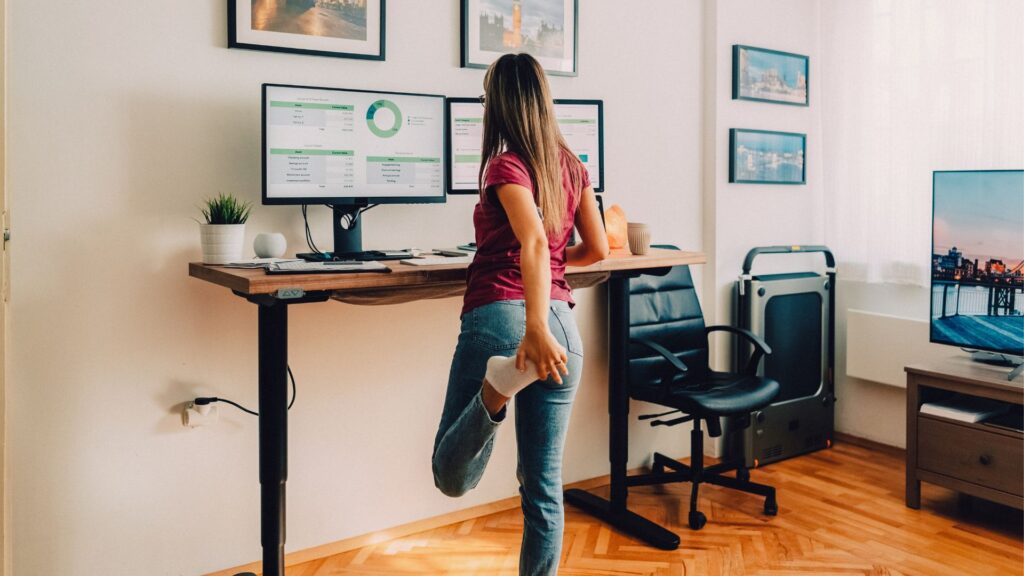
Workplace ergonomics in Singapore is more than just buying new chairs or height‑adjustable desks. It is a systematic approach to designing work and workplaces so that people can perform their jobs safely, comfortably, and efficiently.
By:
- Recognising WRMSDs as a significant and preventable risk
- Integrating ergonomic risk into your WSH processes
- Providing sound workstation setups, good work design, and staff education
- Using ergonomic assessments proactively rather than reactively
Employers and managers can protect their workforce, reduce injury‑related costs, and build healthier, more resilient organisations.
For HR, operations, HSE/WSH officers, and business owners, workplace ergonomics Singapore should be seen as an essential part of risk management and employee wellbeing—not a “nice‑to‑have” that only matters after someone gets hurt.
Workplace Ergonomics Resources from AnjouHealth
This guide is part of AnjouHealth’s Workplace Ergonomics Singapore resource series. You may also find these related articles helpful:
- Workstation Ergonomics Assessment in Singapore: When It’s Needed and What to Expect
(Recommended if your employees experience discomfort from long desk hours or hybrid setups.)
- What Is Ergonomic Risk Assessment? Understanding Workplace Ergonomic Risks in Singapore
(A deeper look into identifying and controlling ergonomic hazards under WSH frameworks.)
- WMSD in Singapore: What Employers Need to Know About Work-Related Musculoskeletal Disorders
(Learn how WRMSDs develop, and what organisations can do to prevent long-term injuries.)
- WHS Risk Assessment in Singapore: How to Identify, Evaluate, and Reduce Workplace Risks
(Ergonomic hazards are a key part of broader workplace safety risk management.)
Explore our full Workplace Health & Safety Blog for more practical employer-focused guidance.