Written by Bryan Sim, Business Development, AnjouHealth
Workplace injury management in Singapore isn’t just about paperwork after an accident; it’s a comprehensive system for handling work injuries, from first aid through to a safe return to work. With 22,157 injuries reported in 2024 (601 per 100,000 workers), poor management costs businesses thousands in medical bills, MC wages, and lost productivity. But done right, using Singapore’s WSHC Return to Work (RTW) programme, employers save $800 per case and cut 10 MC days on average.
The Problem: Workplace injuries hit harder than you think
Singapore employers face a hidden injury crisis. Slips/trips (28% of cases), musculoskeletal strains (22%), and machinery incidents dominate MOM statistics, but the real damage happens after the injury:
- Average cost per case: $2,000-$8,000 (medical + wages + temp replacement)
- Typical MC duration: 7-60 days, depending on injury type
- Repeat injury rate: 25-40% without proper return-to-work planning
“What is workplace injury management?” employers often ask. “Most people assume it’s simply ‘send them to a clinic and wait for an MC.” But transactional injury handling creates a vicious cycle:
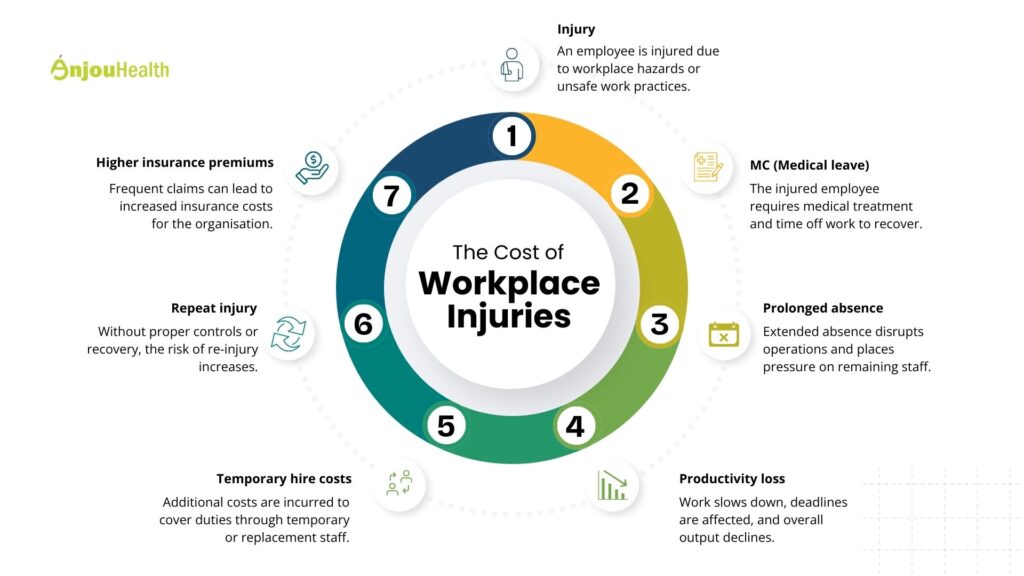
Common gaps:
- No gradual reintegration of employees back into work → Employee sits home longer
- Poor supervisor training → Awkward return attempts fail
- Missing MOM reporting → $5K-$50K fines
- No ergonomic fixes → Same injury hits different worker
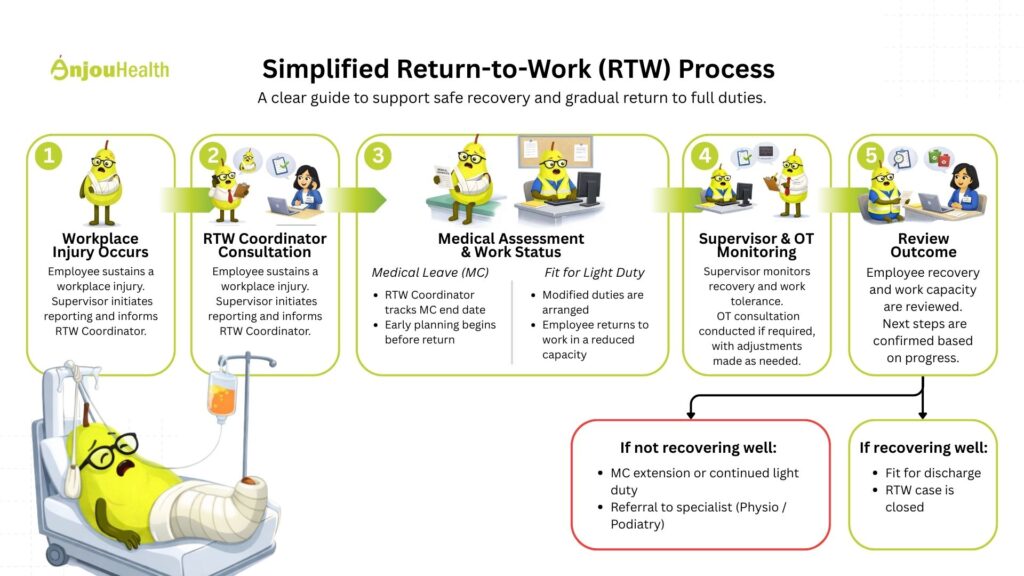
AnjouHealth Injury Management Flowchart
Why it hurts: The hidden costs stack up fast
Gap 1: “Just give MC” mindset
Without work modifications or a proper plan for a gradual return to work, recovery often stalls, employees decondition, morale declines, and claims can escalate. Singapore’s RTW programme proves early intervention cuts MC days by 10 on average.
Gap 2: WICA compliance confusion
- Late reporting (>10 days) = $5K fines
- No WICA insurance = Personal liability
- Poor documentation = Claim disputes
Gap 3: No return-to-work system
“When should return-to-work planning start?” Day 1. Waiting for “100% recovery” loses weeks of productivity. RTW coordinators and occupational therapists work together to create graduated plans matching medical limits to job demands.
Gap 4: Ergonomic blind spots
25% of Singapore injuries are musculoskeletal disorders from poor workstations and repetitive strain. Office workers suffer silently until chronic pain forces extended leave.
Gap 5: Weak internal coordination
“Who manages workplace injury cases?” Usually, no one. Supervisors avoid responsibility, HR handles paperwork, and safety investigates separately. Result: mixed messages, stalled recovery.
The Solution: Your complete workplace injury management system
Step 1: First 60 minutes response protocol
Immediate (0-60 mins):
- Secure the scene, administer first aid
- Document: time/location/witnesses/photos
- Medical transport if serious injury
- Notify supervisor → HR → Safety Officer
- Our coordinators will coordinate with the clinic to brief the doctor ahead of the patient’s arrival. *service that we provide
Step 2: Day 1 medical + legal requirements
Clinic Visits:
- WICA panel clinic + full incident details
- Request a functional capacity evaluation
- Get clear work restrictions (not just MC days)
Legal Reporting:
- Fatalities: IMMEDIATELY via iReport
- 24hr hospitalisation or >3 consecutive MC days: 10-day deadline
Step 3: Week 1 return-to-work foundation
Light-duty jobs are ready immediately after a consultation with an occupational therapist. *patients also see an occupational therapist to receive their return to work plan, not from the clinic
| Role Type | Light Duty Examples |
| Office | Desk work, phone duties, admin |
| Warehouse | Inventory checks, paperwork |
| Factory | Quality inspection, light assembly |
| All roles | Training and mentoring new staff |
Step 4: Activate Singapore RTW Programme
Fully claimable (costs $600-$1,000 but 100% claimable from your WICA insurance; you pay nothing out of pocket)
Who qualifies?
Your injured worker needs:
- Work injury covered by WICA insurance
- The doctor gave 14+ days MC
- Can do some light work (not 100% recovered)
- Work pass valid 9+ months
What you get:
- Personal RTW helper (trained healthcare professional)
- Workplace visit to check job fit
- Custom return plan (Week 1 desk work → Week 4 full duties)
- Therapy booking (physio, occupational therapy)
- Re-injury prevention training
Real savings:
$800 less medical bills + 10 fewer MC days = $2,000+ saved per case
WICA compliance essentials
| Coverage | Employer Pays | Insurer Pays |
| Medical expenses | 100% | – |
| MC Days 1-14 | 100% salary | – |
| MC Day 15+ | – | 75-100% |
| Light-duty wages | 75% daily wage | – |
ALL employees covered (office staff included).
Common Singapore injuries + solutions
| Injury Type | % Cases | Week 1 Light Duty | Week 3 Light Duty |
| Slips/Trips | 28% | Desk work only | Walking supervision |
| Back Strain | 22% | No lifting >5kg | Team lifts ≤10kg |
| Shoulder | 15% | No overhead reach | Waist-level work |
| Wrist/Hand | 12% | Voice-to-text | Light gripping tools |
What AnjouHealth Provides
AnjouHealth delivers complete injury management following our proven flowchart:
1. RTW Coordinator Service
Our coordinators review the injury, brief the doctor, arrange clinic transport, coordinate a gradual return-to-work plan, and check in before the employee resumes regular duties.
2. Functional Capacity Testing
We test real work tasks:
- Sitting tolerance (4 hours for office work)
- Lifting limits (5kg safe maximum)
- Keyboard endurance (repetitive typing test)
Results = precise light-duty restrictions.
3. Light Duty Job Matching (done during the consult with the occupational therapist)
Examples:
- Back strain → Seated inventory checking
- Shoulder injury → Waist-height paperwork only
- Wrist sprain → Voice-to-text admin work
4. Supervisor Training
A virtual call with our coordinators covering:
- How to assign light duties confidently
- Simple daily check-in questions
- When to call us for advice
- Basic documentation for WICA claims
5. Ergonomic Audits
Immediate improvements:
- Office: Laptop risers, ergonomic chairs
- Warehouse: Trolleys for loads over 10kg
- Factory: Adjustable workbenches
Result: Significant reduction in repeat muscle injuries.
6. WICA Compliance
Paperwork handled:
- Functional capacity reports for insurance
- MOM Form 2 completion
- Light-duty wage calculations
- Maximum WSHC RTW funding claims
Frequently Asked Questions
- How does AnjouHealth’s functional assessment work?
We gather advice from an occupational therapist and test actual job tasks (lifting 10kg boxes, 4-hour sitting, repetitive keyboard use) to create precise light-duty restrictions matching medical limits to work demands.
- What makes AnjouHealth different from hospital RTW?
Workplace expertise. Hospitals focus on clinical recovery; we bridge to real job tasks with ergonomic fixes and supervisor training.
- How quickly can AnjouHealth help?
Day 1. Clinic coordination, worksite assessment within 48 hours, RTW plan by Day 5.
- Does AnjouHealth handle WICA paperwork?
Yes. Functional capacity reports for insurers, MOM reporting templates, light duty wage calculations.
- What injuries do you specialise in?
Musculoskeletal (25% of cases), slips/trips recovery, ergonomic injuries across office/manufacturing/logistics.
- Small companies without safety officers?
Perfect fit. We become your case coordinator, train supervisors, and create light-duty banks.
Common pitfalls + fixes
- “Just giving an MC” → Week 1 desk duties saves $4.5K
- Late reporting → Day 1 checklist avoids $10K fine
- Full duties too soon → Graduated RTW plan prevents re-injury
Ready to Improve Your Workplace Injury Management?

Take the first step toward fewer injuries, lower costs, and better employee well-being.
Contact us today for a free review of your current injury management process and build a workplace injury management system that protects your team and your business.
No obligation, just helpful guidance for Singapore employers.