

Written by Bryan Sim, Business Development, AnjouHealth
What Is a Workplace Safety Officer in Singapore?
A Workplace Safety Officer (WSO), commonly referred to as a Workplace Safety and Health Officer (WSHO), is responsible for overseeing workplace safety and health risks and driving continuous improvement in safety performance. In Singapore, the role is governed by the Workplace Safety and Health (WSH) Act and related regulations administered by the Ministry of Manpower (MOM), and is mandatory for certain higher‑risk worksites.
A Workplace Safety Officer helps organisations to:
- Identify and manage workplace hazards in day‑to‑day operations.
- Prevent workplace injuries and occupational diseases through risk‑based controls.
- Ensure compliance with the WSH Act, subsidiary legislation, and industry guidelines.
- Support safer, healthier, and more productive work environments over the long term.
Rather than acting only after accidents, an effective Workplace Safety Officer focuses on early risk detection, system design, and behaviour change.
Why Workplace Safety Officers Matter in Singapore
Singapore’s workplace fatality rate fell to a record low of 0.99 per 100,000 workers in 2023, but there were still 36 workplace fatalities and 590 major injuries that year. Overall, 2023 saw more than 22,000 minor workplace injuries and over 1,200 occupational disease cases, showing that the risk landscape remains significant.
Work-related musculoskeletal disorders (WRMSDs) are a growing concern, with 353 confirmed cases in 2023 and an incidence rate of 29.7 per 100,000 employed persons. From 2020 to 2023, Singapore recorded an average of 350 work-related musculoskeletal disorder cases per year, the majority being back injuries linked to lifting and ergonomic strain. These trends underscore how the role of a Workplace Safety Officer has expanded from traditional physical safety to encompass ergonomics, workload, and health risks in both industrial and office settings.
Key Responsibilities of a Workplace Safety Officer in Singapore
A Workplace Safety Officer’s responsibilities can be grouped into four main areas.
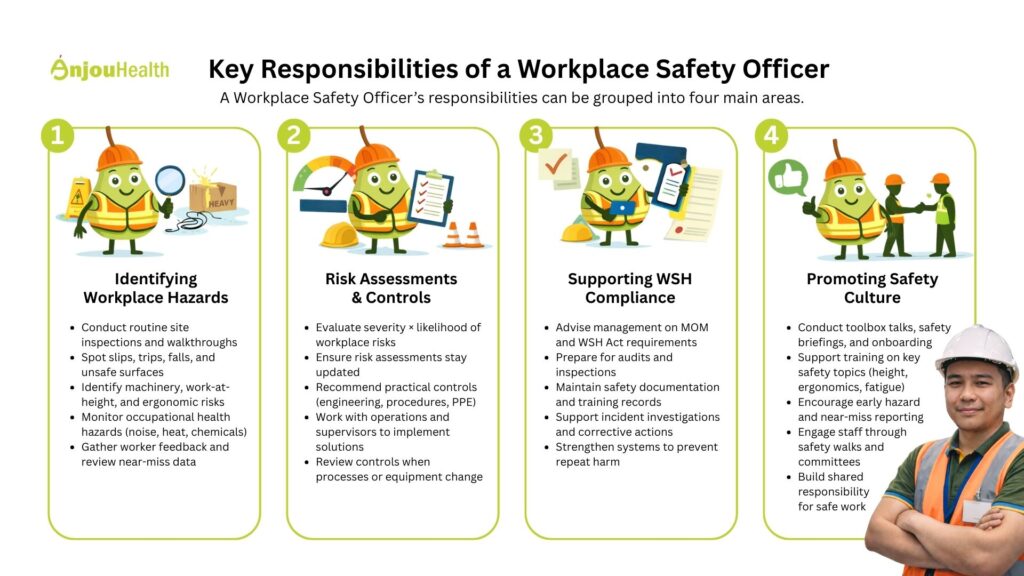
Workplace Safety Officers support organisations in Singapore by strengthening workplace safety management systems, coordinating risk assessments, supporting regulatory compliance under the WSH Act, and improving day-to-day safety performance across worksites. Their role helps employers manage risks proactively rather than reacting after incidents occur.
1. Identifying Workplace Hazards
Workplace Safety Officers systematically assess work activities, workstations, and work environments to uncover safety and health risks. Typical hazards include:
- Slips, trips, and falls on wet, uneven, or cluttered surfaces.
- Machinery, equipment, and work‑at‑height hazards on worksites and in factories.
- Ergonomic risks such as poor workstation setups, repetitive tasks, and unsafe manual handling.
- Noise, heat stress, chemical exposure, and other occupational health risks.
They do this through routine site inspections, observations of work practices, worker feedback, and analysis of incident and near‑miss data.
2. Conducting Risk Assessments and Implementing Controls
One core function of a Workplace Safety Officer is to ensure that risk assessments are carried out, kept up to date, and translated into practical controls. This typically includes:
- Evaluating the severity and likelihood of identified risks in line with WSH guidance.
- Recommending control measures (engineering controls, safe work procedures, PPE, training).
- Working with operations, HR, and line supervisors to implement controls that fit real‑world workflows.
- Reviewing and updating risk assessments when processes, equipment, or manpower change.
Competent Workplace Safety Officers prioritise real risk reduction, such as redesigning tasks to reduce lifting demands or automating high‑risk steps, rather than focusing only on paperwork.
3. Supporting Compliance with WSH Regulations
Workplace Safety Officers support employers in meeting their legal responsibilities under Singapore’s Workplace Safety and Health (WSH) Act and related subsidiary legislation by coordinating structured safety management systems and ensuring regulatory expectations are implemented effectively across worksites. Their compliance‑related responsibilities often include:
- Advising management on applicable MOM requirements, industry codes of practice, and client specifications.
- Preparing for MOM inspections and audits, and following up on findings or stop‑work orders.
- Maintaining safety management system documentation, including policies, risk assessments, SOPs, and training records.
- Supporting incident and accident investigations, identifying root causes, and tracking corrective actions.
While regulatory compliance is essential, the ultimate aim is to prevent harm and build systems that make safe work the default.
4. Promoting Safety Awareness and Culture
Beyond systems and procedures, a Workplace Safety Officer plays a key role in shaping day‑to‑day safety behaviour. They often:
- Conduct safety briefings, toolbox meetings, and onboarding safety orientations for new hires.
- Support training and awareness programmes on topics such as working at height, confined space, ergonomics, and fatigue management.
- Encourage early reporting of hazards, unsafe conditions, and near misses so issues can be fixed before injuries occur.
- Engage employees and supervisors in joint safety walks, suggestion schemes, and safety committees to build shared ownership.
Workplaces with a strong safety culture tend to experience fewer incidents, lower absenteeism, and better morale over time.
At the end of the Responsibilities section (after section 4), insert:
Together, these responsibilities allow Workplace Safety Officers to support organisations in Singapore in reducing incident risks, strengthening WSH compliance readiness, and building a proactive workplace safety culture aligned with MOM expectations.
Where Workplace Safety Officers Work
In Singapore, Workplace Safety Officers are most commonly found in higher‑risk industries and complex operations, such as:
- Construction and infrastructure projects.
- Manufacturing, engineering, and process industries.
- Shipyards, marine, and offshore operations.
- Logistics, warehousing, and transport hubs.
- Data centres, utilities, and large industrial facilities.
Larger organisations often appoint full‑time, in‑house Workplace Safety Officers, while smaller firms or project‑based operations may engage external or outsourced WSH professionals for specific projects or to meet client and regulatory expectations.
When is a Workplace Safety Officer required in Singapore?
Under Singapore’s Workplace Safety and Health (WSH) framework, whether a Workplace Safety Officer (WSHO) is required depends on the industry risk profile, scale of operations, and MOM regulatory thresholds under the WSH Act and related subsidiary legislation.
High-risk workplaces such as construction projects, shipyards, process industries, and larger industrial worksites are typically required to appoint a MOM-registered Workplace Safety Officer once project values, workforce size, or operational risk levels exceed specified thresholds. Even when not strictly required, many organisations voluntarily appoint Workplace Safety Officers to:
- Strengthen risk management and incident prevention.
- Meet tender, client, or international certification expectations (e.g. ISO 45001).
- Improve safety culture and retain talent in a tight labour market.
MOM has also signalled its intention to enhance coverage and standards of safety personnel, including WSH officers and coordinators, to improve oversight at worksites.
Employers unsure whether their workplace requires a Workplace Safety Officer can review their risk profile through a structured workplace risk assessment aligned with MOM expectations.
How to Become a Workplace Safety Officer in Singapore
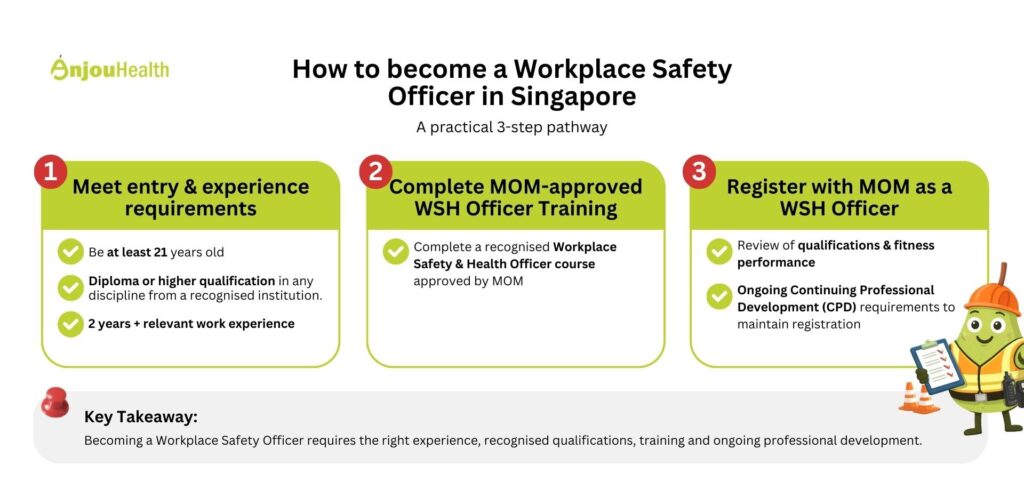
Becoming a Workplace Safety Officer in Singapore involves meeting entry requirements, completing recognised training, and registering with MOM.
Step 1: Meet Entry and Experience Requirements
Candidates typically must:
- Be at least 21 years old.
- Hold at least a diploma or higher qualification in any discipline from a recognised institution.
- Have a minimum period of relevant work experience (often at least 2 years, involving safety, operations, or technical roles).
Prior experience in construction, manufacturing, oil and gas, logistics, or facilities management is often advantageous.
Step 2: Complete MOM‑Approved WSH Officer Training
Prospective Workplace Safety Officers are required to complete a recognised Workplace Safety and Health Officer training programme approved by MOM, typically aligned with the WSHP WSQ framework and supported by professional bodies such as the Singapore Institution of Safety Officers (SISO).
These programmes are designed to equip individuals with the technical competencies required for the WSH profession. Generally covering key areas including WSH legislation and regulatory responsibilities in Singapore, risk management and incident investigation, safety and health management systems, occupational health and ergonomics, as well as safety leadership and stakeholder communication. Successful completion of the course and required assessments is a prerequisite for registration as a Workplace Safety and Health Officer.
Step 3: Register with MOM as a WSH Officer
After fulfilling training and experience requirements, candidates apply to MOM to be registered as a Workplace Safety and Health Officer. Registration can be subject to:
- Assessment of qualifications and work history.
- Fitness to perform duties, considering the demands of site‑based inspections and investigations.
- Ongoing Continuing Professional Development (CPD) requirements to maintain registration and keep up with evolving standards.
Many Workplace Safety Officers also join professional associations and networks to stay updated on best practices and industry developments.
The Expanding Scope of the Workplace Safety Officer Role
Modern workplaces face a broad mix of physical, ergonomic, and psychosocial risks. Beyond traditional site hazards, Workplace Safety Officers increasingly focus on:
- Work-related musculoskeletal disorders from manual handling, poor ergonomics, and prolonged sitting or standing.
- Noise‑induced deafness, which accounted for over 800 occupational disease cases in 2023.
- Fatigue, shift work, and mental well‑being, especially in 24/7 operations and hybrid work environments.
Organisations that treat the Workplace Safety Officer as a strategic partner, rather than as a purely compliance role, tend to achieve better safety outcomes, a stronger reputation, and more resilient operations.
FAQ: Workplace Safety Officer in Singapore
- What is the difference between a Workplace Safety Officer and a WSH Coordinator in Singapore?
No. A Workplace Safety Officer (WSHO) carries broader responsibilities, including legal accountability under the WSH Act in certain workplaces, while a WSH Coordinator primarily supports day‑to‑day safety implementation, housekeeping, and basic risk control on site.
- What does a Workplace Safety Officer do in Singapore?
A Workplace Safety Officer helps organisations identify workplace hazards, coordinate risk assessments, support compliance with WSH regulations, investigate incidents, and strengthen safety management systems across worksites.
- Does every company in Singapore need a Workplace Safety Officer?
Not every company is legally required to appoint a Workplace Safety Officer; the requirement depends on the sector, project size, and workforce numbers. However, many organisations still appoint WSOs or engage external safety officers to manage risks, meet client requirements, and improve safety culture.
- When is a Workplace Safety Officer required in Singapore?
A Workplace Safety Officer is typically required for higher-risk workplaces such as construction sites, shipyards, manufacturing environments, and process industries when project value, workforce size, or operational risk levels exceed thresholds defined under Singapore’s Workplace Safety and Health (WSH) regulations.
- Can a Workplace Safety Officer be outsourced?
Yes. Many companies, especially SMEs or project‑based operations, outsource Workplace Safety Officer services to access specialised expertise, meet contractual requirements, or scale support up and down with project demands.
- What qualifications are required to be a Workplace Safety Officer?
Typically, WSOs must be at least 21 years old, hold at least a diploma, complete an MOM‑approved WSH Officer course, have relevant experience, and obtain MOM registration, which must be maintained through continuing professional development.
AnjouHealth Resources on Workplace Safety and Health
If you are exploring how a Workplace Safety Officer fits into your wider workplace safety strategy, it helps to understand the broader WSH framework in Singapore. Related topics include:
- Common Workplace Safety Hazards in Singapore: What I See Most Often (and What Employers Can Do)
Covers frequent workplace hazards such as slips, trips, falls, ergonomics, and manual handling, and what employers must address under the WSH Act.
- WHS Risk Assessment in Singapore: How to Identify, Evaluate, and Reduce Workplace Risks
Explains risk assessment best practices, how risks are evaluated, and when assessments should be reviewed to prevent incidents.
- WMSD in Singapore: What Employers Need to Know About Work-Related Musculoskeletal Disorders
Provides key insights into WMSD trends in Singapore, who is at risk, and how prevention strategies reduce long-term injuries.
- What Is Ergonomic Risk Assessment? Understanding Workplace Ergonomic Risks in Singapore
Explains hidden ergonomic risks in modern workplaces and how ergonomic risk assessments support safer, healthier employees.
- From Awareness to Action: How AnjouHealth Elevates WSH & EHS Standards in the Workplace
Shows how workplace safety programmes move beyond awareness to drive real behaviour change and measurable safety outcomes.
Together, these areas support a prevention‑focused approach where the Workplace Safety Officer partners with management, HR, and workers to design safer, healthier workplaces.
Organisations in Singapore often appoint Workplace Safety Officers to strengthen workplace safety management systems, support compliance with WSH regulations, and improve risk control across higher-risk worksites.
AnjouHealth supports employers through workplace safety advisory, structured risk assessment support, and safety programme implementation aligned with MOM expectations. These services help organisations manage regulatory responsibilities confidently while improving day-to-day workplace safety performance.
Companies unsure whether they require a Workplace Safety Officer can begin by reviewing their workplace risk profile and compliance requirements through a structured workplace safety assessment.
Need Support With Workplace Safety and Health?
If you are considering appointing a Workplace Safety Officer, reviewing your current WSH arrangements, or addressing ergonomics and WRMSD risks, AnjouHealth can support your organisation’s next steps. Get in touch to explore how to strengthen your workplace safety approach and integrate the Workplace Safety Officer role into a holistic, long‑term WSH strategy.