

Overview
If BizSAFE Level 1 is about leadership commitment, Level 2 is where the real work begins. At this stage, your company appoints a dedicated Risk Management Champion, the person responsible for developing a practical Risk Management Plan that protects your employees and sets your business up for Level 3 certification.
For many companies, Level 2 is the step they are least prepared for. Who should be appointed as the RM Champion? What exactly does the course involve? And how does the Risk Management Plan developed at Level 2 feed into the Level 3 audit?
This guide by AnjouHealth answers all of that in plain language so your company moves through Level 2 efficiently and confidently.
What is BizSAFE Level 2 and What Does It Recognise?
BizSAFE Level 2 recognises that your company has appointed a trained Risk Management (RM) Champion with the knowledge and skills to lead your organisation's risk management process. It is the second milestone in Singapore's national workplace safety programme, managed by the Workplace Safety and Health Council (WSHC).
At this level, the focus shifts from the CEO to an appointed individual within the company. That person attends a structured 2-day WSQ-accredited course and develops a practical Risk Management Implementation Plan tailored to your specific workplace and work activities.Level 2 is not simply a box to tick on the way to Level 3. The Risk Management Plan developed at this stage becomes the foundational document that your Level 3 auditor will assess. A well-developed Level 2 plan makes the Level 3 audit significantly smoother, and a poor one will slow the entire certification process.
What Is a Risk Management Champion?
The Risk Management Champion is the person your company appoints to lead workplace risk management. They are responsible for attending the Level 2 course, forming a risk management team, developing the Risk Management Implementation Plan, and communicating risk controls to all relevant employees.
The RM Champion does not need to be a qualified Workplace Safety and Health Officer (WSHO). In practice, the role is well-suited to:
- Managers or supervisors with operational oversight
- HR or administrative staff who coordinate safety initiatives
- Engineers or project managers involved in day-to-day operations
- Safety coordinators or executives already involved in WSH matters
What matters most is that the RM Champion has enough authority within the organisation to influence safety practices and drive implementation. Someone without any operational influence will struggle to get the Risk Management Plan adopted on the ground.
Prerequisites: What You Need Before Enrolling
Before your RM Champion can enrol in the Level 2 course, your company must have a valid BizSAFE Level 1 certificate. This means your CEO or top management must have completed the Top Executive WSH Programme (TEWP) and the Level 1 recognition must still be within its 6-month validity period.
This is a common timing trap. Companies sometimes delay Level 2 enrolment and find that their Level 1 certificate has expired by the time they are ready. If that happens, top management must redo the Level 1 workshop before proceeding.
Plan your Level 1 and Level 2 timelines together from the start to avoid unnecessary delays.
What the Level 2 Course Covers
The Level 2 course is formally titled WSQ Develop a Risk Management Implementation Plan and runs across 2 full days (16 hours), including a written assessment and oral questioning. It is available in classroom format and is conducted by WSHC-approved training organisations across Singapore.

The course covers the following key areas:
The Role of the Risk Management Champion
Participants learn what is expected of an RM Champion under Singapore's WSH Act and WSH (Risk Management) Regulations, including their responsibilities to the organisation, employees, and the WSHC.Forming a Risk Management Team
The RM Champion does not work alone. The course covers how to assemble and lead a risk management team, assign responsibilities, and establish clear lines of accountability for safety across the organisation.Hazard Identification
Participants learn how to systematically identify all hazards associated with workplace activities, covering physical, chemical, biological, ergonomic, and psychosocial hazards. This includes hazards associated with tools, equipment, materials, machines, and work processes.Risk Assessment Methodology
Using Singapore's risk matrix framework, participants learn to evaluate each identified hazard by assessing the likelihood of occurrence and the severity of potential consequences. This determines the risk level and prioritises control actions.Risk Control Measures
The course introduces the hierarchy of controls, from elimination and substitution at the top to engineering controls, administrative controls, and personal protective equipment at the base. Participants learn how to select and apply appropriate controls for each identified risk.Developing the Risk Management Implementation Plan
Participants develop a practical RM Implementation Plan that documents specific actions to be taken, by whom, and within what timeframe. This plan must be tailored to your actual workplace, not a generic template.Communicating Risks to Employees
A Risk Management Plan is only effective if the people doing the work understand it. The course covers how to communicate hazards, risk assessments, and control measures clearly to all relevant employees.SGSecure Considerations
As part of Singapore's national security initiative, the course includes an overview of SGSecure, covering workplace security threats and how to incorporate security risk considerations into the broader risk assessment framework.
Assessment and Certification
To achieve BizSAFE Level 2 recognition, the RM Champion must:
- Attend at least 75% of the course
- Pass a written assessment conducted on the final day
- Complete an oral questioning session with the assessor
- Submit a completed Risk Management Implementation Plan
Upon passing, the RM Champion receives a WSQ Statement of Attainment (SOA) for Workplace Safety and Health Control Measures. This SOA is submitted to the WSHC as part of the bizSAFE Level 2 application. Once approved, the company's Level 2 status is updated on the bizSAFE Marketplace.
The Level 2 certificate is valid for 6 months and is non-renewable. Companies are strongly encouraged to progress to Level 3 before expiry to maintain continuous certification.
How Long Does bizSAFE Level 2 Take?
| Stage | Time Required |
|---|---|
| Level 2 Course | 2 days (16 hours) |
| Risk Management Plan development | 1 to 2 weeks |
| WSHC application processing | ~10 working days |
| Total | Approximately 3 to 4 weeks |
The timeline assumes your company has a valid Level 1 certificate and that the RM Champion is available to attend a scheduled course without delay. Course dates are offered on weekdays, weeknights, and weekends by approved training organisations. Check availability early, as popular slots fill up quickly.
How Much Does BizSAFE Level 2 Cost?
| Item | Estimated Cost (SGD) |
|---|---|
| Level 2 Course (full fee) | $400 – $600 |
| After SSG funding (SMEs, 70% subsidy) | ~$120 – $180 |
| After SSG funding (SC/PR, 50% subsidy) | ~$200 – $300 |
| WSHC application fee | Free |
Funding of up to 70% of course fees is available for Singapore Citizens, Permanent Residents, and SMEs through SkillsFuture and the Enhanced Training Support for SMEs (ETSS) scheme. Singapore Citizens aged 25 and above may also use their SkillsFuture Credit to offset out-of-pocket expenses. Verify your eligibility directly with your chosen approved training organisation.
How Level 2 Connects to Level 3
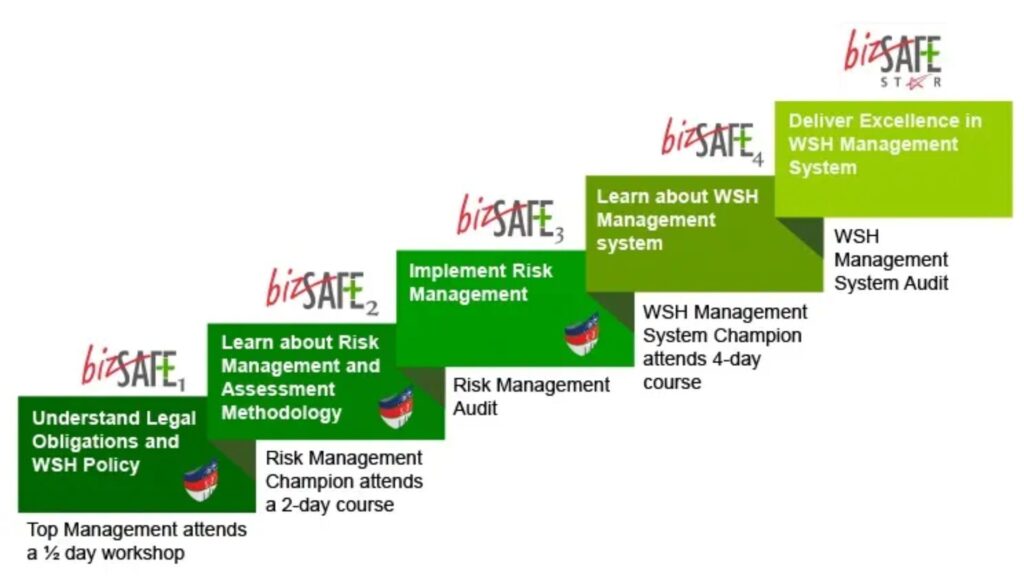
This is the most important thing to understand about BizSAFE Level 2: it is not a standalone achievement. It is the foundation for Level 3.
The Risk Management Implementation Plan developed during the Level 2 course is the same document that your Level 3 auditor will evaluate. Companies that treat the Level 2 plan as a genuine operational document, specific to their workplace, properly implemented, and supported by training records, pass their Level 3 audit far more smoothly than those who treat it as a classroom exercise.
Specifically, the Level 3 audit checklist requires that your appointed Risk Management team leaders hold formal risk management training, such as the bizSAFE Level 2 SOA. Without a valid Level 2 certificate, your company cannot proceed to Level 3.
Think of Level 2 not as a prerequisite to complete, but as the first real investment in your company's workplace safety system.
Common Mistakes to Avoid
Appointing the wrong RM Champion
Choosing someone without enough operational influence to implement the plan on the groundLetting Level 1 expire before enrolling in Level 2
Always plan both timelines togetherTreating the course as a one-off exercise
The RM plan developed must be implemented and maintained, not filed away after the courseUsing generic templates
The Risk Management Plan must reflect your actual workplace hazards, not copied contentMissing the Level 2 validity window
The certificate is valid for only 6 months and is non-renewable. Delays in progressing to Level 3 can mean starting overNot communicating the plan to employees
A plan that workers are unaware of will fail the Level 3 audit immediately
Looking to Strengthen Your Workplace Safety Culture Beyond bizSAFE?

Achieving BizSAFE Level 2 gives your Risk Management Champion the tools to identify and control workplace hazards but building a truly safe workplace goes further than documentation. At AnjouHealth, we are a trusted workplace health and safety partner in Singapore, with over 1,200 professionals trained and a client satisfaction rate exceeding 95%. We help businesses build lasting WSH cultures through evidence-based programmes that engage employees at every level.
Workplace Safety Campaigns
Interactive, hands-on campaigns that bring your Risk Management Plan to life for every employee on the groundWorkplace Ergonomics Risk Assessment (WERA)
Identify ergonomic hazards that feed directly into your Risk Management Implementation PlanOccupational Health Programmes
On-site health screenings, hearing tests, and wellness initiatives that demonstrate genuine care for employee well-beingCustomised WSH Solutions
Tailored programmes built around your industry, workforce size, and specific risk profile
Need Help With Workplace Safety?
Talk to our team about a tailored workplace safety, ergonomics, or wellness programme for your organisation.
Frequently Asked Questions
No. The RM Champion does not need to hold a WSHO licence. However, they should have enough authority within the organisation to drive the implementation of the Risk Management Plan across all relevant teams and worksites.
Level 1 must be attended by the company's top management, CEO, Director, MD, or equivalent. Level 2 is attended by the appointed RM Champion, who is typically a different person. However, if the top management representative also holds an operational role, they can attend both.
The company will need to appoint a new RM Champion and enrol them in the Level 2 course. This is one reason why it is important to progress to Level 3 as quickly as possible. Level 3 certification belongs to the company, not to any individual.
The plan developed during the course is a starting point. It will need to be refined, implemented, and supported by evidence of actual workplace application before it is audit-ready for Level 3.
The Level 2 course involves hands-on workshops, group exercises, and oral assessment, it is primarily delivered in a classroom setting. Check with your chosen approved training organisation for the latest available formats and schedules.