

Quick Summary
From 1 December 2026, four heat stress measures that MOM used to recommend become mandatory for outdoor work: a heat stress training programme, cool drinking water near work areas, emergency cooling supplies on standby, and suitable clothing. The rules on acclimatisation and rest breaks stay as they are. What many workplaces have not settled is the people side: who measures, who watches, and who stops the work.
Our earlier heat stress guide explains what heat stress is and how MOM's heat bands work. This post covers what comes next. It looks at what changes on 1 December, how acclimatisation and rest breaks work in practice, and who should be checking on whom on a hot day.
In short:
- Four recommended practices become requirements on 1 December 2026. Employers have until then to put them in place.
- A new worker, or one back from more than a week's leave, needs at least 7 days to build up to a full day in the heat.
- At WBGT 32°C and above, heavy physical work needs a break of at least 10 minutes every hour. It cannot be split up or combined.
- MOM's page names the measures but not the people. Decide who does each job before the first hot day, not during it.
What changes on 1 December 2026?
Four measures move from "recommended" to "required", and one new practice is added as a recommendation. MOM announced the change on 28 August 2026 and gave employers three months to prepare. The four measures are:
- A heat stress training programme for workers exposed to heat
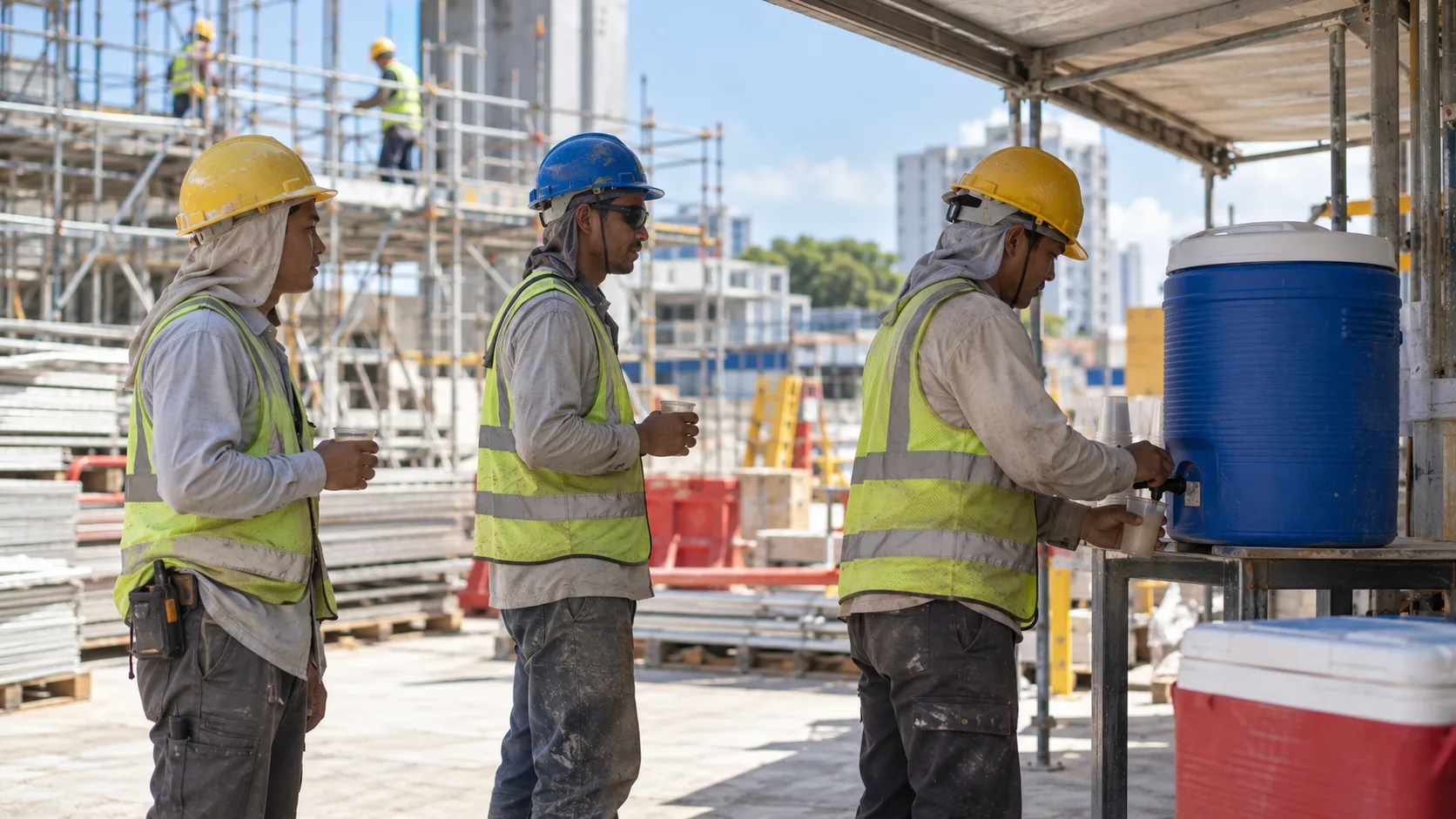
- Cool drinking water near work areas
- Cold water, ice packs or water spray on standby for emergency response
- Suitable clothing that can mitigate or protect workers from excessive heat stress
The new recommended practice is shaded rest areas that are well ventilated and well insulated or cooled.
MOM's FAQs add detail on what it expects:
- Training can be done in-house and must cover at least four topics: early signs and symptoms of heat stress, risk factors, the workplace's own heat stress measures, and its own emergency procedures. MOM recommends it is done every year and before workers are first sent to hot environments.
- Water should be within "not more than 3 to 5 minutes' walk" of work areas, subject to site constraints. Where there is no chilled supply, water should at least be stored in shade, away from direct sun and heat sources.
- Emergency cooling should be enough "to actively cool at least one affected worker for several minutes while awaiting emergency services". Instant chemical ice packs do not give the same cooling as ice, so they can only add to the basics.
- Clothing should be loose-fitting, breathable or moisture-wicking. The employer is responsible for it, and can meet this by supplying it, paying an allowance, or letting workers wear suitable clothing they already own. Workers who must already wear protective clothing for other reasons, such as fire-retardant clothing, may be exempted.
Does this apply to your workplace?
The framework is written for outdoor work, which MOM describes as "work done primarily in the open without permanent shade". All workplaces still have to assess whether work can be carried out safely and run an effective heat stress management programme.
Indoors is different but not risk-free. MOM's FAQs say hot processes, such as welding or cooking, and heat sources, such as generators or electrical equipment, "can pose heat stress risks indoors". For indoor work they point to the WSH Council's guidelines. Whether the four new requirements reach indoor hot work in the same way is not something MOM's page spells out, so ask MOM if you run hot indoor processes.
How does acclimatisation work?
A worker who is new to the heat needs at least 7 days to build up to a full day. MOM's page says to "acclimatise workers new to Singapore or returning from prolonged leave of more than a week and gradually increase workers' daily heat exposure over at least 7 days". This applies at every heat band.
MOM's FAQs list who needs to go through it:
- Workers newly assigned to outdoor work
- Workers new to, or returning from, countries with a cold climate
- Workers returning from leave of more than one week
- Workers recovering from a prolonged illness
The FAQs describe the method in a sentence: "increasing the number of hours they spend in the hot environment and taking frequent rest and water breaks".
The WSH Council's guideline gives a worked example. It is an example, not a rule. In it, the worker has two hours of heat exposure on each of the first two days, with light tasks in a cool or shaded place for the rest of the day, and avoids direct sun in the hottest part of the day (typically 11am to 3pm). From Day 3 the exposure goes up by an hour a day. The same guideline suggests the second week begins at four hours on Day 6, rising by an hour a day until the full day is reached.
In plain terms, the risk is not only the first morning. It is the supervisor who assigns a returning worker a full day on Monday because the project is behind. That is why somebody has to know who is on day 2 and who is on day 6.
How do rest breaks work?
At WBGT 32°C and above, heavy physical work needs a break of at least 10 minutes every hour, and MOM has said how strict that is. MOM's page marks this as a requirement: "Provide hourly rest breaks of a minimum of 10 minutes for heavy physical work activity when WBGT reaches 32°C and above". Between 31°C and 32°C, workers must get "adequate rest under shade for recovery from heat".
MOM's FAQs answer the questions supervisors ask most:
- Can the 10 minutes be split into shorter breaks? No. "The rest duration should be continuous and not broken into shorter durations."
- Can the breaks be saved up, for example 20 minutes after two hours? No. "The hourly rest break should be adhered to."
- Is the break paid? Yes. It "should be considered paid working hours" as workers may still take direction from the employer.
- What about a tea break already given? If workers already have a tea break of 10 minutes or more in that hour, an extra heat break is not needed.
At 33°C and above, plan for 15 minutes. MOM's page lists "hourly rest breaks of a minimum of 15 minutes for heavy physical work activity, with longer rest periods as WBGT increases". On that page, the 10-minute break at 32°C carries the label "Requirement", and the 15-minute line does not. The FAQs say that at higher WBGT readings "longer rest breaks every hour are recommended". These can be read as 15 minutes being a recommendation. We have written to the stricter reading, because a crew that takes only 10 minutes at 34°C is not doing what the framework asks. Treat the 10-minute break as the legal floor and 15 minutes as the standard to plan for, and check with MOM if you want to rely on the lower figure.
Who checks on whom?
MOM's page sets out the measures but does not name the people, so you have to. Here is what MOM and the WSH Council say about each job, and what we suggest you decide.
| Job | What the sources say | Decide this |
|---|---|---|
| Measuring WBGT | Every hour during work hours, especially in the hotter parts of the day. "Anyone who is familiar with the operation of the WBGT meter can take WBGT measurements." On-site meters are required for construction sites with a contract sum of $5 million or more, shipyards and the process industry. Other workplaces can use NEA's myENV app. | Who reads it, at what times, and who they tell. A reading nobody acts on does not help |
| Setting the rest schedule | The WBGT band decides the break, and the rest duration must be continuous. | Who may stop the work, and whether they can do it without asking for permission first |
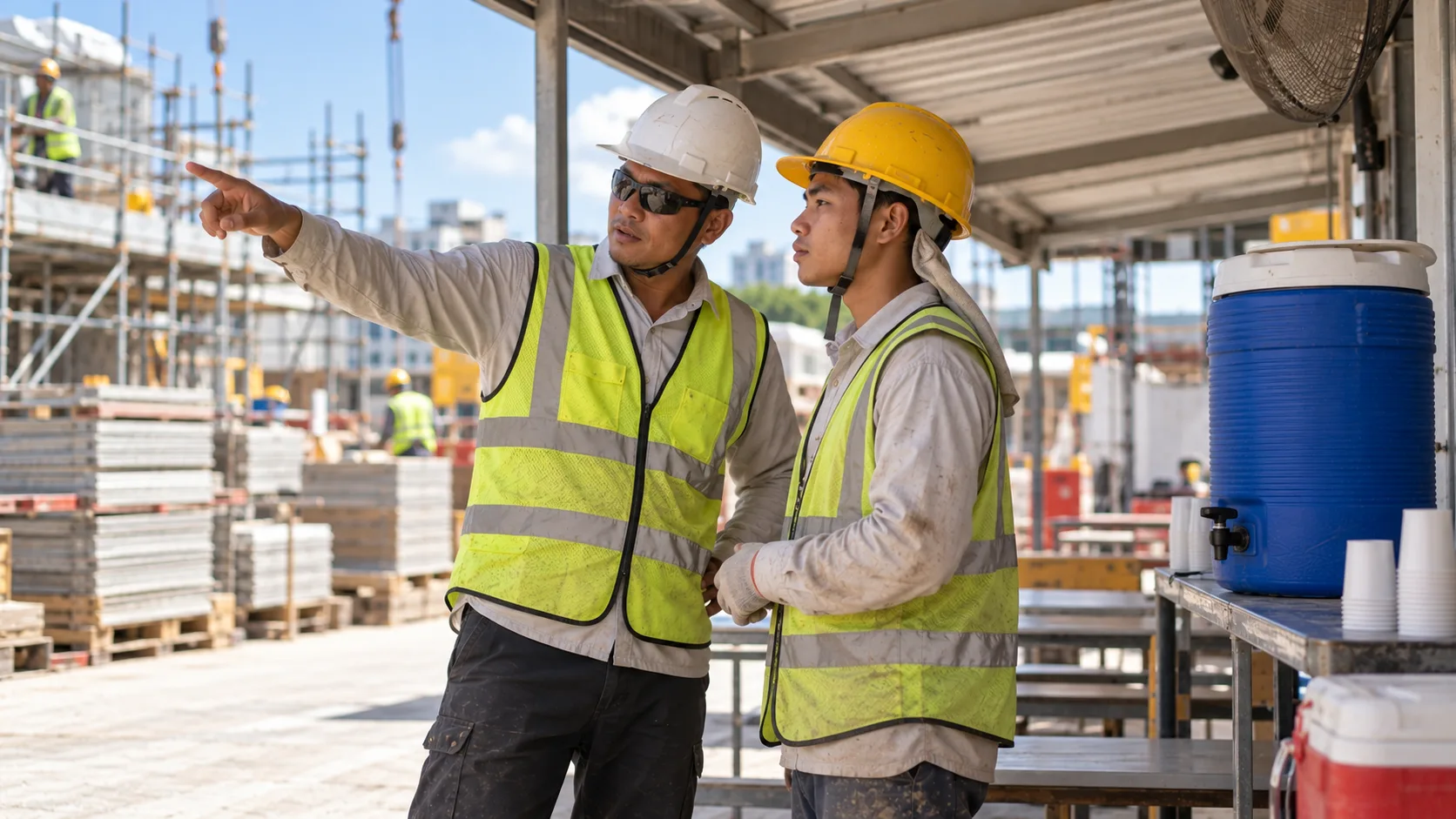
| Watching workers | At 31°C and above MOM's page lists "close monitoring of worker's health condition, particularly for vulnerable workers" and "implement a buddy system. Workers should look out for each other for signs of heat-related illnesses." The WSH Council checklist asks: "Are supervisors checking for workers who are feeling unwell prior to starting work?" | Who pairs with whom, and who the supervisor checks at the start of the shift |
| Vulnerable workers | Employers are to "identify workers vulnerable to heat stress and make re-deployment arrangements where required". At 33°C and above, redeploy them to non-outdoor work. | Who keeps the list, and who has the authority to move someone |
| Fitness to work | An employer who wants to deploy a vulnerable worker "has a duty to ensure they are fit for outdoor work", should "seek the worker's consent" and make provisions for the worker to consult a doctor. | Who asks, who records the consent, and where it is filed |
| Emergency | "Establish emergency response plan and implement reporting procedures." Heat-related illness caused by excessive heat is reportable as an occupational disease under the WSH (Incident Reporting) Regulations. | Who calls 995, who stays with the worker, who reports |
MOM's list of vulnerable workers includes people over 65, pregnant workers, overweight or obese workers, those newly assigned to outdoor work, those returning from more than a week's leave, those unwell or recovering from illness, and those with chronic disease, medication use or a history of heat illness. MOM says the list "is not exhaustive".

What should an employer do before 1 December?
Fill in the gaps in the next five weeks. This list is our suggestion for turning the framework into a plan. It is not a legal checklist.
- Write the training programme. Cover the four topics MOM names, using your own site's measures and emergency steps. Decide who delivers it and how you will record attendance
- Check the water. Walk from your furthest work area. If the water is more than a few minutes away, move it
- Build the emergency kit. Cold water, ice or ice packs, or water spray in enough quantity to cool one person for several minutes. Know where it is kept and who brings it
- Sort out clothing. Supply it, pay an allowance, or confirm workers have their own. Record which
- Name the people. Use the table above. One name per job, with a backup
- Keep an acclimatisation list. Who started or returned when, and which day each person is on
- Brief supervisors. On the rest-break rules, including that the break is continuous and paid
Where does AnjouHealth fit, and where doesn't it?
We don't supply WBGT meters, cooling equipment or clothing, and we don't certify that a worker is fit for outdoor work. Fitness is for a doctor.
We run workplace safety talks and campaigns, and heat stress is one of the topics our safety campaigns and educational talks page lists. We have not confirmed that a standard talk would meet MOM's requirement for a heat stress training programme. That requirement asks for workplace-specific content on four topics and sets a recommended frequency. If you want us to build to it, say so at the scoping stage so the content is written to the four topics. A talk raises awareness. It does not replace your own measures or your own records.
A hot day tests the plan you wrote in advance
Most of the framework is simple. The hard part is that the person with a clipboard and the person with the authority to stop work are not always the same. By 1 December, make sure every job in the table has a name next to it, that a new worker's first week is written down, and that the hourly break is treated as the rule and not as an offer. The first hot afternoon is a poor time to find out who was supposed to decide.
Next Steps: Get Heat Stress Training Built Around Your Site
If you need a talk or campaign that covers your site's heat risks, measures and emergency steps, start with our safety campaigns and educational talks.
References
- Ministry of Manpower, "Heat stress measures for outdoor work", last updated 28 August 2026: mom.gov.sg
- Ministry of Manpower, "FAQs on Heat stress measures for outdoor work", last updated 28 August 2026: mom.gov.sg
- Ministry of Manpower, press release "MOM Enhances Heat Stress Protection for Workers Amid Rising Heat Risks", 28 August 2026: mom.gov.sg
- Workplace Safety and Health Council, WSH Guidelines on Managing Heat Stress in the Workplace, 31 December 2020: tal.sg
Need Help With Workplace Safety?
Talk to our team about a tailored workplace safety, ergonomics, or wellness programme for your organisation.
Frequently Asked Questions
Four existing recommended practices become mandatory: a heat stress training programme for workers exposed to heat, cool drinking water near work areas, cold water, ice packs or water spray on standby for emergencies, and suitable clothing. Shaded rest areas that are well ventilated and well insulated or cooled become a new recommended practice.
MOM's page says to gradually increase daily heat exposure "over at least 7 days" for workers new to Singapore or returning from leave of more than a week.
No. MOM's FAQs say the rest duration should be continuous and not broken into shorter durations. The break should also be taken every hour, not saved up.
Yes. MOM's FAQs say they should be considered paid working hours.
Anyone familiar with how the WBGT meter works. Construction sites with a contract sum of $5 million or more, shipyards and the process industry must have a WBGT meter on site. Other workplaces can use NEA's myENV app.