

Quick Summary
To assess a lifting task, break it into small steps and watch it being done. Check what makes each step hard on the body. Give each step a risk score, choose fixes, then score it again. In Singapore this sits inside the risk assessment every employer must already do. The reference standard for manual handling is SS 569.
Our Manual Handling Safety Singapore guide explains what manual handling is, what the law requires and which industries are most exposed. This post goes one step further. It shows you how to assess one lifting task from start to finish, using the WSH Council's own scoring method, with a worked example.
In short:
- A lifting task is assessed like any other workplace risk, with a few extra questions.
- Score each step by how badly someone could be hurt and how likely it is.
- Fix the task first (for example, raise the pallet), and train people second.
- Safe weight limits are in SS 569. This post does not give any weight numbers.
How is this different from a normal risk assessment?
It is the same assessment, with extra attention to how the body is used. The Workplace Safety and Health (Risk Management) Regulations count any "ergonomic hazard" as a hazard. They also require the employer to carry out a risk assessment of the risks to anyone affected by the work. A lifting task that could injure someone belongs in that assessment.
The extra questions are simple: how heavy, how often, from where to where, in what posture, and by whom.
What about weight limits? MOM points to SS 569. It says the standard "serves as a reference standard for acceptable practices for manual handling in Singapore" and "provides recommended lifting limits, which depend on load and task variables". You buy SS 569 from the Singapore Standards eShop. We do not copy its figures here, and you should not trust a weight limit quoted from anywhere else.
What do you need before you start?
Gather what you already know about the task before anyone watches it. The WSH Council's Code of Practice on risk management suggests using past incident records, observations and interviews, existing controls, and feedback from employees.
Before you walk to the work area, have these ready:
- A short list of manual handling tasks, with the ones that caused pain, near misses or sick leave at the top
- The real weight and size of what is lifted (measure it, do not guess)
- How many times per shift, and for how long
- A copy of SS 569, if you want to compare the task with its limits
- A small team that knows the work. The Code says assessments should be done by "a multi-disciplinary team who has thorough knowledge of the work to be assessed". In plain terms, a mix of roles, such as a supervisor, a safety officer and a worker
How do you assess a lifting task, step by step?
Five steps take you from "this seems heavy" to a recorded, scored decision.
Step 1: Split the task into small steps
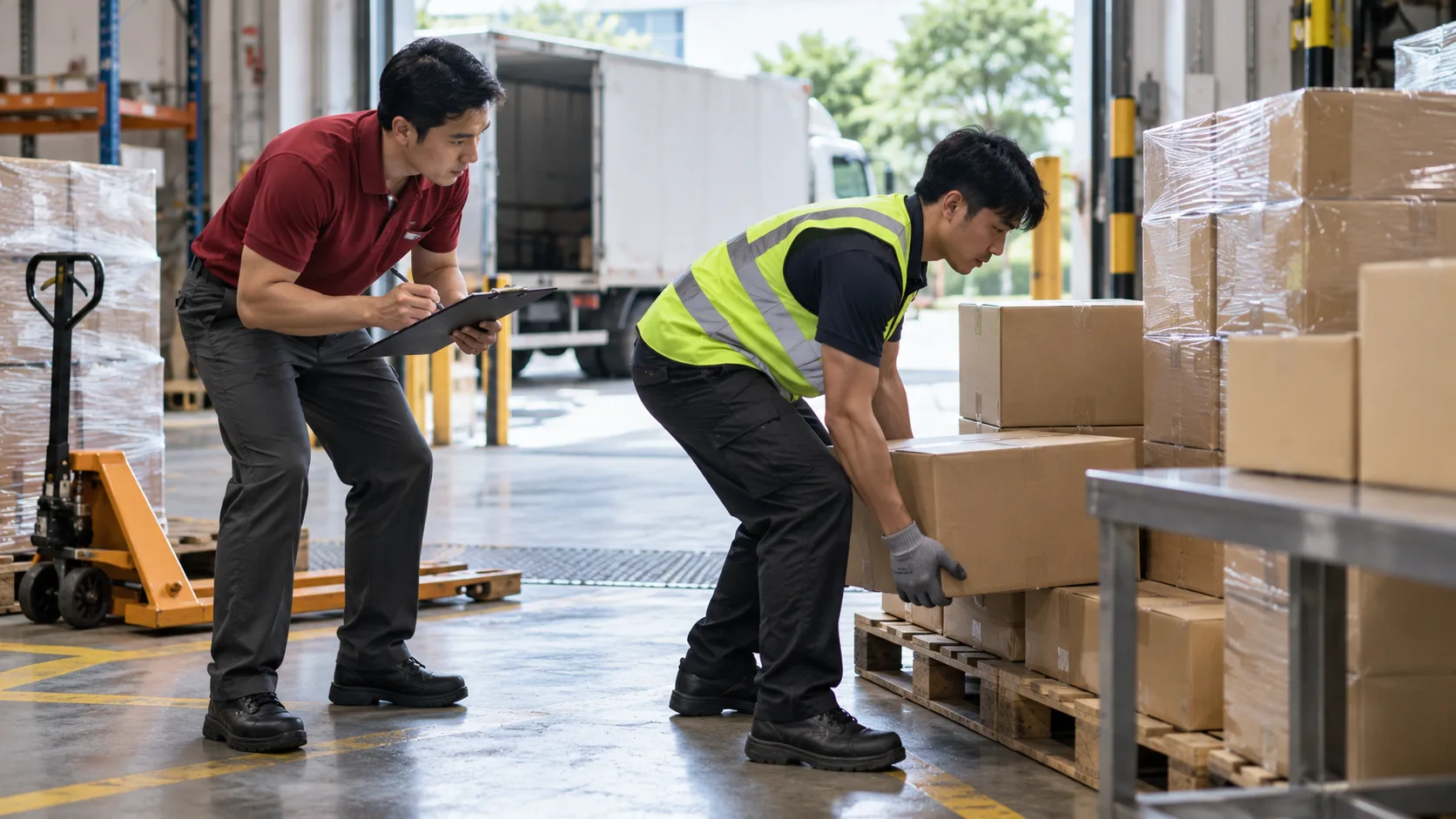
A lift is rarely one action. Our worked example below has three steps: lifting from the bottom layer of a pallet, carrying to a rack, and placing on a high shelf. Splitting the job up shows you which part is the real problem.
Step 2: Watch it and check the factors
Watch the task as it is really done, not as the procedure says. The WSH Council's ergonomics guideline has a free sample checklist. It groups its questions into load, posture, movement, environment and individual factors. A "Yes" to any question means the step needs a closer look. Some examples:
| Factor | Question from the checklist |
|---|---|
| Load | "Is the weight of the load too much for most employees to handle?" |
| Load | "Is it difficult to get an adequate grip on the load or tool?" |
| Posture | "Is there frequent or prolonged twisting of the back?" |
| Movement | "Are loads moved or carried manually over long distances?" |
| Environment | "Is the floor surface that employees work on uneven or slippery?" |
The guideline also notes that "lifting heavy loads below the waist level or above the shoulders strains the back".

Step 3: Give each step a risk score
The WSH Council's Code recommends a simple 5-by-5 scoring grid. It also says companies are free to use another method. You give each step two ratings from 1 to 5, then multiply them:
- Severity: how badly could someone be hurt? Level 3 is an injury needing medical treatment, such as a sprain. Level 2 needs first aid only. Level 4 is a serious injury.
- Likelihood: how likely is it? Level 3 is "possible or known to occur". Level 4 is a "common occurrence".
- Risk score = severity × likelihood. The Code calls this the "RPN".
Rate the step as it is now, with the controls already in place. After you add new controls, score it again.
Who decides what counts as low, medium or high? You do. The Code says the team decides "which are the areas within the Matrix to be classified as Low, Medium and High risks", with the employer's agreement. If the team cannot agree on a rating, the Code says to "gather more information and/or consult an industry expert".
Step 4: Choose fixes, starting with the task itself
The WSH Council's guideline says "elimination and substitution are the most effective ways to control ergonomic risks" and "engineering controls are usually preferred". In practice, change the job before you rely on people's habits or on equipment worn on the body. For manual handling, the guideline suggests things like:
- Use mechanical aids, such as a pallet jack or hand trolley
- Pack goods in smaller boxes, so each one is lighter and smaller
- Store heavier items on shelves at waist level if they are handled often
- Add handles or grips to the load
- Get a second person to help where appropriate
Lifting-technique training helps, but it comes after changing the task. The guideline gives a real example. A restaurant manager lifted and carried about 100 boxes over two hours and received 3 months of medical leave. Afterwards the employer brought in height-adjustable trolleys and trained staff in handling.
Step 5: Score again, write it down, tell people, set a review date
Under the Regulations, you must keep a record of the assessment and of what you did about it, "for a period of not less than 3 years". You must also take reasonable steps to tell the people exposed what the risk is and how it is controlled. And you must review the assessment "at least once every 3 years". Review it sooner if someone is injured by a hazard at work, or if work practices change significantly.
What does a worked example look like?
This example is invented to show the method. It is not a client case, and the scores are only what a team might reach. A team assesses a receiving bay where staff move cartons from pallets to racking. In the table, S is severity and L is likelihood.
| Step | What the team sees | Score now (S × L) | Fix chosen | Score after (S × L) |
|---|---|---|---|---|
| Lift from the bottom layer of a pallet | Deep forward bend, twisted finish, many times a shift | 3 × 4 = 12 | Raise the pallet on a lift table so the layer being unpacked is at waist height | 3 × 2 = 6 |
| Carry to the rack | Long carry, load held away from the body | 3 × 3 = 9 | Use a hand trolley, and share the task when two people are available | 3 × 1 = 3 |
| Place on the top shelf | Reaching above the shoulder with the heaviest cartons | 3 × 3 = 9 | Move heavy items to waist-level shelves and keep light items high | 3 × 2 = 6 |
Notice that severity stays at 3. A strained back still needs treatment, whatever the controls. The fixes work by making the injury less likely. Whether a score of 12 counts as "High" is for the team and the employer to decide. The Code gives no fixed number.

When is a risk assessment not enough?
An assessment shows what is risky and what to change. It does not give you a safe weight, and it does not make a lift safe by itself. Permitted limits come from SS 569. If your task is close to a limit, or the load, frequency and posture all interact, ask a trained assessor to score it.
When you bring in a provider, ask two questions. How do they score lifting? Do they check the task against SS 569? Here is what our Workplace Ergonomics Risk Assessment (WERA) page says. It covers "roles involving manual handling, lifting, or carrying". It scores with two standard tools, REBA and RULA, and lists a "manual handling assessment" among its elements. The on-site visit "typically takes half a day to a full day". Whether it also compares a task with SS 569's limits is something to ask the assessor when you scope the work. Do not assume.
Our safety campaigns and educational talks cover "manual handling and safe lifting". The page says a standard talk runs 45 to 90 minutes. A talk raises awareness. It is not a risk assessment and cannot replace one.
What should you do this week?
Choose one task and assess it. Pick the task with the most complaints or the heaviest handling. Split it into small steps, go through the checklist questions, score each step, and write down the fixes you will try first. Put a review date on it. One recorded assessment of a real task is worth more than a list of every task in the building.
Next Steps: Get a Lifting Task Scored
If you want a trained assessor to score the physical demands of your lifting and carrying roles, our Workplace Ergonomics Risk Assessment is the place to start.
References
- Workplace Safety and Health (Risk Management) Regulations, Singapore Statutes Online, current version as at 5 October 2026: sso.agc.gov.sg/SL/WSHA2006-RG8
- Ministry of Manpower, "Is there a safe load reference for manual handling (lifting and lowering of loads)?", last updated 9 December 2024: mom.gov.sg
- WSH Council, Code of Practice on Workplace Safety and Health Risk Management, second revision 2015: tal.sg
- WSH Council, Improving Ergonomics in the Workplace (WSH Guidelines), January 2014: tal.sg
Need Help With Workplace Safety?
Talk to our team about a tailored workplace safety, ergonomics, or wellness programme for your organisation.
Frequently Asked Questions
SS 569 gives recommended lifting limits, which depend on the load and the task. It is a reference standard, not a single number, and you buy it from the Singapore Standards eShop.
Yes. The Regulations require a record of the assessment, kept for at least 3 years.
A small team that knows the work, with a trained person doing the detailed scoring.
At least every 3 years. Do it sooner if someone is injured by a hazard at work, or if work practices change significantly.
No. The WSH Council ranks changing the task above training, so use training in addition to a fix, not instead of one.