


Quick Summary
Most employers know noise above a certain level is dangerous. Fewer know that "dangerous" has a specific legal number attached to it, that the hearing test itself isn't actually required by the noise regulations at all, and that it sits in a different regulation entirely: one with its own pre-placement window, its own annual cycle, and its own penalties. Get the two regulations confused, as a fair amount of the advice online does, and you can tick every box in one and still be in breach of the other.
What actually counts as "excessive noise" under the law?
A specific, defined threshold, not a judgement call. Under the Workplace Safety and Health (Noise) Regulations 2011, a person is deemed exposed to excessive noise if, without hearing protection, they would be exposed to more than the permissible exposure limit set out in the regulation's First Schedule, an equivalent sound pressure level of 85 dB(A) over an 8-hour workday, or a peak sound pressure level exceeding 140 dB(C). The First Schedule sets shorter permissible durations as the level rises: 85 dB(A) tops out at 8 hours, but by 100 dB(A) the limit drops to 15 minutes.
This threshold is what triggers every other duty that follows, from hearing protection to the medical examination itself.
Which regulation actually requires the hearing test?
Not the one most people assume. The Noise Regulations cover noise control, noise monitoring, hearing protectors and training, but they do not contain a medical examination requirement anywhere in the text. The duty to actually test an employee's hearing sits in a separate regulation: the Workplace Safety and Health (Medical Examinations) Regulations 2011, which lists "exposure to excessive noise" as one of several defined "hazardous occupations" alongside exposure to specific chemicals, dust and compressed air work.
It's a small distinction with a real consequence: a workplace can be fully compliant with the Noise Regulations (protectors issued, training run, monitoring done) and still be in breach of the Medical Examinations Regulations if nobody has arranged the actual hearing test.
What does the required test actually involve, and how often?
A pre-placement exam within three months of starting, then annually. Under the Medical Examinations Regulations, a person employed in a hazardous occupation (including noise exposure) must undergo a pre-placement medical examination by a Designated Workplace Doctor (DWD), certified fit to work, not later than 3 months after the date they commence that role. Periodic examinations then follow at the interval the regulation specifies for that hazard.
For noise specifically, the First Schedule sets that interval at every 12 months, and specifies the test itself: an audiometric examination, extended to include bone conduction testing and an auroscopic examination where the air conduction result is abnormal.
Two things worth being precise about, because both get shortened in ways that change the meaning: the pre-placement window is three months after the person starts in the role, not three months before, and the periodic cycle is fixed at 12 months by the regulation itself, not a general "annual health screening" that happens to include a hearing check.
Who's allowed to run the test, and who has to sign off on it?
Two different people can be involved, and the regulation is specific about which one does what. The medical examination (the certification of fitness to work, the reporting of results, and the authority to recommend suspension from the role) has to be done by a Designated Workplace Doctor, a doctor specifically registered with MOM for this purpose under Part III of the regulations.
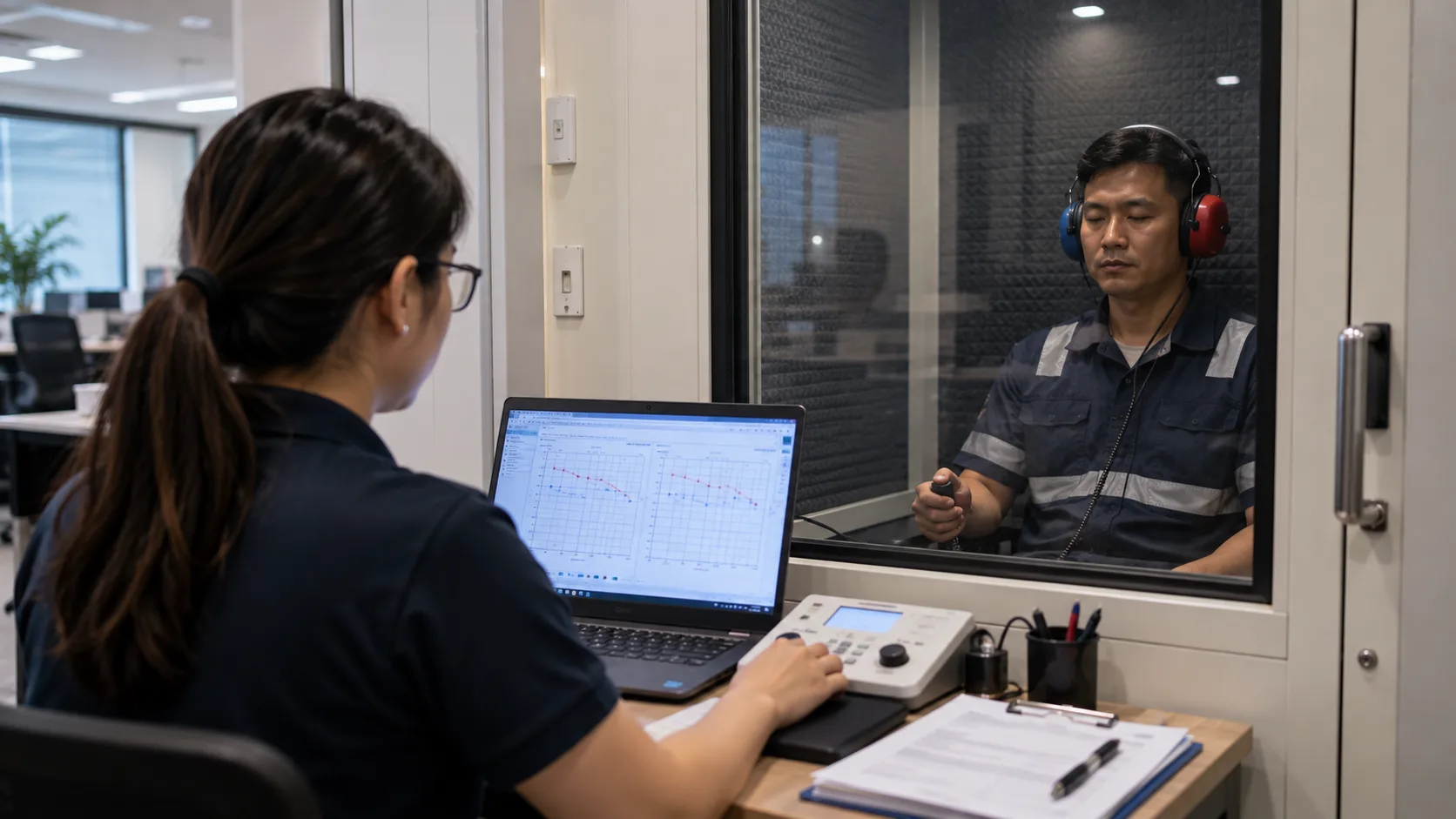
The audiometric test itself is treated separately. The regulation requires it to be "carried out by persons who have undergone a course of training in audiometric screening acceptable to the Commissioner," which doesn't have to be the DWD personally administering the tone sequence, provided whoever does is trained to the standard MOM specifies. In practice, that's why on-site audiometric testing is usually delivered by a trained audiometric technician working alongside or reporting into a DWD, rather than the doctor running every test individually.
What else does the employer have to do, beyond the exam itself?
The test is the visible part. The paperwork is where most of the actual duty sits. Under the Medical Examinations Regulations, the responsible person (the employer, or the principal directing the work) has to:
- Bear the full cost of the examination and grant paid leave for the employee to attend it
- Keep a register of everyone currently or previously employed in a hazardous occupation, covering at least the last 5 years
- Keep every medical examination report for at least 5 years from the date of the exam, and produce it to MOM on request
Separately, under the Noise Regulations, once 10 or more people are exposed to excessive noise in a workplace, the employer also has to arrange noise monitoring at least once every 3 years (sooner if conditions change), report the results to affected workers within 14 days and to the Commissioner within 30 days, and keep that monitoring report for at least 10 years. At 50 or more exposed workers, a competent person also has to be appointed specifically to advise on noise control. None of this substitutes for the medical examination duty: they run in parallel, under different regulations, with different record-keeping periods.
Is a general health screening the same thing?
No, and treating it as interchangeable is one of the more common ways this duty gets missed. A statutory audiometric examination under the Medical Examinations Regulations has a specific form (the tests set out in the First Schedule), a specific examiner requirement (a DWD, with the audiometric test itself run by someone with Commissioner-acceptable training), and a specific reporting obligation back to MOM. A general annual health screening booked as a broad wellness benefit doesn't automatically satisfy any of that unless it was specifically scoped to.
If your organisation runs annual health screenings and noise exposure applies to some employees, the practical question to ask your provider isn't "do we screen for hearing." It's whether the screening is being delivered as the statutory examination under the Medical Examinations Regulations, by a registered DWD, on the regulation's own cycle, with the paperwork MOM would expect to see. If that hasn't been explicitly confirmed, it's worth checking rather than assuming.

What happens if you don't comply?
Real penalties, and they sit in two separate places. Under the Medical Examinations Regulations, failing to arrange the pre-placement or periodic examination, or failing to bear the medical costs, or failing to act on a DWD's suspension advice, carries a fine of up to $20,000, up to 2 years' imprisonment, or both, rising to up to $50,000 for a repeat offence. A DWD's failure to report results, or an employer's failure to ensure the audiometric test is run by a properly trained person, carries a fine of up to $10,000.
Under the separate Noise Regulations, failing on the core duties (noise control, appointing a competent person where required, noise monitoring, or providing hearing protectors) carries the same up-to-$20,000/2-years penalty, rising to $50,000 for repeat offences. Lesser duties under that regulation, including the training programme, carry penalties up to $10,000.
Two regulations, one duty, no shortcuts between them
The noise-control side of this (protectors, monitoring, training) is where most of the visible effort tends to go, because it's the part a safety walk-through actually catches. The medical examination side is easier to miss precisely because it's paperwork sitting with a doctor rather than equipment on a factory floor. Both are real duties, under different regulations, with different penalties, and neither substitutes for the other.
Arranging Statutory Audiometric Testing in Singapore
If your organisation has employees exposed to excessive noise, our onsite health screening service arranges pre-placement and periodic audiometric examinations through registered Designated Workplace Doctors and Commissioner-trained audiometric staff, scoped to what the Medical Examinations Regulations actually require for your workforce.
Need Help With Workplace Safety?
Talk to our team about a tailored workplace safety, ergonomics, or wellness programme for your organisation.
Frequently Asked Questions
Where a person would be exposed to more than 85 dB(A) over an 8-hour day (or the equivalent under the First Schedule table, or a peak of 140 dB(C)) without hearing protection, they are deemed exposed to excessive noise, which brings them under the Medical Examinations Regulations' hazardous occupation category for noise.
Not later than 3 months after the employee commences work in the noise-exposed role: a pre-placement examination by a Designated Workplace Doctor.
Every 12 months, per the interval the Medical Examinations Regulations' First Schedule specifies for noise exposure.
No. The regulation requires the audiometric test to be run by someone who has completed Commissioner-acceptable training in audiometric screening. The DWD's role is the medical examination, certification, and reporting.
Only if it was specifically scoped as the statutory examination: by a Designated Workplace Doctor, on the regulation's 12-month cycle, with the required reporting. A general wellness screening that happens to include a hearing check is not automatically the same thing.
A register of everyone in a noise-exposed role, covering at least the last 5 years, plus every individual exam report for at least 5 years from its date, both under the Medical Examinations Regulations. Separately, noise monitoring reports must be kept for at least 10 years under the Noise Regulations.
Up to $20,000, up to 2 years' imprisonment, or both, rising to $50,000 for a repeat offence, under the Medical Examinations Regulations. Separate noise-control and monitoring duties under the Noise Regulations carry their own penalties of the same order.