


Quick Summary
An employee reports back pain on Monday. You give them a day off, they see a GP, they get a referral, and by the time they are actually treated it is the following week — if the appointment does not clash with a shift. Onsite physiotherapy removes most of that gap by bringing the physiotherapist to the workplace instead. It is not the right answer for every injury, and it does not replace a clinic. But for the musculoskeletal complaints that make up most workplace injury cases, treating early matters more than treating in a purpose-built room — and the evidence for early treatment is considerably stronger than most providers, including us, have been claiming.
What is onsite physiotherapy, exactly?
Onsite physiotherapy is a qualified physiotherapist coming to your workplace to assess and treat employees, using a portable treatment table set up in a room you already have. It is not a talk, a screening or an ergonomics walkthrough — those are separate services. It is clinical treatment, delivered at work.
A first session runs 45 to 60 minutes and covers history, physical examination, postural and movement analysis, and functional testing. Follow-ups run 30 to 45 minutes. Treatment is hands-on: manual therapy, soft tissue and joint mobilisation, therapeutic exercise, taping. The employee leaves with a recovery plan — home exercises, activity modifications, duty recommendations, and where relevant a phased return-to-work timeline — and the physiotherapist adjusts it at follow-up visits.
Multiple employees can be seen in a single visit, which is what makes the model practical for an employer rather than a perk for one person.
When does onsite physiotherapy beat sending someone to a clinic?
When the delay is the problem. Most workplace musculoskeletal complaints are not diagnostically difficult. Back, neck, shoulder and knee pain, repetitive strain, the slow-building discomfort that desk workers report — these need assessment and treatment, and they need it early. What they usually get instead is a queue.
Onsite removes three specific frictions:
- The travel and the half-day. A clinic appointment costs the employee a commute in each direction and usually a chunk of a working day. Onsite costs them the length of the session.
- The scheduling gap. Appointments get booked around shifts, and shifts win. When the physiotherapist comes to the workplace, sessions are slotted into the working day rather than negotiated around it.
- The reporting gap. A physiotherapist who has seen your actual workstations, your actual lifting tasks and your actual shift pattern gives duty recommendations that fit the job. One who has only heard the job described gives generic ones.
It also helps with the cases that never reach a clinic at all. A lot of early-stage discomfort goes untreated because booking an appointment feels disproportionate — and untreated early discomfort is what turns into a claim six months later.

When is a clinic the better call?
When the case needs equipment or investigation that does not fit in a car boot. This is the honest limit of the model, and any provider who tells you otherwise is selling.
Send someone to a clinic or a doctor when:
- Imaging or specialist investigation is likely. Suspected fractures, nerve involvement, anything where an X-ray or MRI is the obvious next step. A portable table does not change that.
- The presentation is unclear or has red flags. Unexplained weight loss, night pain, numbness, symptoms that do not fit a mechanical pattern. These need a doctor first, not a physiotherapist.
- Rehabilitation needs equipment. Later-stage strengthening for a serious injury, gym-based reconditioning, hydrotherapy. Onsite handles assessment, hands-on treatment and exercise prescription well; it does not handle a rehab gym.
- There is genuinely no private space. The treatment needs a room that closes. If the only option is a corner of an open-plan floor, the answer is a clinic, not a compromise.
- The employee prefers it. Some people do not want colleagues knowing they are being treated. That is a reasonable preference and it should be respected rather than managed.
In practice the two work together: onsite for assessment, early treatment and the return-to-work side; clinic or specialist for investigation and equipment-dependent rehabilitation.
What does the evidence actually say about treating injuries early?
The best available evidence puts the benefit at roughly three weeks earlier return to work, not the halved recovery times often quoted in marketing.
The strongest study comes from Victoria, Australia, where researchers analysed compensation claims data for 11,361 injured workers over three years and compared those treated by physiotherapists trained under an early-intervention framework against those receiving routine physiotherapy. Workers in the early-intervention group returned to work on average 25 days sooner, and 21 days sooner after adjusting for age and injury type. The difference in the proportion who had returned to work at six months was smaller — 37.5% against 34.2%.
Two caveats worth stating plainly. That study compared physiotherapists trained in an early-intervention framework against regular physiotherapists inside a compensation scheme; it is not a head-to-head trial of onsite versus clinic treatment, and no such trial exists for Singapore. And three weeks is an average across a large claims population, not a promise about any individual employee.
Three weeks is still a substantial number. For an employer it is three weeks of medical leave wages, three weeks of a role uncovered, and three weeks less of the drift from acute complaint to chronic one. It just isn't 50%, and we would rather give you the figure that survives checking.
What does an employer actually need to provide?
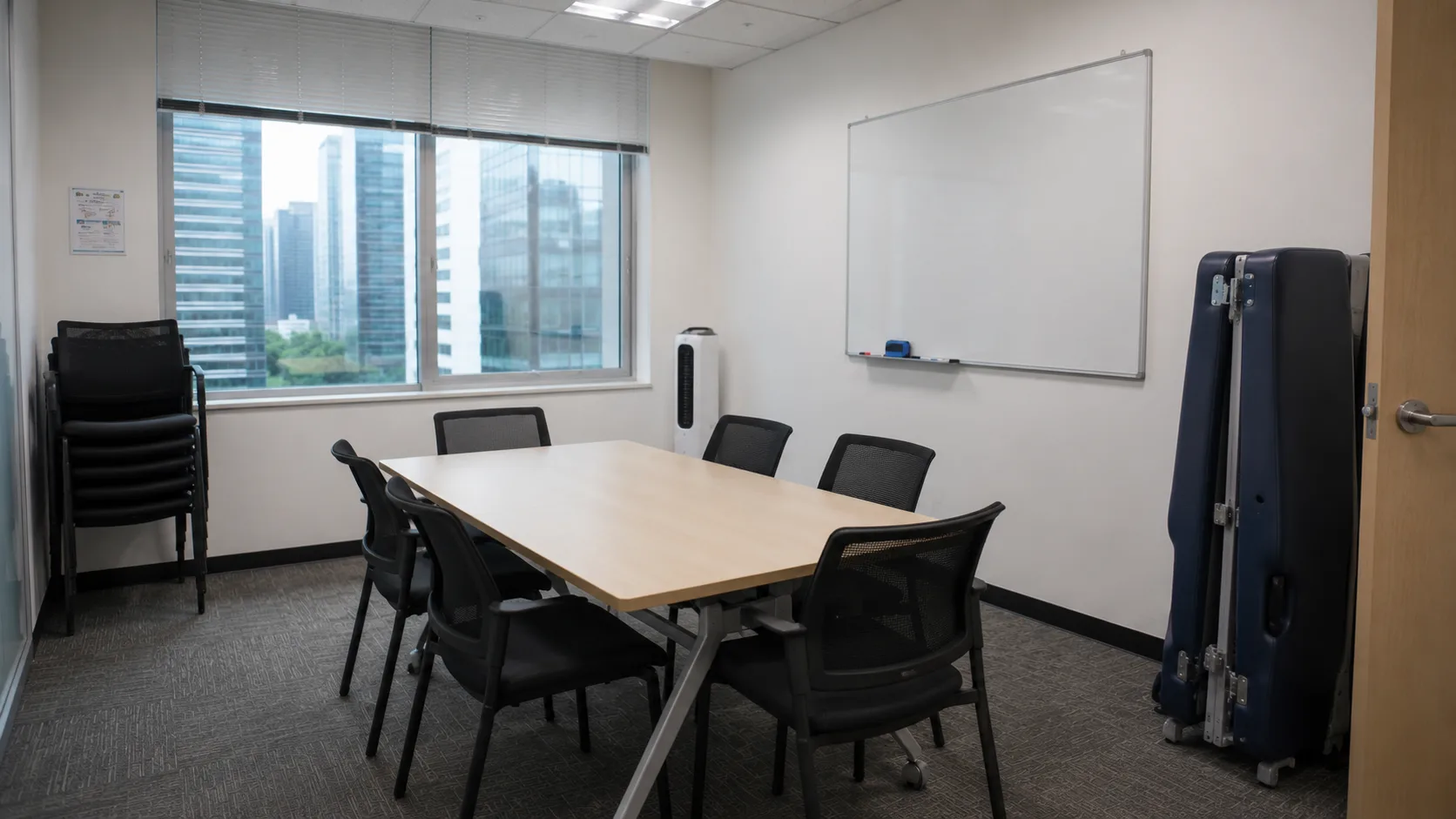
A private room roughly 3m x 3m or larger, with decent lighting and ideally a power point. Enough space for a treatment table and two people. A meeting room with the chairs pushed back is usually fine. The physiotherapist brings the table and equipment.
Beyond the room, the practical requirements are a scheduling contact who can book employees in, and a decision about how sessions are communicated internally — whether staff self-refer, whether supervisors refer, or both. That decision matters more than most employers expect: a service nobody knows how to access gets used by nobody.
Scheduling is usually within one to three working days of a request. Cases under the Work Injury Compensation Act are prioritised, for the reason set out below.
How does this fit with WICA and your injury management duties?
If the injury is work-related, your obligations under the Work Injury Compensation Act apply regardless of where treatment happens. MOM states that an employer "will be required to pay for medical expenses related to a work accident up to the maximum limit or 1 year from the date of the accident, whichever comes first", and medical leave wages must be paid by the next pay day.
One detail matters for onsite treatment specifically. MOM says medical expenses can be claimed "only if your treatment is prescribed and billed by a Singapore-registered doctor or dentist" and delivered at recognised facilities. Whether a given onsite physiotherapy session is claimable therefore depends on how it has been prescribed and billed, not on the fact that it is physiotherapy. If cost recovery under WICA matters to you, settle that question with your provider and your insurer before the first session, not after the invoice.
Separately from compensation, early treatment supports the documentation side of injury management — assessment records, duty recommendations and a return-to-work timeline written by the person who examined the employee. That is the part employers most often find missing when a case escalates.
What should you ask a provider before booking?
Ask the questions whose answers are inconvenient. Any provider can describe a treatment process. Fewer will give you a straight answer on these:
- Who exactly is treating our staff, and what are their qualifications?
- How quickly can you get someone here after we call?
- What happens when a case is beyond what onsite can handle — do you refer, and to whom?
- What documentation do we get, and is it in a form that stands up if the case becomes a claim?
- Have you handled WICA return-to-work cases before, and can you walk us through how the billing worked?
- What do you not treat onsite?
A provider who cannot name the limits of their own service has not thought about them.
Making the call
The question is not whether onsite physiotherapy is better than a clinic. It is which cases belong where. Straightforward musculoskeletal complaints, early-stage discomfort and return-to-work management are well served by treating people where they work — the delay you remove is worth more than the room you gain. Anything needing investigation, imaging or equipment is not, and a provider who blurs that line is not one to trust with the rest.
Most employers already know which of their injury cases have been sitting untreated in a queue. That is where this starts.
Booking Onsite Physiotherapy in Singapore
If you want to see how this would work in your workplace — including whether your space is suitable and how quickly we could get to you — our onsite physiotherapy consultations page sets out the process, and a no-obligation quote is based on your headcount, visit frequency and scope.
Need Help With Workplace Safety?
Talk to our team about a tailored workplace safety, ergonomics, or wellness programme for your organisation.
Frequently Asked Questions
An initial assessment takes 45 to 60 minutes. Follow-up sessions take 30 to 45 minutes. Multiple employees can be scheduled into a single onsite visit.
A private, enclosed room large enough for a treatment table and two people — typically 3m x 3m or larger — with good lighting and ideally a power outlet. The physiotherapist brings a portable treatment table.
Onsite consultations are usually arranged within one to three working days of a request. Cases under the Work Injury Compensation Act are given scheduling priority.
It depends on how the treatment is prescribed and billed. MOM requires that claimable medical expenses be prescribed and billed by a Singapore-registered doctor or dentist and delivered at recognised facilities, so confirm the arrangement with your provider and insurer before treatment starts rather than after.
No. It handles assessment, early hands-on treatment, exercise prescription and return-to-work planning well. Cases needing imaging, specialist investigation or gym-based rehabilitation still belong in a clinic.
Yes, though less dramatically than often claimed. The largest study available, covering 11,361 injured workers in Victoria, Australia, found early-intervention physiotherapy returned workers to work an average of 21 to 25 days sooner than routine physiotherapy.
Musculoskeletal pain in the back, neck, shoulder and knee, work-related injuries and repetitive strain, post-surgical recovery, chronic musculoskeletal conditions, ergonomic-related discomfort in office workers, and WICA return-to-work cases.