

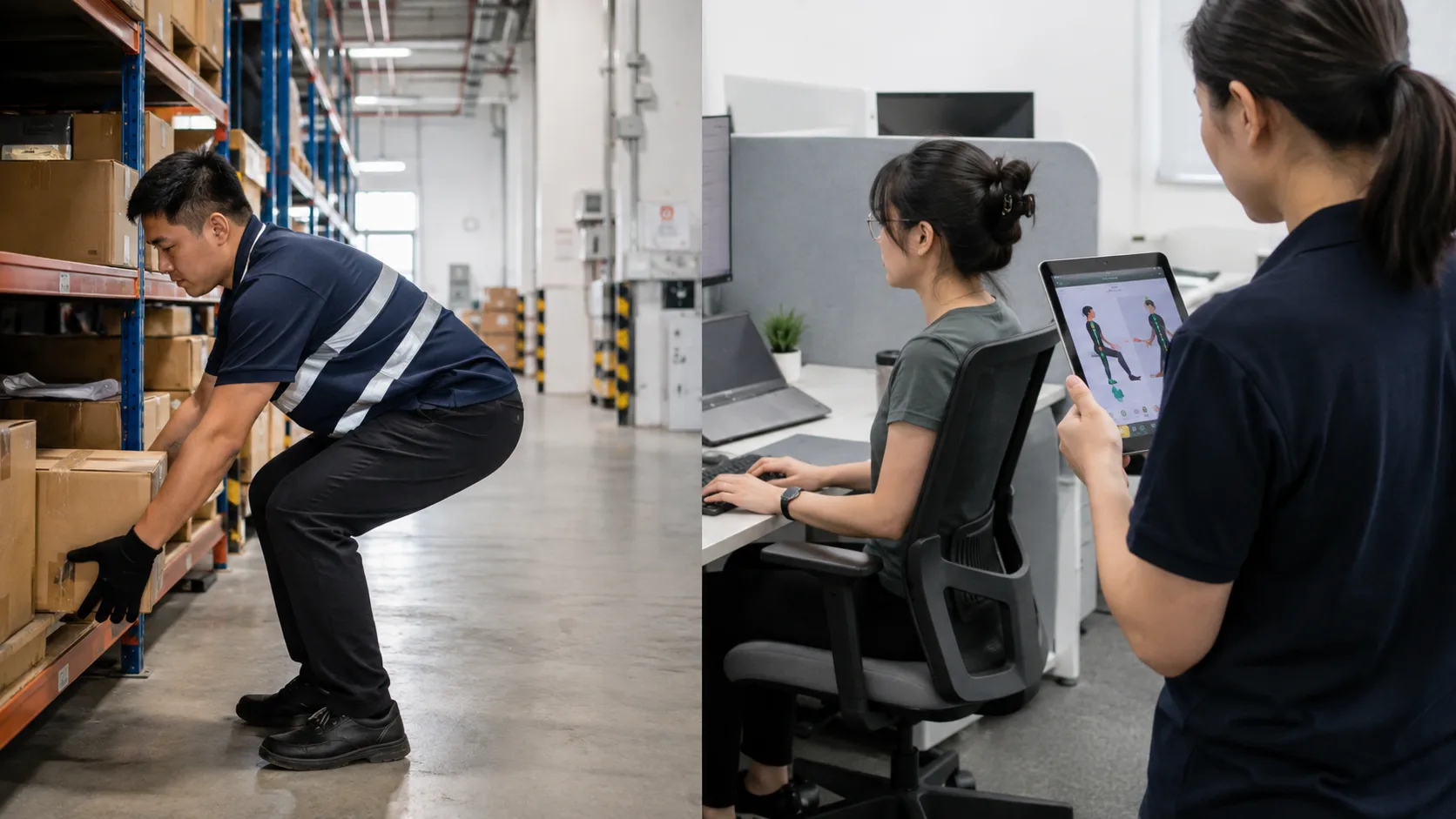
Quick Summary
Both are called an "ergonomic assessment" on the phone, and both show up on our services page, and that is exactly why employers book the wrong one. A Workplace Ergonomic Risk Assessment (WERA) and a workstation ergonomics assessment are built for different problems. One scores physical risk in a task — lifting, carrying, awkward postures — against a validated injury-risk method. The other watches how someone actually sits at their desk and adjusts what's in front of them. Get the match wrong and you either pay for a multi-week programme a warehouse role didn't need, or a single site visit that never touches the desk-based discomfort you actually called about.
What is WERA actually assessing?
WERA scores the physical demands of a task, not a person's desk. It uses two validated tools — REBA (Rapid Entire Body Assessment) and RULA (Rapid Upper Limb Assessment) — to grade postures, repetitive movements and forceful exertions against established risk thresholds, then classifies each task from low to high risk with a documented root cause.
It's built around roles that involve physical strain: manual handling, lifting, carrying, repetitive or fixed-posture work. That covers manufacturing, construction, healthcare, logistics, facilities management, F&B and engineering — and, notably, office environments too, which is exactly where the confusion starts.
A WERA site visit runs half a day to a full day depending on how many roles are in scope, and the report — a risk score matrix, annotated photo or video documentation, a prioritised action plan, and a supervisor briefing — usually lands within 5 to 7 working days. It's a point-in-time assessment, with a follow-up re-assessment recommended within 12 months.
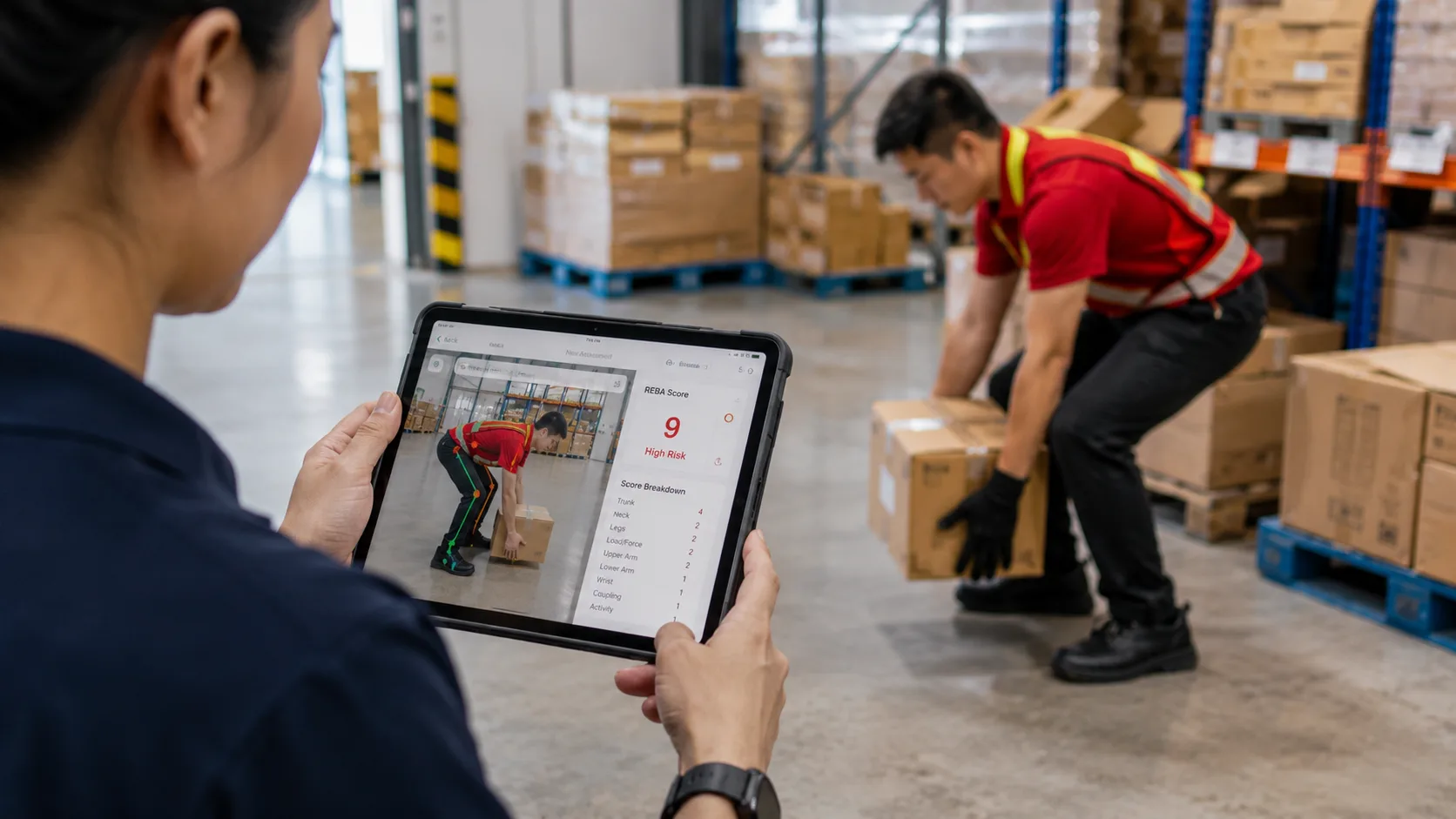
What does a workstation ergonomics assessment actually do?
It watches how one person actually works at their desk, then changes what's in front of them. Where WERA scores a task against a risk method, this is built around an individual employee, their screen, their chair, and the postures they've settled into without noticing.
It runs as a structured four-module programme: an onsite assessment using video analysis of posture and movement, a personalised one-on-one review where adjustments are made on the spot, workshops and exercise training led by a physiotherapist, and — where discomfort already exists — onsite physiotherapy for the people affected. It targets desk-based or hybrid roles specifically: office-intensive work across sectors like technology, finance, corporate services and education, and it can be run across multiple sites, including Malaysia and Taiwan.
Because it's a programme rather than a single visit, it runs over 2 to 4 weeks rather than a day, and the deliverables reflect that — a risk summary, a personalised adjustment checklist per employee, equipment recommendations, workshop attendance records, and physiotherapy session notes for anyone already in discomfort.
So which one do you actually need?
There isn't a clean rule that reliably sorts every case — the honest answer is to describe the actual problem rather than try to name the service yourself. Both pages list "office environments" or "desk-based roles" as in scope in their own way, and the overlap is real, not a marketing accident. The distinguishing factor is what you're trying to find out, not who the employees are.
That said, the structural difference points you in a direction:
- If the concern is physical risk in a task — lifting, carrying, repetitive strain, a role where an injury could plausibly happen — that's what REBA and RULA are built to score. That's WERA, regardless of whether the role sits in a warehouse or an office.
- If the concern is ongoing desk-based discomfort — someone's back, neck or wrists hurting from how they sit, use a screen, or have their workstation set up — that's what the video-analysis and adjustment process is built for. That's the workstation assessment.
- If someone is already injured or returning to work, the workstation programme is the one with physiotherapy built in. WERA identifies risk before an injury; it doesn't treat one.
If a workplace has both physically demanding roles and desk-based staff, both services may be relevant — but how that gets scoped, whether as one engagement or staged separately, depends enough on the specific site that it's worth a direct conversation rather than guessing from a checklist.
What actually drives the cost of each?
Neither publishes a number, and for the same honest reason: neither is a fixed product. WERA's page states pricing "depends on the number of roles assessed, site complexity, and scope of deliverables." The workstation programme's page says the same thing in different words: cost depends on "the number of employees assessed, the modules selected, and the scope of deliverables required."
Whether one typically costs more than the other for a similar headcount isn't something either page states, and it varies enough by scope that stating a direction here would be a guess dressed up as a fact. What's more useful than a guessed comparison is knowing what actually moves the number for each:
For WERA:
- Number of roles being assessed, not number of employees — assessing five people doing the same task costs less than five people doing five different tasks
- Site complexity — one warehouse floor versus multiple sites or shifts
- Scope of deliverables — a risk matrix and action plan versus that plus a supervisor briefing and follow-up re-assessment
For the workstation programme:
- Number of employees assessed
- Which of the four modules are included — assessment alone costs less than assessment plus workshops plus physiotherapy for a subset of staff
- Whether it's a single site or run across multiple locations
Ask for a quote against your actual headcount and scope rather than trying to estimate from either service's typical range — neither publishes one, and the two aren't priced on the same basis to begin with.
What should you tell a provider before booking either?
Describe the problem, not the service you think you need. Whichever you call to book, the same information gets you scoped correctly faster:
- What's the actual complaint — a specific task, a specific role, or general desk-based discomfort?
- Has anyone already been injured, or is this before-the-fact risk identification?
- Roughly how many roles or employees, and are they doing similar work or a mix?
- Single site, or does this span more than one location?
A provider who asks these back before quoting either service is scoping it properly. One who quotes a number before asking is guessing too.
Naming the problem gets you the right service
The two services aren't competing explanations of the same thing — they're built for different questions. WERA asks whether a task is physically risky enough to cause an injury. The workstation assessment asks whether someone's current desk setup is causing discomfort right now. Both can legitimately apply to an office. Neither is the "bigger" or "more serious" option; they're just answering different questions.
The fastest way through the confusion isn't researching which service sounds more relevant — it's describing what's actually happening and letting the assessment get scoped to that.
Comparing WERA and the Workstation Ergonomics Programme in Singapore
If you're not sure which fits your situation, the WERA page and the workstation ergonomics programme page both set out exactly what's included — or describe the problem directly and get scoped against whichever actually fits.
Need Help With Workplace Safety?
Talk to our team about a tailored workplace safety, ergonomics, or wellness programme for your organisation.
Frequently Asked Questions
WERA scores the physical risk in a task — lifting, repetitive movement, awkward posture — using REBA and RULA, and is built around roles where injury risk exists. A workstation ergonomics assessment focuses on an individual's desk setup and posture, using video analysis, and is built for desk-based or hybrid employees.
Yes — WERA's scope includes office environments alongside manufacturing, construction, healthcare and logistics. The distinguishing factor isn't the setting, it's whether the concern is physical task risk or desk-based posture and comfort.
A WERA site visit runs half a day to a full day depending on the number of roles, with a report following in 5 to 7 working days. The workstation ergonomics programme runs as a structured engagement over 2 to 4 weeks, since it includes personalised adjustments, workshops and, where needed, physiotherapy.
Neither service publishes pricing, and which costs more depends on scope rather than which service it is. WERA is priced on the number of roles, site complexity and deliverables; the workstation programme on headcount, which modules are included, and number of sites.
Both may be relevant, and whether they're scoped as one engagement or run separately depends on the specific site. Describe both parts of the workforce when you enquire rather than booking one service and hoping it covers everyone.
The workstation ergonomics programme includes onsite physiotherapy as one of its four modules for employees already affected. WERA is a risk-identification assessment; it doesn't include treatment.
Describe the actual problem — the task, the complaint, whether anyone's hurt, roughly how many people, single site or multiple — rather than trying to name the service yourself. A provider that asks these questions before quoting is scoping it properly.