

Quick Summary
Most workplace health talks are booked because someone decided the company should do something about wellness, and a talk is the easiest thing to book. That is also why most of them change nothing. A talk is worth running when the topic is one your staff actually have a problem with, the person delivering it is qualified in that specific thing, and somebody decided in advance what would count as it having worked. Get those three right and it is a good hour. Get them wrong and you have bought attendance.
What is a workplace health talk, exactly?
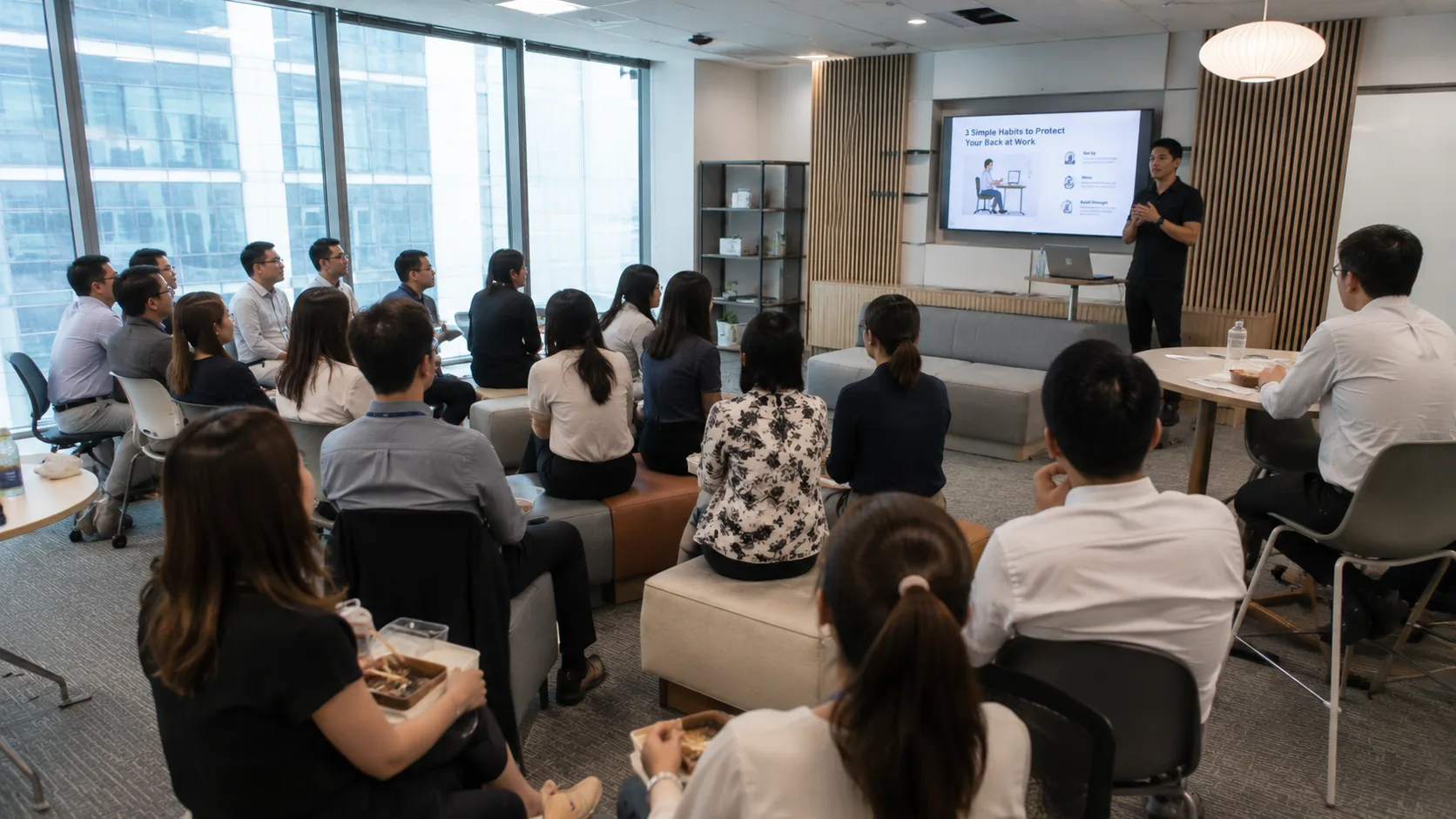
A workplace health talk is a short, facilitated session on one health topic, run at your workplace during working hours for a group of employees. A standard session runs 45 to 90 minutes. It is not a screening, not a fitness class and not a training course with an assessment at the end — it is education, and its whole value depends on whether the people in the room can act on what they hear.
Sessions can run onsite or virtually, and can be extended into half-day wellness events or a series across several weeks where one hour clearly is not enough.
HPB runs free health talks. So why pay for one?
Because free talks are scheduled around the building, not around your problem. This is the first question any employer should ask, and it deserves a straight answer rather than a sales one.
The Health Promotion Board runs over 80 healthy workplace ecosystems across Singapore, and describes the programme as combining "physical activity sessions, health talks and cooking workshops", brought free to workers and tenants through partnerships with landlords and developers. Employees find and register for sessions through the Healthy 365 app. If your office sits inside a participating ecosystem, there is genuinely useful free provision available, and you should use it.
Note also that HPB's Workplace Outreach Wellness programme concluded on 28 February 2026, so employers who used to rely on it are now choosing between the ecosystem model and paying a provider directly.
A paid session earns its place in four situations:
- The topic is specific to your workforce. Shift-work nutrition, or sleep for people on rotating rosters, is not what a general ecosystem talk covers.
- You need it in a language your staff actually use. Sessions can run in English, Mandarin or Bahasa Melayu, which matters for a workforce where the people most affected are least likely to attend an English talk.
- You need it at your site, at your time. Ecosystem sessions run where and when they run. If you have two shifts and a warehouse, that is not a scheduling detail — it is the whole question of who gets to attend.
- You want it tied to something else you are doing. A talk that follows a health screening, or supports an ergonomics programme already underway, does work that a standalone session cannot.
If none of those four applies, use the free provision. That is an honest answer, and a provider who cannot give it is not one to trust with the topics that matter.
Which topics are worth running?
The one your staff already have a problem with — which you usually already know. In practice, general health topics draw the biggest audiences, so if you are starting cold and have no signal to work from, that is the safer first booking.
The four core areas are:
- Diet and nutrition — practical guidance built around how people in Singapore actually eat, including hawker centre choices and eating patterns on shift work
- Exercise and movement — physical activity that fits a working day, desk stretches, injury prevention
- Mental health and resilience — recognising, managing and talking about mental health at work
- Sleep and stress management — sleep hygiene and chronic stress, particularly for shift workers
Custom topics are available on request, including weight management, diabetes prevention and women's health.
If you have run a health screening, the results tell you which of these to book, and that is a far better basis than guessing.

Who should actually deliver the talk?
Someone qualified in the topic — which often means not the same person every time. This is the part employers rarely ask about and should.
A physiotherapist is the right person to talk about movement, posture and injury prevention. A physiotherapist is not the right person to deliver a nutrition talk, and a nutrition talk delivered by whoever the provider happened to have available is worth very little. For topics outside physiotherapy, we bring in the relevant professional — a dietitian for diet and nutrition, and appropriately qualified professionals for the other areas — rather than stretching one discipline across every subject.
Two questions get you the answer from any provider:
- Who specifically is delivering this session, and what are they qualified in?
- Is that the same person you would send for a different topic?
If the answer to the second is yes for every topic on their list, you are booking a generalist.
What should you measure afterwards?
Satisfaction scores are the floor, not the finish. Sessions include attendance recording and a post-session feedback survey as standard, which tells you whether people turned up and whether they liked it. Both are worth knowing. Neither tells you whether anything changed.
What else gets measured is worth agreeing before the session rather than after, because it determines how the session is designed. Depending on what you are trying to move, that might be:
- Self-reported confidence or intention on the specific behaviour the talk covered, asked before and after
- Uptake of whatever the talk pointed people towards — a screening, a stretch routine, an EAP line
- Repeat attendance across a series, which tells you more than one room's satisfaction score ever will
Tell the provider what you want to be able to say afterwards, and let them build the session backwards from that. Any provider should be willing to have that conversation before you book.
What do you need to provide?
A room, a time when people can actually come, and a decision about whether attendance is expected or optional.
The third one is the one employers underthink. A voluntary lunchtime talk reaches the people already interested in their health. If the point is to reach shift workers with back pain or a team under sustained stress, a voluntary lunchtime slot will miss them, and the session will look successful on its satisfaction score while missing everyone it was for.
What should you ask a provider before booking?
Ask the things that are awkward to answer.
- Who is delivering this, and what are they qualified in?
- Can you run it in the language our staff actually speak, on the shift they actually work?
- What will we know afterwards that we do not know now?
- What would you not recommend running as a talk?
- Have you done this for a workforce like ours?
Deciding whether it is worth it
A health talk is a small thing to book and an easy thing to waste. The employers who get value from them treat the session as the middle of something — a screening produced a finding, the talk addresses it, and something afterwards tells you whether it landed. The ones who do not treat it as the whole intervention.
If you already know what your staff are struggling with, book the person qualified in that. If you do not know, run a screening first and let the results choose the topic. And if the topic is general and your building is inside an HPB ecosystem, use the free session and spend the budget on the thing that is actually specific to you.
Booking a Workplace Health Talk in Singapore
If you know the topic and want to know who would deliver it and what you would get back, our health workshops page sets out the four-step process, and a quote is based on topic, format, session length and group size.
Need Help With Workplace Safety?
Talk to our team about a tailored workplace safety, ergonomics, or wellness programme for your organisation.
Frequently Asked Questions
A standard workshop runs 45 to 90 minutes. Half-day wellness events and multi-session series are also available where a single session is not enough.
Four core areas — diet and nutrition, exercise and movement, mental health and resilience, and sleep and stress management. Custom topics including weight management, diabetes prevention and women's health are available on request.
Yes, depending on what is needed. Sessions can be delivered in English, Mandarin or Bahasa Melayu, which matters where the employees most affected by a topic are least likely to attend an English-language session.
The professional matched to the topic. Movement and injury prevention sit with a physiotherapist; nutrition sits with a dietitian; other topics are delivered by professionals qualified in that area rather than by whoever is available.
Some are. HPB runs over 80 healthy workplace ecosystems across Singapore offering free health talks and workshops to workers and tenants at participating workplaces, bookable through the Healthy 365 app. HPB's separate Workplace Outreach Wellness programme concluded on 28 February 2026.
Either. Onsite and virtual delivery are both available, and the choice usually comes down to whether the people you are trying to reach can leave their post.
Attendance records and feedback survey results as standard. Anything beyond that — behaviour-change measures, uptake of a follow-on service, repeat attendance across a series — is worth agreeing before the session so it can be designed in.