


Written by
Bryan Sim, Business Development at AnjouHealth
An OHS programme developer at AnjouHealth focused on designing workplace health and safety initiatives that help organisations create safer, healthier, and more engaged environments. He works on translating ergonomic assessments and workplace risk insights into practical initiatives such as safety campaigns, wellbeing programmes, and workplace interventions that are impactful, sustainable, and aligned with operational needs.
Overview
Every workplace accident that happens in Singapore could have been prevented. Many of them share a common thread, workers started a task without being reminded of the specific hazards involved, the controls in place, or the safe work procedures they were supposed to follow.
This is exactly what toolbox meetings are designed to prevent. Short site-specific briefings, control measures, and safe work procedures specific to the day’s activities.
Done well, a toolbox meeting takes 10 to 15 minutes and can be the difference between a safe shift and a serious incident. Done poorly or not at all, they leave workers starting high-risk tasks without the information they need to stay safe.
This guide by AnjouHealth covers everything Singapore employers, supervisors, and WSH officers need to know about toolbox meetings, what they are, when they are required, how to run them effectively, and what to document for compliance and bizSAFE audits.
In This Guide
- What is a toolbox meeting, and why does it matter
- Is a toolbox meeting legally required in Singapore
- Who should conduct toolbox meetings
- When to hold a toolbox meeting
- What to cover in a toolbox meeting
- How to run an effective toolbox meeting: step by step
- What to document and why it matters
- Common mistakes that make toolbox meetings ineffective
- Toolbox meetings and your bizSAFE Risk Management Plan
- Frequently asked questions
What Is a Toolbox Meeting and Why Does It Matter?
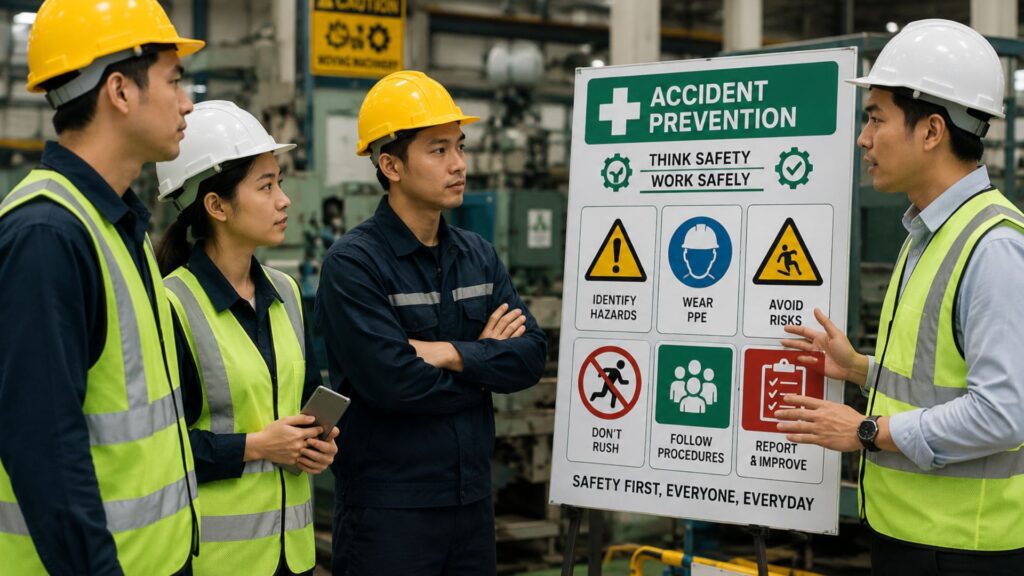
A toolbox meeting is a short, focused safety briefing conducted at the workplace, typically at the start of a shift or before a specific high-risk task begins. Toolbox meetings are not just a box-ticking exercise. When done properly, they are one of the most effective tools for preventing workplace accidents.
The name comes from the tradition of workers gathering around a toolbox before starting work, a practical, informal setting that sets the tone for the day ahead. In Singapore’s modern workplaces, the format has evolved, but the purpose remains the same: making sure every worker knows the specific risks they face that day and exactly what to do about them.
There are three reasons toolbox meetings matter:
- Legal compliance
Toolbox meetings are required under WSH regulations for construction and other high-risk industries in Singapore. Failure to conduct them or failure to document them leaves employers exposed during MOM inspections and bizSAFE audits.
- Accident prevention
Workers are reminded of specific hazards before starting work, reducing complacency. Most workplace accidents happen when workers are fatigued, distracted, or simply unaware of a hazard that has changed since the last time they did a similar task.
- Communication
A toolbox meeting is a two-way channel between management and workers where concerns can be raised before anyone picks up a tool. It is often the only structured opportunity frontline workers have to flag a hazard before it becomes an incident.
Is a Toolbox Meeting Legally Required in Singapore?
Under the Workplace Safety and Health Act and its subsidiary regulations, employers are required to provide adequate safety information and instructions to all workers before they perform any work activity. Toolbox meetings are the primary mechanism through which this obligation is fulfilled on a day-to-day basis.
Toolbox meetings are required under WSH regulations for construction and other high-risk industries in Singapore. For construction sites, toolbox meetings before the start of work activities are a standard MOM and BCA inspection point, sites without documented toolbox meeting records are at significant risk of enforcement action.
Beyond construction, the requirement extends to any workplace where workers perform tasks with identified hazards, which under a properly developed bizSAFE Risk Management Plan, includes most industrial, manufacturing, logistics, and facilities management operations.
Attendance must be recorded, this is your documentary proof for regulatory inspections.
Who Should Conduct Toolbox Meetings?

Toolbox meetings are most effective when conducted by someone with direct operational authority over the team, typically:
- Site supervisors or foremen
The most common conductors on construction and industrial sites
- Team leaders or shift leaders
For manufacturing, logistics, and facilities operations
- Workplace Safety and Health Officers (WSHOs)
Who may conduct toolbox meetings directly or train supervisors to do so effectively
- Project managers
For project-specific or task-specific briefings before high-risk activities
The person conducting the toolbox meeting should be familiar with the specific work activities being discussed that day, not reading from a generic script, but speaking knowledgeably about the actual hazards workers will face during that shift.
When to Hold a Toolbox Meeting
Toolbox meetings should be held:
- Before every shift
A brief daily toolbox meeting at the start of each shift is standard practice for construction, manufacturing, and other high-risk industries.
- Before any new or non-routine task
Whenever workers are asked to perform a task they do not regularly do, or one that carries a higher risk level than normal, a dedicated toolbox meeting should be held before the task begins.
- After an incident or near miss
When a workplace incident or near miss occurs, a toolbox meeting should be convened as soon as possible to communicate what happened, what caused it, and what controls have been put in place to prevent recurrence.
- When environmental or site conditions change
If weather conditions, site layout, equipment, or materials change significantly, a toolbox meeting should be held to brief workers on the new hazards and controls.
- When new workers join the team
Any time a new worker, contractor, or visitor joins a worksite, a toolbox meeting or equivalent safety induction should be conducted before they start work.
What to Cover in a Toolbox Meeting

A well-structured toolbox meeting covers five areas:
- The day’s work activities
A clear overview of what will be done that day, which tasks, in which sequence, using which equipment and materials. Workers should leave the toolbox meeting knowing exactly what is expected of them.
- Specific hazards for the day
Not a generic list of all possible hazards but the specific hazards relevant to the tasks being performed that day. These should be drawn directly from the Risk Management Plan and Safe Work Procedures. If working at height is involved, the fall hazards specific to that day’s setup should be discussed. If chemicals are being used, the specific substances and their risks should be covered.
- Control measures in place
For each identified hazard, the control measures that are in place, barriers, PPE requirements, isolation procedures, permit-to-work conditions should be clearly communicated. Workers should understand not just what the controls are, but why they matter.
- Emergency procedures
A brief reminder of the emergency response procedures relevant to that day’s activities, where the nearest first aid kit is, who the first aider on shift is, the assembly point location, and any task-specific emergency procedures such as chemical spill response or rescue from height.
- Questions and concerns
Every toolbox meeting should close with an open invitation for workers to raise hazards, concerns, or questions. This is the most valuable part of the meeting, workers on the ground often see hazards that supervisors and managers miss. A culture where workers feel comfortable speaking up is one of the most effective accident prevention tools available.
How to Run an Effective Toolbox Meeting: Step by Step
Before the meeting
- Review the Risk Management Plan and Safe Work Procedures for the day’s activities
- Check whether any new hazards have arisen (changed site conditions, new materials, equipment defects, weather forecasts)
- Prepare specific talking points, not a generic script
- Have the attendance register ready
During the meeting
- Keep it to 10 to 15 minutes, focused and specific, not a lecture
- Stand where everyone can see and hear you clearly
- Speak in the language workers are most comfortable in, for multilingual teams, use a bilingual supervisor or visual aids to ensure comprehension
- Ask questions to check understanding “What should you do if you notice the harness is damaged?” is more effective than just telling workers to check their harness
- Actively invite workers to raise concerns and take them seriously when they do
- Do not conduct toolbox meetings while workers are distracted, moving, or performing tasks
After the meeting
- Record attendance immediately (name, signature, date, topic covered)
- Note any hazards or concerns raised and document the actions taken
- File the record in your WSH documentation folder, it is your proof of compliance
What to Document and Why It Matters
Proper documentation is crucial for compliance and audits. Keep records of all training attended, including dates, topics, trainer names, and attendance lists. For toolbox meetings, your documentation should include:
- Date and time of the meeting
- Location: site name, area, or workstation
- Conductor: name and designation of the person who led the meeting
- Topics covered: a brief description of the hazards and controls discussed
- Attendance: name and signature of every worker who attended
- Hazards or concerns raised and the actions taken in response
- Follow-up actions if any corrective measures were identified, document what was agreed and by when
Under Regulation 5 of the WSH (Risk Management) Regulations, every record of risk assessment, measures, and safe work procedures, including toolbox meeting records that demonstrate implementation, must be kept for a period of not less than 3 years. For bizSAFE Level 3 companies, toolbox meeting records are among the implementation evidence your auditor will review, they demonstrate that your Risk Management Plan is being communicated and applied on the ground, not just filed in a folder.
Common Mistakes That Make Toolbox Meetings Ineffective

Despite being a legal requirement and a genuine safety tool, toolbox meetings in many Singapore workplaces fall short of their potential. Here are the most common mistakes:
- Reading from a generic script
A toolbox meeting that covers the same generic hazards every day regardless of what work is actually being done that day quickly becomes background noise. Workers switch off. The meeting happens but nothing is communicated. Every toolbox meeting should be specific to the actual tasks being done that day.
- Conducting the meeting while workers are distracted
Toolbox meetings conducted while workers are walking to the site, putting on PPE, or preparing equipment are ineffective. Workers should stop what they are doing, gather in one place, and give their full attention to the briefing.
- Not checking for comprehension
Telling workers about a hazard is not the same as ensuring they understand it. Effective supervisors ask questions, not to test workers, but to confirm that critical safety information has actually landed.
- Conducting meetings in a language workers do not understand
Singapore’s construction and industrial workforces include large numbers of migrant workers. A toolbox meeting conducted only in English, without translation or visual aids, fails to communicate effectively with workers who are most likely to be at risk.
- Skipping documentation
A toolbox meeting that is not documented did not happen from a compliance perspective. During MOM inspections and bizSAFE audits, undocumented toolbox meetings leave employers unable to demonstrate that safety information was communicated to workers.
- Treating it as a one-way broadcast
The most dangerous toolbox meetings are the ones where the supervisor talks and workers listen passively. The most valuable part of any toolbox meeting is what workers say, the hazard they noticed, the equipment that is not working properly, the task that does not feel right. If workers do not speak up, the toolbox meeting has missed its most important function.
Toolbox Meetings and Your bizSAFE Risk Management Plan
For companies pursuing or maintaining bizSAFE Level 3 certification, toolbox meeting records are a key component of implementation evidence. During the RM Implementation Audit, your auditor will verify that:
- The hazards identified in your Risk Management Plan are being communicated to workers through regular safety briefings
- Workers are aware of the control measures that apply to their work activities
- Evidence of communication exists in the form of toolbox meeting attendance records and topic documentation
A Risk Management Plan that sits in a folder without being communicated to the people doing the work does not meet the audit requirements. Regular, well-documented toolbox meetings are one of the clearest ways to demonstrate that your plan is actually being implemented, not just documented.
Beyond Level 3, toolbox meetings feed directly into the WSH Management Programmes required at bizSAFE Level 4, where the frequency, content, and effectiveness of safety briefings become part of a broader performance monitoring and continual improvement system.
Looking to Strengthen Your Workplace Safety Culture Beyond Toolbox Meetings?
Toolbox meetings are a foundation, but building a genuinely safe workplace requires a comprehensive programme that engages employees at every level. At AnjouHealth, we are a trusted workplace health and safety partner in Singapore, with over 1,200 professionals trained and a client satisfaction rate exceeding 95%. We help businesses build lasting WSH cultures through evidence-based programmes that go beyond compliance.
- Workplace Safety Campaigns
Interactive, hands-on campaigns that reinforce the safety messages from your daily toolbox meetings across your entire workforce
- Workplace Ergonomics Risk Assessment (WERA)
Identify ergonomic hazards that should be included in your toolbox meeting topics and Risk Management Plan
- Occupational Health Programmes
Onsite health screenings, hearing tests, and wellness initiatives that complement your day-to-day safety practices
- Customised WSH Solutions
Tailored programmes built around your industry, workforce size, and specific risk profile
Frequently Asked Questions
- Are toolbox meetings legally required in Singapore?
Yes. Under the WSH Act, employers must provide adequate safety information and instructions to workers before they perform work activities. For construction sites, toolbox meetings are specifically required and are a standard MOM and BCA inspection point. For other industries, the obligation to communicate hazards and controls to workers applies to all workplaces with identified risks.
- How long should a toolbox meeting last?
Toolbox talks are short, typically 10 to 15 minutes, site-specific briefings before work activities begin. They should be focused and specific, not a lecture. If a meeting is consistently running longer than 15 minutes, it is likely covering too much ground and should be restructured.
- Who is responsible for conducting toolbox meetings?
The site supervisor, team leader, or shift leader is typically responsible for conducting daily toolbox meetings. WSHOs may also conduct toolbox meetings or provide supervisors with training and guidance to do so effectively.
- What records do I need to keep for toolbox meetings?
At a minimum, keep a record of the date, location, conductor, topics covered, and the names and signatures of all attendees. These records are your documentary proof of compliance during MOM inspections and bizSAFE audits.
- How is a toolbox meeting different from a safety induction?
A safety induction is a one-time briefing given to new workers when they first join a workplace, covering general site rules, emergency procedures, and their specific role-related hazards. A toolbox meeting is a regular briefing, typically daily, that covers the specific hazards and tasks relevant to that particular day’s work.
- Do toolbox meetings need to be conducted in different languages for foreign workers?
There is no specific legal requirement prescribing the language of toolbox meetings, but the WSH Act requires employers to ensure workers understand the safety information they are given. If workers do not understand English, employers should conduct meetings in the workers’ preferred language, use a bilingual supervisor, or supplement verbal briefings with visual aids, failure to ensure comprehension defeats the purpose of the meeting entirely.
- How do toolbox meetings connect to my bizSAFE Risk Management Plan?
Toolbox meeting records are among the implementation evidence your Level 3 auditor will review. They demonstrate that the hazards and controls documented in your Risk Management Plan are being actively communicated to the workers who face those hazards every day. A plan without evidence of communication will not satisfy the audit requirements.