

Quick Summary
Both get booked the same way: a room, a facilitator, 45 to 90 minutes, somewhere on the wellness or safety calendar. That similarity is exactly why the wrong one gets booked. A Health Workshop and a Safety Campaign or Educational Talk solve different problems: one is about the lifestyle habits that affect how an employee feels and performs, the other is about the workplace risks that could injure them. Get the two confused, and you end up running a stress-management session when the floor actually needed a manual-handling refresher, or the other way round.
What's actually different between the two?
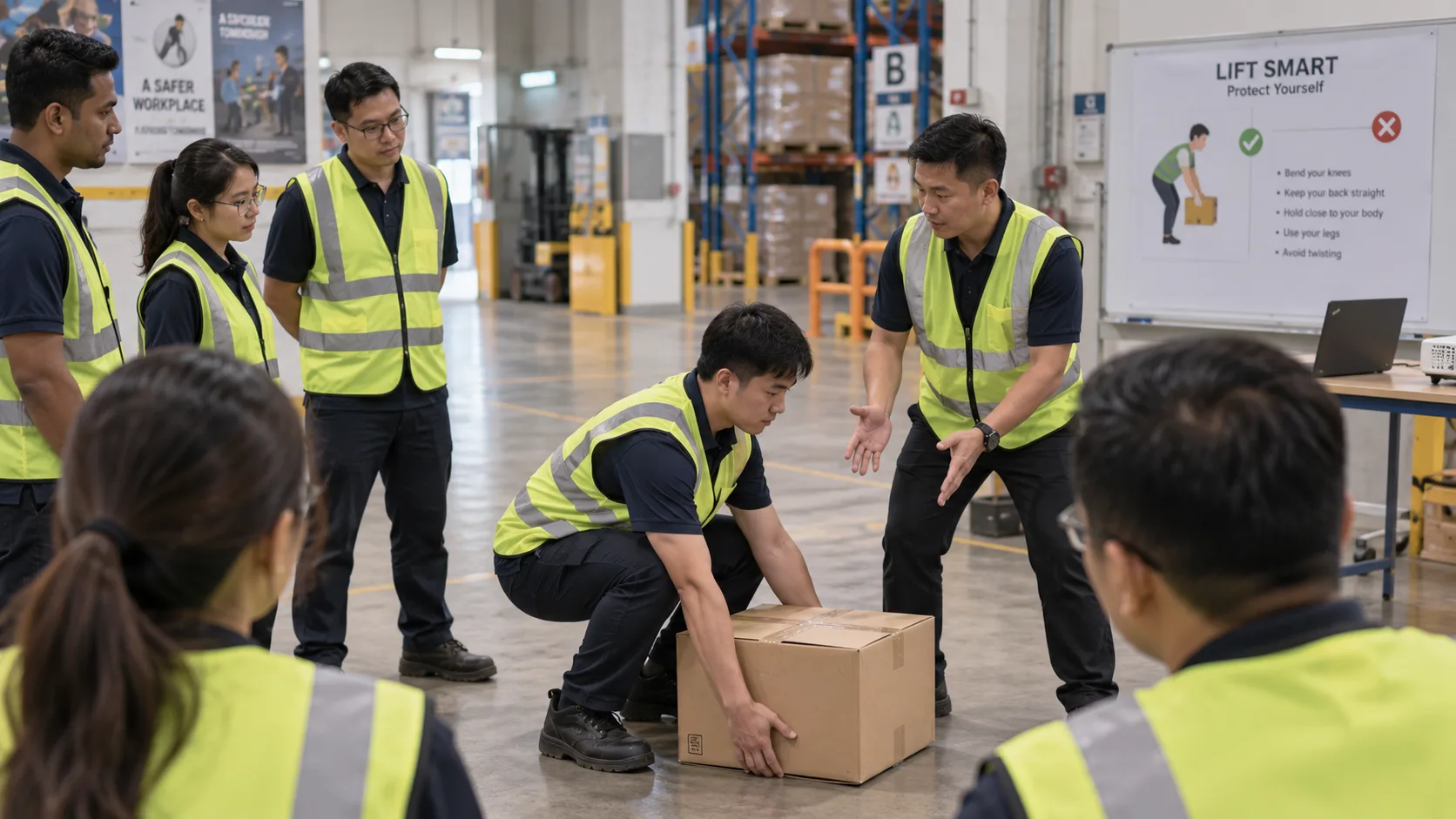
One is about the person, the other is about the job. A Health Workshop covers the lifestyle habits that affect an employee's health, energy and performance: nutrition, exercise, mental health and resilience, sleep and stress management, plus custom topics like weight management or women's health on request. A Safety Campaign or Educational Talk covers the risks specific to how the work gets done (manual handling, PPE use, slip and trip prevention, heat stress, electrical safety) and is built to reinforce findings from a WERA or ergonomics assessment and support the safety awareness employers are expected to maintain under BizSAFE and MOM's WSH framework.
Structurally, the two look almost identical. Both run 45 to 90 minutes as a standard session, both extend into half-day events or multi-session series, both come in English, Mandarin or Bahasa Melayu, and both come with attendance records afterwards. The difference is entirely in the content, not the format, which is exactly why booking the wrong one by name alone is an easy mistake to make.

Where the two genuinely overlap
Stress and mental health show up on both service pages, and that's not a mix-up. Health Workshops list "mental health and resilience" as one of four core topics. Safety Campaigns list "mental wellness and stress management" as one of their covered areas too. The subject is the same; the framing is not. A Health Workshop treats stress as a personal wellbeing topic: sleep, coping, individual resilience. A Safety Campaign treats it as a workplace-risk factor, often discussed alongside fatigue and its effect on incidents on a physically demanding site. If stress is what you're booking for, say which framing you actually want before the provider designs the session. The same topic, run the wrong way, answers the wrong question.
So which one do you actually need?
Start from the problem, not the calendar slot.
- If the concern is how employees feel or perform day-to-day (energy, sleep, stress, nutrition, general fitness), that's a Health Workshop.
- If the concern is a specific risk in how the job gets done (a lifting technique, PPE compliance, an incident that could plausibly happen on the floor), that's a Safety Campaign or Educational Talk.
- If you're following up on a health screening, a Health Workshop that addresses the actual findings (a nutrition session after elevated cholesterol or BMI results, for instance) does more than a generic one.
- If you're following up on a WERA or ergonomics assessment, a Safety Campaign that reinforces the specific findings does the same job on the risk side.
If none of those apply and you're booking cold, the safer default is whichever calendar event you're already running: a wellness week points to a Health Workshop, a safety week points to a Safety Campaign.
Can you run both together?
Yes, and for some events that's the point. A health day or an annual WSH event is exactly where employers commonly book both: a Safety Campaign covering the physical risks on site, and a Health Workshop covering the lifestyle side, run back-to-back or across the same week. Booking both isn't duplicating the same session twice. It's covering two different categories of risk to the same workforce in one push.
Where to go for the depth on each
This post is the triage, not the full guide to either. If a Health Workshop is what you need, our guide to workplace health talks covers choosing the right topic, who should actually deliver it, what HPB already offers for free, and what to measure afterwards. For a Safety Campaign, the service page itself sets out the full topic list and how sessions tie into existing WERA or ergonomics findings.
Naming the problem picks the session
The two aren't competing options for the same booking: they answer different questions about the same workforce. A Health Workshop asks how employees are doing. A Safety Campaign asks what could hurt them. Both are worth running; neither substitutes for the other, and a wellness or safety week often needs both rather than a choice between them.
Booking a Health Workshop or Safety Campaign in Singapore
If you're not sure which fits what you're planning, our Health Workshops and Safety Campaigns & Educational Talks pages both set out what's included, or describe the problem directly and we'll scope it against whichever actually fits.
Need Help With Workplace Safety?
Talk to our team about a tailored workplace safety, ergonomics, or wellness programme for your organisation.
Frequently Asked Questions
No. Both are facilitated sessions of similar length and format, but a Health Workshop covers lifestyle and wellbeing topics (nutrition, exercise, mental health, sleep) while a Safety Campaign or Educational Talk covers workplace-specific risks such as manual handling, PPE and slip/trip prevention.
Yes. Stress and mental health appear on both service pages, framed differently: as a personal wellbeing topic in a Health Workshop, and as a workplace-risk factor tied to fatigue and incidents in a Safety Campaign. Tell the provider which framing you need.
Both run 45 to 90 minutes as a standard session, with half-day events and multi-session series available for either.
Yes, both are available in English, Mandarin, and Bahasa Melayu.
Often, yes. Employers commonly book a Safety Campaign for the risk side and a Health Workshop for the wellbeing side of the same event, rather than picking one to try to cover both.
Start from the problem: a concern about how people feel or perform is a Health Workshop; a concern about a specific job risk is a Safety Campaign. If you're following up on a health screening or a WERA/ergonomics assessment, let those findings pick the topic.