


Written by
Bryan Sim, Business Development at AnjouHealth
An OHS programme developer at AnjouHealth focused on designing workplace health and safety initiatives that help organisations create safer, healthier, and more engaged environments. He works on translating ergonomic assessments and workplace risk insights into practical initiatives such as safety campaigns, wellbeing programmes, and workplace interventions that are impactful, sustainable, and aligned with operational needs.
In This Blog
- What Actually Has to Happen for bizSAFE Certification?
- What Does SAC Accreditation Mean for the Provider Running Your Audit?
- What Does WSH Officer Registration Mean for the Person Leading Your Programme?
- What to Check Before Booking a Safety Campaign or Ergonomic Assessment Provider
- Frequently Asked Questions (bizSAFE, SAC Accreditation & WSH Registration Singapore)
Quick Summary
bizSAFE, SAC accreditation, and WSH Officer registration all sound like paperwork, but each one actually points to real, physical work someone has to deliver: risk assessments carried out on-site, a WSHMS audit conducted by an accredited certification body, or a registered WSH professional running your safety programme day-to-day. Knowing what each credential actually requires helps Singapore employers tell a genuine service delivery partner from one offering a shortcut.
This matters when booking a safety campaign, ergonomic assessment, or risk assessment provider during MOM’s Safety Time-Out enhanced enforcement window (through 31 July). The credential on paper is only as good as the work actually delivered behind it.
What Actually Has to Happen for bizSAFE Certification?
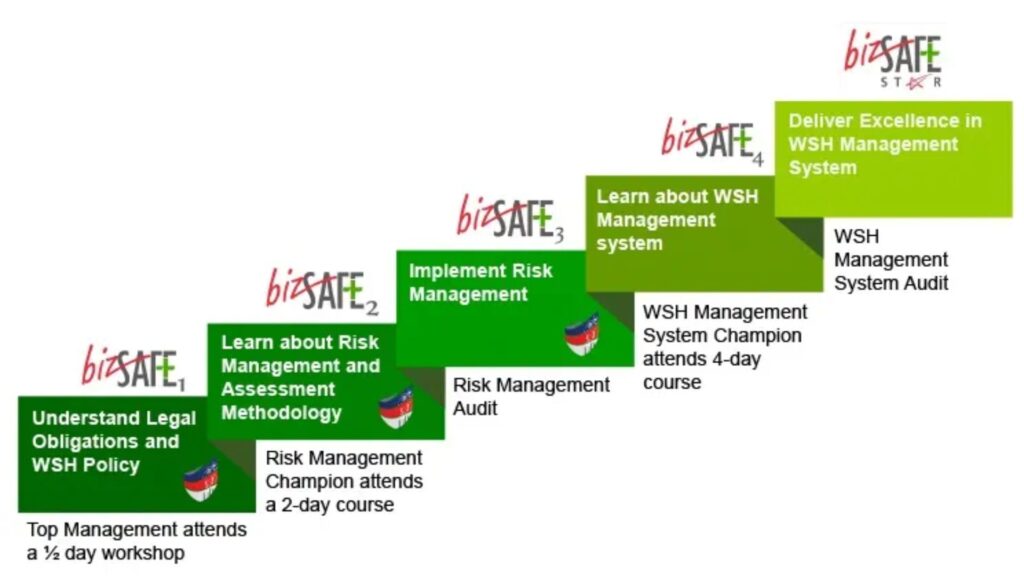
Each bizSAFE level requires real work to be delivered, not just a signed form. It’s a 5-level programme run by the WSH Council under MOM (WSH Council).
- Level 1: Top management actually attends a 3-hour WSH workshop.
- Level 2: Risk Management and Risk Assessment leaders complete a 2-day WSQ course, and a Risk Management Implementation Plan actually gets produced, not just discussed.
- Level 3: Risk assessments are conducted for every work activity and process on-site, then verified by an approved auditor. This is hands-on assessment work, not a desk exercise, and it’s the minimum most government and GLC tenders require.
- Level 4: A trained WSHMS Champion implements a full Workplace Safety and Health Management System across the organisation.
- Star: That WSHMS is independently audited and certified to ISO 45001. This is where SAC accreditation becomes directly relevant.
For full level-by-level requirements, timelines and costs, see our BizSAFE Singapore: Complete Guide to Levels, Requirements & Certification, BizSAFE Level 3 Requirements: Audit, Costs & Certification, and How Much Does bizSAFE Cost? A Full Breakdown.
What Does SAC Accreditation Mean for the Provider Running Your Audit?
SAC accreditation applies to the certification body doing the auditing, not to your company. The Singapore Accreditation Council (SAC) accredits certification bodies to issue internationally recognised certificates, including ISO 45001, the standard behind bizSAFE Star (SAC).
Why this matters when you’re booking the work: if a provider is running your WSHMS audit or ISO 45001 certification as part of a bizSAFE Star push, the certificate only holds up for government tenders and most international clients if the certification body they use is SAC-accredited (SAC-accreditation.gov.sg). SAC is also part of the IAF Multilateral Recognition Arrangement, so a SAC-accredited certificate is recognised across 50+ other member economies, not just as a local stamp.
The question to ask a provider isn’t “Are you accredited?” It’s “which certification body handles the audit, and is that body SAC-accredited?”
What Does WSH Officer Registration Mean for the Person Leading Your Programme?

WSH Officer registration is a personal qualification held by an individual, not the company delivering your programme. Higher-risk workplaces such as construction sites, shipyards, and large factories must have a registered WSH Officer once project value, workforce size, or risk level crosses MOM’s thresholds; for construction, this typically applies once project value exceeds roughly $10 million (MOM).
To register, an individual must be at least 21, hold minimum qualifications plus a prescribed WSH course, have at least 2 years of relevant experience, and register with MOM for a $110 fee, valid for 2 years and then renewed. If a safety campaign or assessment provider has a WSH Officer named on your programme, it’s that individual’s registration, not the company’s marketing claims, that MOM actually checks. See our Workplace Safety Officer Singapore: Roles, Duties & How to Become One for the full pathway.
What to Check Before Booking a Safety Campaign or Ergonomic Assessment Provider
Before booking a provider to run risk assessments, ergonomic assessments, or a workplace safety campaign, four questions actually matter:
- Do they conduct the on-site work themselves, or subcontract it?
Risk assessments and ergonomic assessments that count toward bizSAFE Level 3 need to reflect your actual workplace and be done by people who were physically on-site.
- If they’re supporting a bizSAFE Star push, is their certification/audit partner SAC-accredited?
A provider can run excellent groundwork and still hand you a certificate that won’t clear a tender if the certifying body isn’t accredited.
- Is any named WSH Officer on the delivery team currently registered with MOM?
Ask, don’t assume.
- Do they hold these credentials themselves?
A provider running safety campaigns and assessments should be able to show its own bizSAFE level and professional affiliations, such as SISO membership, not just explain what the credentials mean.
How to Tell These Credentials Apart
| Factor | bizSAFE | SAC Accreditation | WSH Officer Registration |
| What it certifies | A company’s risk management capability | A certification body’s competence to audit | An individual’s competence to manage WSH |
| Who holds it | The company | The certification/auditing body | The named WSH professional |
| Levels/tiers | 1, 2, 3, 4, Star | Pass/fail accreditation status | Registered or not registered |
| Who grants it | WSH Council (under MOM) | Singapore Accreditation Council | Ministry of Manpower |
| Validity | 6 months (Levels 1-2) / 3 years (Levels 3-4, Star) | Periodic reassessment (body-level) | 2 years, renewable |
| What to check when booking a provider | Have they actually delivered the on-site risk assessments? | Is their audit partner SAC-accredited? | Is the named officer’s registration current? |
Frequently Asked Questions (bizSAFE, SAC Accreditation & WSH Registration Singapore)
- Is an ISO 45001 certificate valid if the certification body isn’t SAC-accredited?
Not for most purposes that matter commercially. Government agencies, statutory boards, and most international clients require ISO certificates to come from a SAC-accredited certification body, or an equivalent IAF MLA member.
- Is bizSAFE mandatory in Singapore?
Not universally, but it’s effectively required for government and GLC tenders (typically at least Level 3), for subcontractors to larger enterprises that mandate it contractually, and for higher-risk sectors like construction, manufacturing, marine, and logistics.
- How much does bizSAFE certification cost?
It depends on the level. Level 1 workshops run roughly $50-$100 per participant, while Level 3 and Star costs scale with company size and complexity, and Star can exceed $14,000 for large or multi-site operations. See our bizSAFE cost breakdown for the full picture by level.
- Does every safety campaign or assessment provider need to be SAC-accredited?
No. SAC accreditation applies specifically to the certification body issuing ISO certificates, not to every provider delivering risk assessments, ergonomic assessments or safety campaigns. It only becomes relevant if a provider is issuing or coordinating an ISO 45001 certification as part of your bizSAFE Star push.
- How long is WSH Officer registration valid?
Two years from approval, after which it must be renewed with MOM.
- What’s the difference between bizSAFE Level 4 and bizSAFE Star?
Level 4 requires implementing a full WSHMS led by a trained Champion, verified through an MOM-recognised audit. Star requires that the same system be independently certified to ISO 45001 by an SAC-accredited, or equivalent, certification body.
- Why does this matter right now?
MOM’s Safety Time-Out enhanced enforcement window (through 31 July) means the gap between what a company assumes it holds and what was actually delivered on-site is being checked more closely than usual.
Credentials Are Only as Good as the Work Behind Them
A bizSAFE level reflects real risk assessments actually carried out, not paperwork alone. A SAC-accredited certificate means the audit itself was independently verified, not just claimed. The safest provider to book is one that holds these credentials for its own work, not just one that can explain them to you.
Booking a Safety Campaign or Ergonomic Assessment in Singapore?

AnjouHealth is a leading provider of corporate health initiatives and workplace safety programmes across Singapore, Malaysia, and Taiwan, bizSAFE-certified and SISO-member, delivering the on-site work behind these credentials directly.
Our team runs:
- On-site ergonomic assessments for offices, warehouses and worksites
- Risk assessments that support your bizSAFE Level 2/3 renewal
- Workplace safety campaigns and WSH awareness programmes, including Safety Time-Out support
Book an assessment or campaign with our team. We’ll scope the work against what your bizSAFE level or WSH obligations actually require.