


Written by
Bryan Sim, Business Development at AnjouHealth
An OHS programme developer at AnjouHealth focused on designing workplace health and safety initiatives that help organisations create safer, healthier, and more engaged environments. He works on translating ergonomic assessments and workplace risk insights into practical initiatives such as safety campaigns, wellbeing programmes, and workplace interventions that are impactful, sustainable, and aligned with operational needs.
Overview
“We just had a MOM inspector come by. What happens now?”
It’s a question employers ask in a hurry, often when they’re already dealing with the fallout. Whether an inspector flagged a minor documentation gap or issued a Stop Work Order on the spot, the consequences of failing a Ministry of Manpower (MOM) workplace safety inspection can range from a composition fine to a full site shutdown, depending on what was found and how serious it is.
Understanding what happens after a failed inspection and what steps you need to take is essential. Delays in responding, or responding incorrectly, tend to make the situation worse rather than better.
This guide walks through what MOM inspectors are looking for, the types of enforcement action they can take, and exactly what employers need to do if their worksite falls short.
In This Guide
- What MOM inspectors are looking for
- The three levels of enforcement action
- What a Stop Work Order means for your business
- The reinspection process, step by step
- Longer-term consequences of a failed inspection
- What to do before your next inspection
What MOM Inspectors Are Looking For

MOM inspectors conduct both scheduled and unannounced visits to workplaces across Singapore under the Workplace Safety and Health Act (WSHA). They are assessing whether your organisation is meeting its statutory obligations as an employer, not just whether a safety poster is on the wall.
Common areas of focus during an inspection include whether risk assessments have been carried out and documented, whether safe work procedures are in place and being followed, whether workers have received adequate safety training, whether personal protective equipment is being used correctly, and whether the physical worksite environment is free of hazards.
Workplace safety compliance is not optional; it carries real consequences. In the first half of 2025 alone, the Ministry of Manpower (MOM) carried out over 3,000 inspections specifically targeting high-risk industries, uncovering nearly 7,000 safety breaches. According to a MOM press release dated 29 September 2025, offending firms faced penalties totalling more than $1.5 million in fines, with 28 stop-work orders issued immediately. Inspectors have the authority to issue notices, fines, and Stop Work Orders on the spot, without prior warning
The Three Levels of Enforcement Action
Not all inspection failures are treated the same. MOM’s response scales with the severity of the breach.
Composition Fines
For less serious violations, MOM may issue a composition fine, an out-of-court financial penalty. Typical amounts vary depending on the breach:
| Violation | Typical Fine |
| Failure to conduct risk assessments | $1,000 – $5,000 |
| Inadequate PPE provision or usage | $1,000 – $3,000 |
| Poor housekeeping or site conditions | $2,000 – $5,000 |
| Inadequate training records | $1,000 – $3,000 |
Composition fines are discretionary, capped at $5,000; the ranges shown are industry estimates, not an official MOM schedule.
A single inspection can uncover multiple breaches. A worksite with five separate violations could face $15,000 to $25,000 in composition fines from one visit alone.
Source: https://sageshield.com/workplace-safety-fines-mom-singapore/
Stop Work Orders (SWOs)
When an inspector identifies conditions that pose an imminent danger to workers or the public, they can issue a Stop Work Order immediately. There are two types:
A Full Site SWO requires all work on the entire worksite to cease immediately. This is typically issued when systemic safety failures are identified, rather than a single isolated hazard.
A Partial SWO applies only to a specific activity or area. Other unrelated work on site may continue, but the identified dangerous activity must stop until the issue is resolved and MOM lifts the order.
Court Prosecution
For serious breaches or repeat offenders, MOM may pursue prosecution in court rather than issue a composition fine. Penalties under the WSHA can reach up to $50,000 per offence for serious safety risks, doubled from previous limits as of June 2024, and up to $200,000 for repeat violations. Individual managers, supervisors, and directors can be personally prosecuted and face fines or imprisonment.
In early 2025, a construction firm was fined $250,000 after a worker fell from height due to inadequate edge protection. The company had received prior warnings about fall hazards but had not implemented corrective measures. The site supervisor was separately fined $15,000 and sentenced to four weeks’ imprisonment.
Source: https://www.mom.gov.sg/workplace-safety-and-health/workplace-safety-and-health-act/liabilities-and-penalties , https://sageshield.com/workplace-safety-fines-mom-singapore/
What a Stop Work Order Means for Your Business
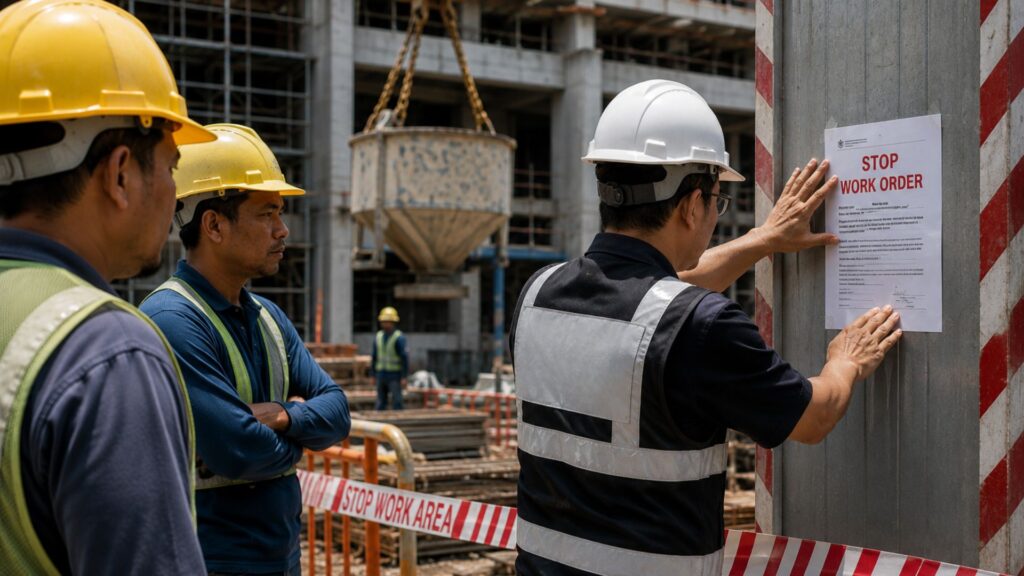
A Stop Work Order is not simply a warning. Once issued, it is a legal directive; continuing affected work while an SWO is in force is a criminal offence.
The direct financial impact extends well beyond any fine issued. Project delays, idle manpower costs, contractual penalties, and potential liquidated damages can accumulate quickly. For businesses dependent on timelines, whether in construction, manufacturing, or logistics, even a partial SWO can have cascading effects across the wider project.
There is also a reputational dimension. Clients, main contractors, and principals may become aware of the order, and some will treat it as grounds to reassess the relationship.
The Reinspection Process, Step by Step
If your worksite has received a Stop Work Order, here is what you need to do to get the order lifted.
- Step 1: Stop all affected work immediately.
Do not attempt to continue operations covered by the SWO. Ensure all workers, supervisors, and subcontractors on site are aware of the order and its scope.
- Step 2: Identify the full extent of non-compliance.
Do not limit your review to the specific breach that triggered the SWO. MOM expects comprehensive corrective action, and a reinspection that reveals additional issues will extend the process and likely result in further enforcement.
- Step 3: Engage an external WSH auditor.
Businesses issued with a Stop Work Order are required to engage an accredited external auditor to conduct a thorough review of their WSH management systems. This is a mandatory step before the SWO can be lifted, not optional.
- Step 4: Implement corrective actions and document everything.
Rectify all identified safety lapses. Maintain clear, dated records of every corrective action taken, including photos, updated risk assessments, training records, and revised safe work procedures.
- Step 5: Notify MOM and request reinspection.
Once rectification is complete, formally notify MOM in writing and submit a reinspection request. Your documentation of corrective actions will be reviewed as part of this process.
- Step 6: Pass MOM verification.
An MOM officer will return to verify that all issues have been fully resolved. The SWO is only lifted once they are satisfied that the worksite is safe. Operations cannot resume until this sign-off is received.
Longer-Term Consequences of a Failed Inspection

The impact of a failed MOM inspection does not end when the fine is paid or the SWO is lifted. There are longer-term business consequences that employers should be aware of.
- Debarment from government tenders
Companies with poor WSH records can be barred from bidding on public sector contracts. For businesses that rely on government projects, this is often the most financially significant consequence of all.
- Increased scrutiny and follow-up inspections.
Once flagged, your worksite is likely to receive more frequent visits. MOM tracks enforcement history, and repeat offenders face progressively serious consequences.
- Insurance implications.
A history of WSH violations can affect your premiums, coverage terms, and claims handling with your insurer.
- bizSAFE impact
If your organisation holds or is pursuing bizSAFE certification, enforcement actions can affect your standing. Auditors look at your WSH record as part of the certification process.
Strengthening Your Safety Structure Before MOM Visits

Responding to a failed inspection is significantly harder and more expensive than preventing one. At AnjouHealth, we work with businesses to build the safety culture and systems that hold up under scrutiny:
- Workplace Safety Campaigns & Educational Talks
Reinforce daily safety messaging across your workforce so that safe behaviour becomes a habit, not a checkbox.
- Workplace Ergonomics Risk Assessment (WERA)
Identify physical hazards in your environment before an inspector does, and feed the findings into your Risk Management Plan.
- Injury Rehabilitation & Return to Work
Structured support when a workplace injury does occur, helping manage the situation properly and minimise downstream risk.
- Onsite Health Screenings
Occupational health checks that demonstrate a holistic approach to worker wellbeing, complementing your WSH compliance efforts.
Frequently Asked Questions
- Can MOM inspect my workplace without notice?
Yes. MOM inspectors have the authority to conduct unannounced visits to any workplace under the WSHA. There is no requirement to give advance notice, and employers cannot refuse entry to an authorised inspector.
- What is the difference between a composition fine and a court prosecution?
A composition fine is an out-of-court settlement; you pay the fine, and the matter is resolved without a criminal record. Court prosecution is more serious: it results in a formal conviction, higher financial penalties, and, in some cases, imprisonment for individuals found personally liable. MOM typically pursues prosecution for serious breaches or where previous warnings have been ignored.
- Can we continue working on parts of the site not covered by a Stop Work Order?
If a Partial SWO has been issued, yes, work unrelated to the specific area or activity cited in the order may continue. However, if a Full Site SWO has been issued, all work on the entire site must stop. Confirming the exact scope of the SWO with MOM in writing is important to avoid inadvertently breaching it.
- How long does it take to lift a Stop Work Order?
There is no fixed timeline. The duration depends on how quickly you can rectify the identified issues, engage an external auditor, and pass MOM’s reinspection. Businesses that move quickly, document thoroughly, and engage proactively with MOM typically resolve orders faster than those that delay or provide incomplete documentation.
- Can individual managers or directors be personally penalised?
Yes. Under the WSHA, individuals, including managers, supervisors, and directors, can be held personally liable for WSH offences if it can be shown that the offence was committed with their consent, connivance, or neglect. Personal fines and imprisonment are both possible outcomes.
- What should we do if we disagree with MOM’s findings? You can raise your concerns with MOM formally. However, compliance with the enforcement action — including stopping work if an SWO is issued — is required regardless of whether you intend to dispute the findings. Non-compliance with an SWO while a dispute is pending is itself an offence.
Read Next
- Workplace Safety Compliance Singapore: What Employers Must Do
- WSH Risk Assessment Singapore: A Practical Guide
- bizSAFE Singapore: The Complete Guide, All Levels Explained
- Toolbox Meetings Singapore: A Complete Guide for Employers (2026)
- Workplace Safety Officer Singapore: Roles, Duties & How to Become One