
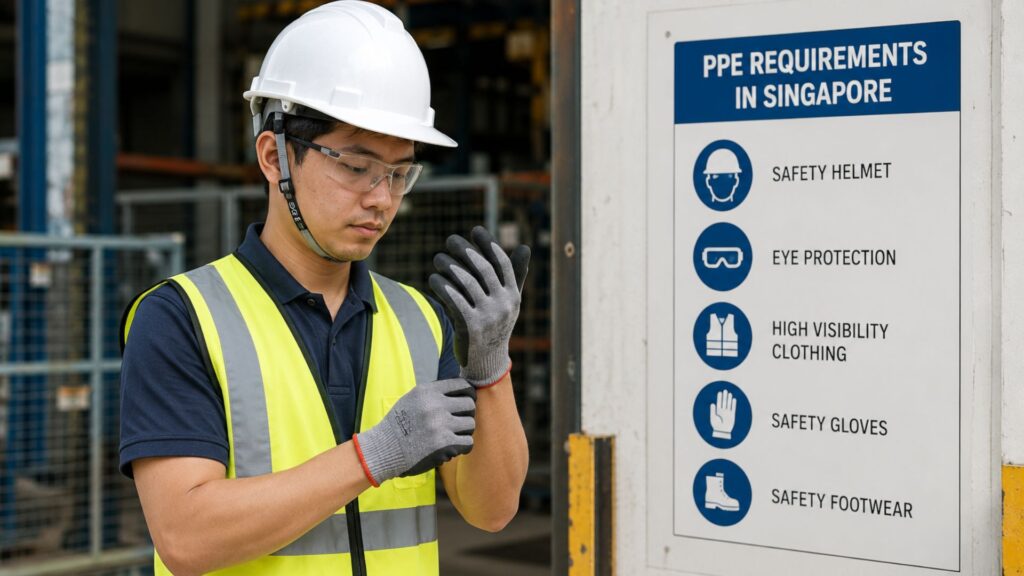

Written by
Bryan Sim, Business Development at AnjouHealth
An OHS programme developer at AnjouHealth focused on designing workplace health and safety initiatives that help organisations create safer, healthier, and more engaged environments. He works on translating ergonomic assessments and workplace risk insights into practical initiatives such as safety campaigns, wellbeing programmes, and workplace interventions that are impactful, sustainable, and aligned with operational needs.
Overview
“We’ve got helmets on site. That should cover us, right?”
It’s a common assumption, and one that can land employers in serious trouble with MOM. Personal Protective Equipment (PPE) requirements in Singapore are more specific than many businesses realise. The law doesn’t just say “provide PPE.” It sets out which types are required for which hazards, who is responsible for providing and maintaining them, and what happens when those obligations aren’t met.
Getting PPE compliance right matters for two reasons. First, it protects your workers. Second, PPE is one of the first things a MOM inspector will assess when they walk onto your worksite, and inadequate PPE is one of the most commonly cited violations in enforcement actions.
This guide covers the legal framework, the types of PPE required for common workplace hazards, what employers and employees are each responsible for, and what MOM inspectors are looking for.
In This Guide
- What PPE is and where it fits in the hierarchy of controls
- The legal framework governing PPE in Singapore
- Employer obligations under the WSH Act
- Types of PPE and the hazards they cover
- Employee responsibilities
- Common PPE compliance failures
- What to do if you’re unsure whether your PPE meets requirements
What PPE Is And Where It Fits
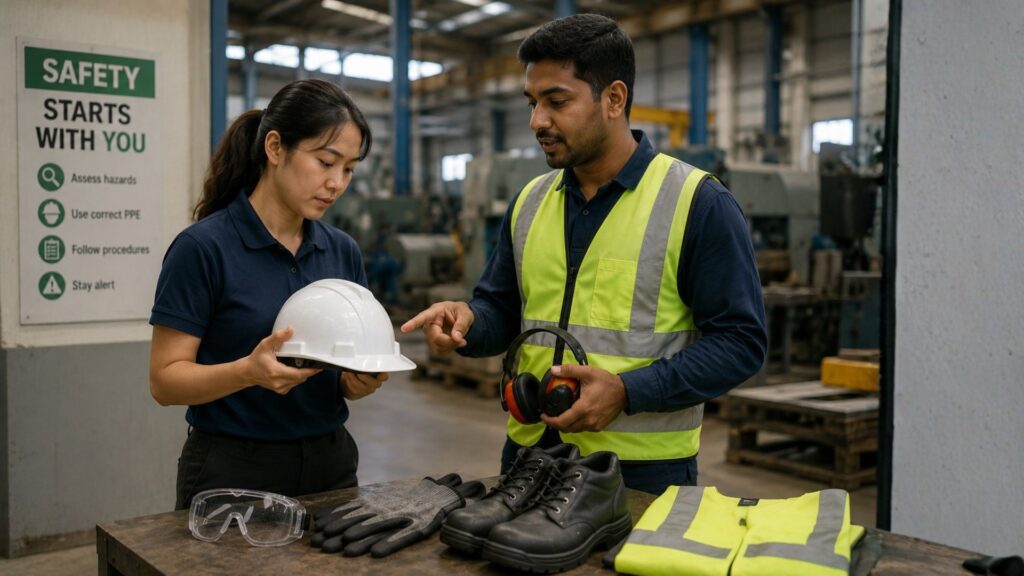
Personal Protective Equipment refers to any device or garment worn by a worker to minimise exposure to a specific hazard. This includes safety helmets, gloves, eye and face protection, hearing protection, respiratory protective equipment, high-visibility clothing, safety footwear, and fall arrest harnesses, among others.
Under Singapore’s WSH framework, PPE is considered the last line of defence in the hierarchy of controls. Before reaching for PPE, employers are expected to first attempt to eliminate the hazard, then substitute it with something less dangerous, then engineer controls that reduce exposure, and then implement administrative controls such as limiting time near the hazard. Only when these measures are not reasonably practicable or do not fully address the risk should PPE be relied upon.
This is an important point for MOM compliance. Inspectors are not only checking whether PPE is present. They are also assessing whether employers have followed a proper risk management process, of which PPE is just one part. A worksite that relies entirely on PPE without exploring upstream controls may be found non-compliant even if every worker is fully equipped.
The Legal Framework Governing PPE in Singapore
PPE obligations in Singapore stem from the Workplace Safety and Health Act (WSHA) and several regulations made under it.
The WSH (General Provisions) Regulations require employers to provide appropriate PPE to workers who are exposed to risks that cannot be adequately controlled through other means. It also requires that PPE be suitable for the hazard, properly maintained, and replaced when worn or defective.
The WSH (Construction) Regulations set out specific PPE requirements for construction worksites, including mandatory use of safety helmets, safety footwear, and fall protection equipment for work at height.
The WSH (Risk Management) Regulations require employers to conduct formal risk assessments covering all significant hazards in the workplace. The outcome of that risk assessment should identify where PPE is necessary, what type is required, and for which workers, making risk assessments and PPE selection directly linked to obligations.
Employers who fail to meet these requirements can face composition fines, Stop Work Orders, or court prosecution, depending on the severity of the breach.
Employer Obligations Under the WSH Act
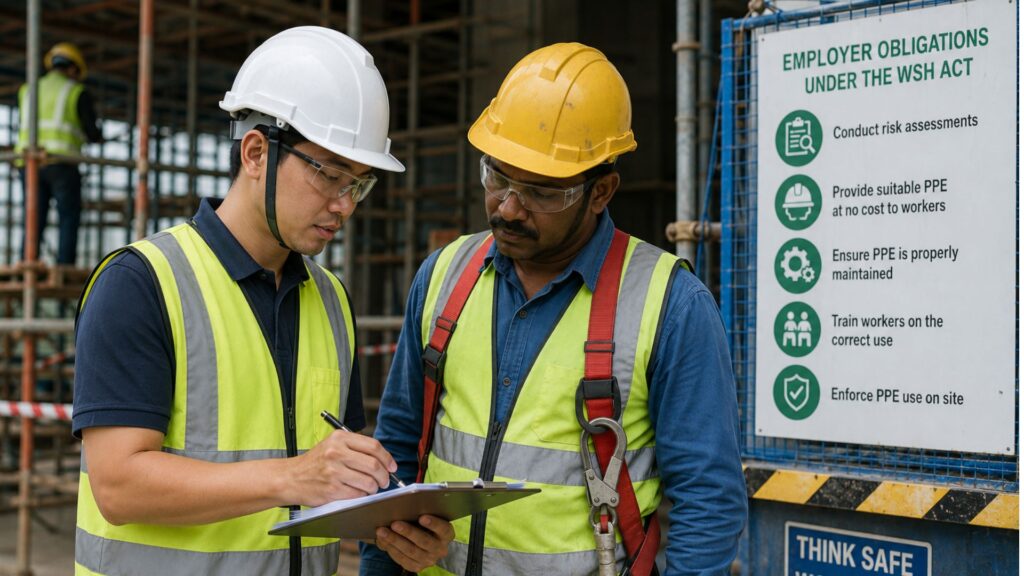
The WSHA places the primary duty of PPE compliance on employers. Specifically, employers are required to:
- Conduct risk assessments.
Before selecting PPE, employers must identify the hazards workers are exposed to and assess the level of risk. This assessment determines which types of PPE are appropriate and for whom.
- Provide suitable PPE at no cost to workers.
Employers must supply PPE that is appropriate for the specific hazard identified. Providing generic PPE that does not match the actual risk, for example, issuing dust masks where respiratory protection against chemical vapours is required, does not satisfy the obligation.
- Ensure PPE is properly maintained.
PPE must be regularly inspected, cleaned, and replaced when damaged or at the end of its service life. Maintaining records of PPE inspections is good practice and supports compliance during a MOM visit.
- Train workers on the correct use.
Providing PPE without training on how to wear it, fit it, and when to use it does not fulfil the employer’s duty. Workers must understand not only how to use PPE but also its limitations.
- Enforce PPE use on site.
Supervisors are responsible for ensuring that workers actually wear the PPE provided. A box of unused helmets in a storeroom is not compliance.
Types of PPE and the Hazards They Cover
Different PPE protects against different hazards. The table below covers the main categories relevant to most Singapore workplaces.
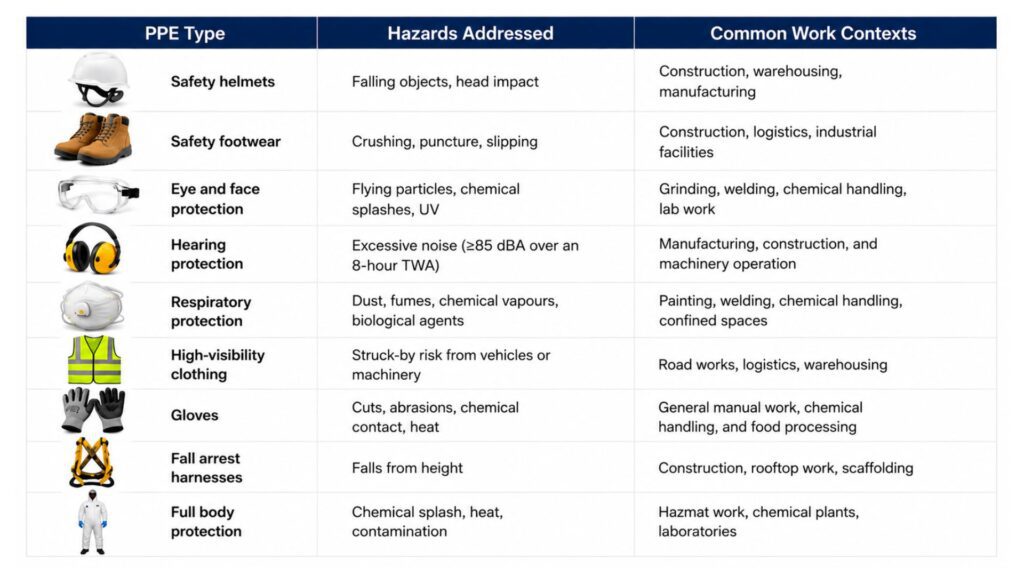
The appropriate type within each category also matters. For example, not all gloves protect against chemical exposure; a worker handling solvents needs chemical-resistant gloves specifically rated for the substances involved, not general-purpose work gloves. Similarly, not all dust masks provide respiratory protection against chemical fumes. Selecting the right PPE requires understanding the specific hazard, not just the broad category.
Employee Responsibilities
While employers carry the primary legal duty, the WSHA also places obligations on employees. Workers are required to:
Use the PPE provided correctly and in the manner you have been trained to do so. Wearing a helmet with the strap undone, using gloves that are the wrong size, or removing a respirator in a hazardous environment all constitute failures to comply.
Take care of PPE in their possession, storing it correctly, not modifying or damaging it, and reporting defects or wear to their supervisor promptly.
Cooperate with their employer’s safety measures and do not intentionally circumvent PPE requirements. Employees who refuse to wear required PPE themselves can be subject to enforcement action under the WSHA.
In practice, the culture around PPE on a worksite reflects the tone set by management. When supervisors and managers consistently model correct PPE use and enforce it fairly, workers follow. When PPE use is treated as optional or inconvenient at the supervisory level, compliance at the worker level tends to break down.
Common PPE Compliance Failures
Based on MOM enforcement patterns, the most common PPE-related failures found during inspections include:
- Wrong PPE for the hazard.
Providing PPE that does not match the risk identified in the risk assessment, for example, standard dust masks where fume protection is needed, or non-chemical-resistant gloves for chemical handling tasks.
- PPE is not being worn.
Workers on site without required PPE, or wearing it incorrectly. This is often a supervision failure as much as an individual one.
- Worn or damaged PPE is still in use.
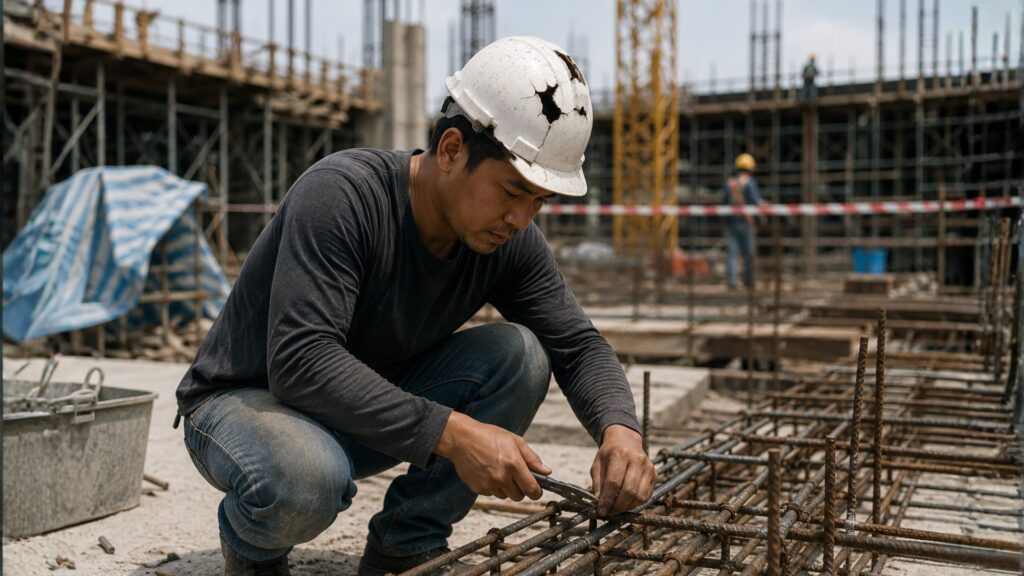
Helmets with cracks, gloves with tears, harnesses past their inspection date, or respirators with expired filter cartridges. PPE that is damaged or past its service life provides little or no protection.
- No training records.
Employers who provide PPE but cannot demonstrate that workers have been trained on its correct use will struggle to prove compliance during an inspection.
- PPE selection not linked to risk assessment.
Where employers cannot show that their choice of PPE was informed by a formal risk assessment, MOM may treat the risk management process as deficient, not just the PPE itself.
Strengthening Your Safety Culture Around PPE
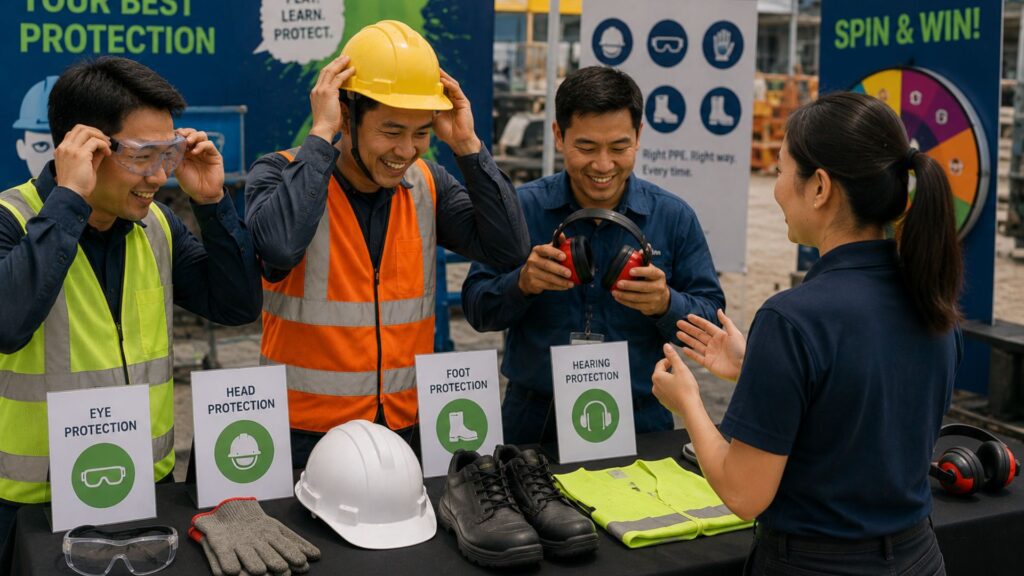
Providing PPE is only part of the equation. Getting workers to use it consistently, correctly, and without being reminded is a culture question, and that takes more than a policy document. At AnjouHealth, we help businesses build the foundations that make safety behaviours stick:
- Workplace Safety Campaigns & Educational Talks
Engaging, on-site safety programmes that make the case for PPE in language workers understand, reinforcing compliance without a top-down enforcement-only approach.
- Workplace Ergonomics Risk Assessment (WERA)
A structured assessment of physical hazards in your workplace that identifies where PPE is needed and feeds directly into your Risk Management Plan.
- Workplace Injury Management
When a PPE-preventable injury does occur, structured injury management helps your organisation respond properly and put controls in place to prevent recurrence.
- Onsite Physiotherapy Consultations
Addressing musculoskeletal issues that can arise from poor PPE fit or ergonomic
Frequently Asked Questions
- Is PPE mandatory for all workplaces in Singapore?
Not every workplace requires every type of PPE, but all employers in Singapore are legally required under the WSHA to conduct risk assessments and provide appropriate PPE where hazards are identified. If your risk assessment shows no significant hazards requiring PPE, you are not required to provide it, but the assessment itself is mandatory.
- Who is responsible for paying for PPE, the employer or the worker?
The employer. Under the WSH (General Provisions) Regulations, employers are required to provide PPE at no cost to workers. Workers should not be expected to purchase their own PPE for work tasks, though they are responsible for using and maintaining PPE provided to them.
- What happens if a worker refuses to wear PPE?
Employers must take reasonable steps to enforce PPE use, including through supervision, counselling, and, if necessary, disciplinary measures. Under the WSHA, employees also have a duty to comply with their employer’s safety requirements. However, if MOM finds that PPE is not being used on a worksite, the employer, not just the individual worker, may face enforcement action for failing to enforce its own safety procedures.
- How often does PPE need to be inspected or replaced? This depends on the type of PPE and the intensity of use. As a general rule, PPE should be inspected before each use, with more formal periodic inspections documented for high-risk items like fall arrest harnesses. Manufacturers’ guidance on service life and replacement intervals should be followed. Damaged or expired PPE must be removed from use immediately.
- Does PPE need to meet any specific Singapore standards?
PPE used in Singapore workplaces should generally meet recognised safety standards such as Singapore Standards (SS), International Organisation for Standardisation (ISO) standards, or equivalent standards from bodies like ANSI or EN. MOM expects PPE to be fit for purpose and to provide genuine protection against the identified hazard. Low-cost PPE that does not meet recognised standards is not considered compliant.
- Can I use PPE as the only control measure for a hazard?
Not as a first resort. Under Singapore’s risk management framework, PPE is the last resort in the hierarchy of controls. Employers are expected to explore elimination, substitution, engineering controls, and administrative controls before or alongside PPE. However, in practice, many workplaces use a combination of controls, with PPE addressing residual risk after other measures have been applied.
Read Next
- What Happens If You Fail a MOM Inspection? (Singapore Guide 2026)
- Workplace Safety Compliance Singapore: What Employers Must Do
- WSH Risk Assessment Singapore: A Practical Guide
- Toolbox Meetings Singapore: A Complete Guide for Employers (2026)
- bizSAFE Singapore: The Complete Guide, All Levels Explained