
Quick Summary
A safety campaign runs, the room nods along, the feedback forms come back positive, and three months later the same shortcut that prompted the campaign in the first place is back. This is not a sign the campaign failed. It is a sign of what was actually measured. Most safety campaigns test whether people learned something. Almost none confirm whether people are doing anything differently because of it. Those are not the same question, and conflating them is why campaigns that score well on paper keep failing to move the number that mattered.
What does a safety campaign actually measure today?
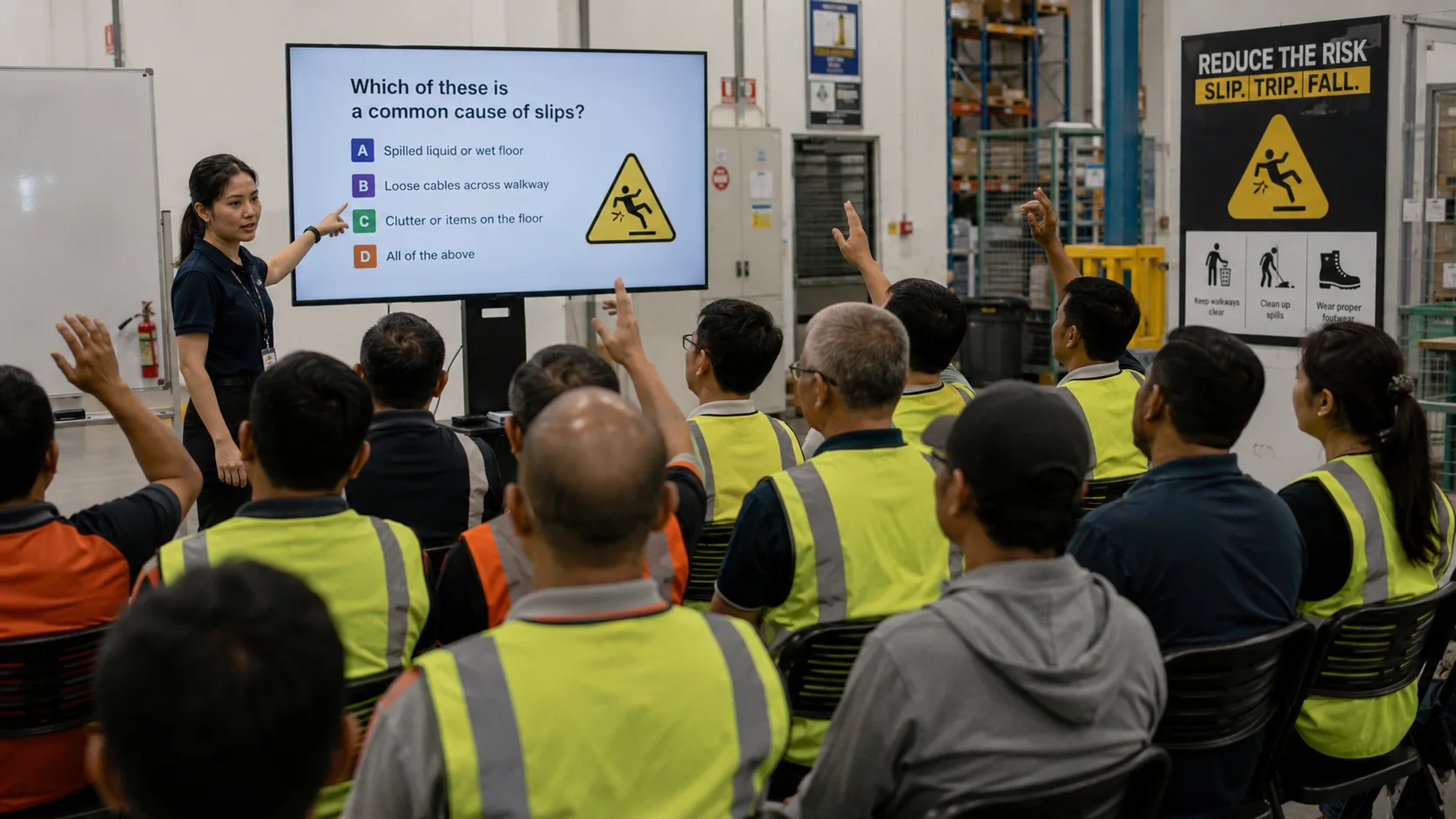
A knowledge check, before and after. The standard method is a pre- and post-session quiz: what someone could answer before the campaign, compared with what they can answer immediately after. That is a real, useful measurement. It tells you whether the content landed, whether the facilitator held the room, and whether the material was pitched at the right level.
What it does not tell you is whether anyone does anything differently on the floor next week. A worker can score well on a manual handling quiz on Tuesday and lift exactly the way they always have on Wednesday. Knowing the correct technique and using it under time pressure are different skills, and a quiz only tests the first one.
This is not a criticism specific to any one provider. It is the default shape of workplace training everywhere, and worth naming plainly rather than letting "we measure knowledge retention" quietly stand in for "we know it worked."
What would actually confirm behaviour changed?
Something observed after the fact, not something answered in the room. A few honest options, roughly in order of how much they cost to set up:
- Incident and near-miss trends. Compare the months after a campaign against the months before it, for the specific behaviour the campaign targeted. This is the closest thing to a direct answer, and it is also the slowest: you need enough time and enough volume of activity for a trend to mean anything.
- Supervisor spot-checks. A supervisor who already walks the floor notes whether the specific behaviour (correct PPE, a particular lifting technique, following a lockout procedure) is actually happening, before and after the campaign, without announcing they are checking.
- Audit or checklist compliance. If the campaign targeted something already covered by a routine inspection or bizSAFE audit checklist, the existing audit data is a behaviour measure that costs nothing extra to collect: you are just looking at it with the campaign date in mind.
None of these are things a training provider can hand you as part of a standard package, because they depend on data that lives inside your own operations, not inside the session. That is not a gap in the service; it is simply outside what a facilitator standing in a room for ninety minutes can measure.

What do you actually get from a campaign booking?
A scope document, the session materials, and documentation, with the exact reporting shaped to what you ask for. A confirmed campaign runs to a scope document covering topics, audience, format, language and timeline, delivered on-site using presentations, demonstrations, group activities and case studies, in sessions from 45 minutes up to multi-day, multi-department campaigns.
What comes afterwards (signed attendance records, a post-campaign summary with feedback and recommendations) is not a fixed package that looks the same for every booking. It is scoped to what the client asks for. A single 45-minute talk and a recurring multi-department campaign are reasonably expected to come with different levels of reporting, and the way to get what you actually need is to specify it when you book, not assume it is included.
If attendance records need to stand up to a MOM or bizSAFE audit, say so at the scoping stage. If you want the post-campaign summary to include the quiz results broken down by department, say that too.
What should you ask for, if you actually want to know it worked?
Decide what "worked" means before the campaign runs, not after. Three things to settle at the scoping stage rather than the debrief:
- What behaviour, specifically, is this campaign trying to change? Not "safety awareness." A named action: correct PPE worn on the floor, a specific lifting technique used, a lockout step not skipped. You cannot measure a behaviour you have not named.
- Where does the evidence for that behaviour already live? Incident logs, existing supervisor walk-throughs, an audit checklist. If nothing already tracks it, decide whether you are willing to set up a spot-check, or whether the quiz score is the only measure you will have, and go in knowing that is a knowledge measure, not a behaviour one.
- Who is checking, and when? A specific person, a specific interval (six weeks out, three months out). Left unscheduled, this does not happen, for the same reason unimplemented ergonomic recommendations do not happen: good intentions without an owner and a date rarely survive contact with a normal working week.
A quiz score is not nothing. It tells you the session worked as a session. It just is not evidence that anyone's behaviour changed, and a campaign is only worth repeating if you can actually tell the difference.
A quiz score is a start, not an answer
Testing what people learned is easy to set up and genuinely useful. It just is not the same question as whether anyone behaves differently because of it. The two get conflated because the first is simple to measure inside a session and the second is not. If a campaign matters enough to run, it matters enough to decide, before it starts, what evidence would tell you it worked, and to check for that evidence somewhere other than the quiz.
Booking a Workplace Safety Campaign in Singapore
If you want a campaign scoped around a specific behaviour you're trying to shift, not just a topic you're trying to cover, our workplace safety campaigns and educational talks page sets out the format options, and a scope document is built around what you actually need to measure afterwards.
Need Help With Workplace Safety?
Talk to our team about a tailored workplace safety, ergonomics, or wellness programme for your organisation.
Frequently Asked Questions
The standard method is a pre- and post-session knowledge quiz, comparing what participants could answer before and after. This measures whether the content was learned, not whether behaviour on the job has changed.
No. A quiz measures what someone can recall immediately after a session. Whether they apply it under normal working conditions weeks later is a separate question that needs separate evidence: incident trends, supervisor observation, or audit compliance data.
Knowledge retention is what someone can answer correctly. Behavioural change is what they actually do differently at work. A campaign can score well on the first and produce nothing on the second if the behaviour was never separately checked.
Reporting is scoped to what the client requests rather than fixed for every booking. If you need attendance records suitable for a MOM or bizSAFE audit, or a summary broken down a particular way, specify that when booking.
Format is flexible: standard talks run 45 to 90 minutes, with half-day events and multi-day, multi-department campaigns also available, customised to the topic and workforce.
Manual handling and safe lifting, ergonomics and workstation health, slip and trip prevention, PPE usage, mental wellness and stress management, heat stress, electrical safety, road safety and disease prevention, customised to the industry and specific WSH risks involved.
Pick one thing before the campaign runs: incident or near-miss trends for the targeted behaviour, unannounced supervisor spot-checks, or existing audit checklist data. Name who checks and when, or it will not get checked.