

Written by
Bryan Sim, Business Development at AnjouHealth
An OHS programme developer at AnjouHealth focused on designing workplace health and safety initiatives that help organisations create safer, healthier, and more engaged environments. He works on translating ergonomic assessments and workplace risk insights into practical initiatives such as safety campaigns, wellbeing programmes, and workplace interventions that are impactful, sustainable, and aligned with operational needs.
Overview
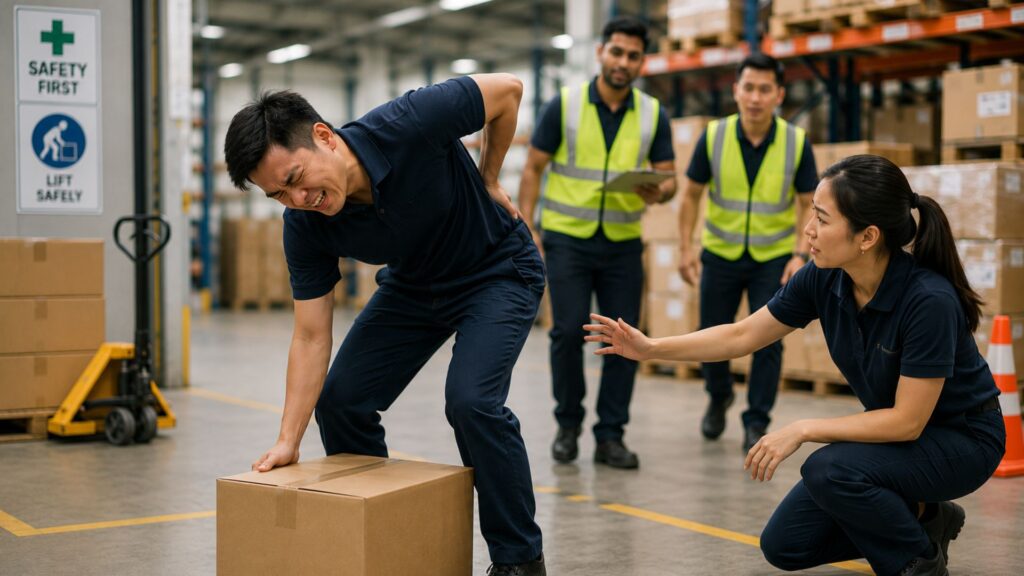
Manual handling is one of the most common work activities in Singapore and one of the most consistently underestimated sources of workplace injury. Lifting, lowering, carrying, pushing, pulling, and moving loads are tasks that workers perform dozens of times a day across construction, logistics, manufacturing, healthcare, retail, and food and beverage environments.
The injuries that result, back pain, shoulder strains, wrist injuries, and herniated discs, rarely happen immediately. They build quietly, through repeated exposure to loads that are too heavy, postures that are too awkward, or movements that are too frequent. By the time a worker reports pain, the damage has often been accumulating for weeks or months.
In Singapore, work-related musculoskeletal disorders accounted for 60% of occupational disease cases, with manual handling tasks among the leading contributing risk factors. Most of these cases are entirely preventable with the right assessment, training, and controls in place.
This guide by AnjouHealth covers everything Singapore employers, supervisors, and WSH officers need to know about manual handling safety, what it is, what the law requires, how to assess the risks, and the practical steps every workplace should take to protect workers and stay compliant.
In This Guide
- What is manual handling, and what activities does it cover
- Why manual handling injuries matter, the cost to your business
- What Singapore law requires, the WSH Act and SS569
- How to identify manual handling hazards in your workplace
- Manual handling risk assessment: what to assess
- Control measure: the hierarchy of controls applied to manual handling
- Safe lifting techniques: what every worker should know
- Which industries are most at risk
- Manual handling and your bizSAFE Risk Management Plan
- Frequently asked questions
What Is Manual Handling?
Manual handling includes lifting, lowering, pulling, pushing, carrying, moving, holding, or restraining an object. It covers any situation where a worker uses their body to move or support a load, whether that load is a cardboard box, a patient, a piece of equipment, a bag of cement, or a rack of garments.
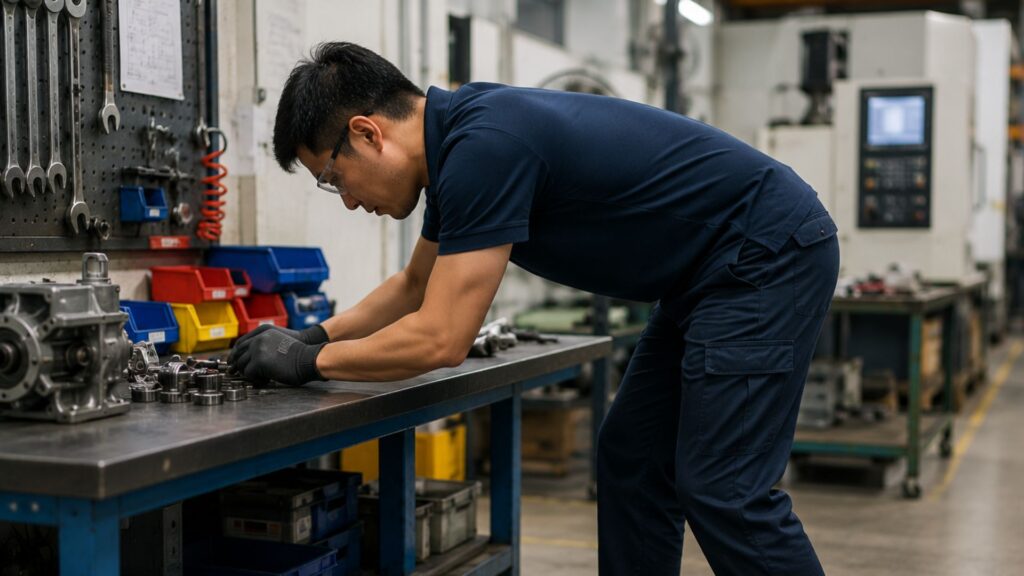
It is important to understand that manual handling injuries are not limited to heavy lifting. Many of the most common and most costly manual handling injuries result from:
- Repetitive low-force movements
Packing, assembly, data entry, scanning
- Sustained awkward postures
Bending over a workbench, reaching overhead, twisting while carrying
- Prolonged static postures
Standing at a counter, holding tools in a fixed position
- Sudden unexpected forces
Losing grip of a load, slipping while carrying
Any task that involves these characteristics, regardless of the weight involved, carries a manual handling injury risk that must be assessed and managed.
Why Manual Handling Injuries Matter
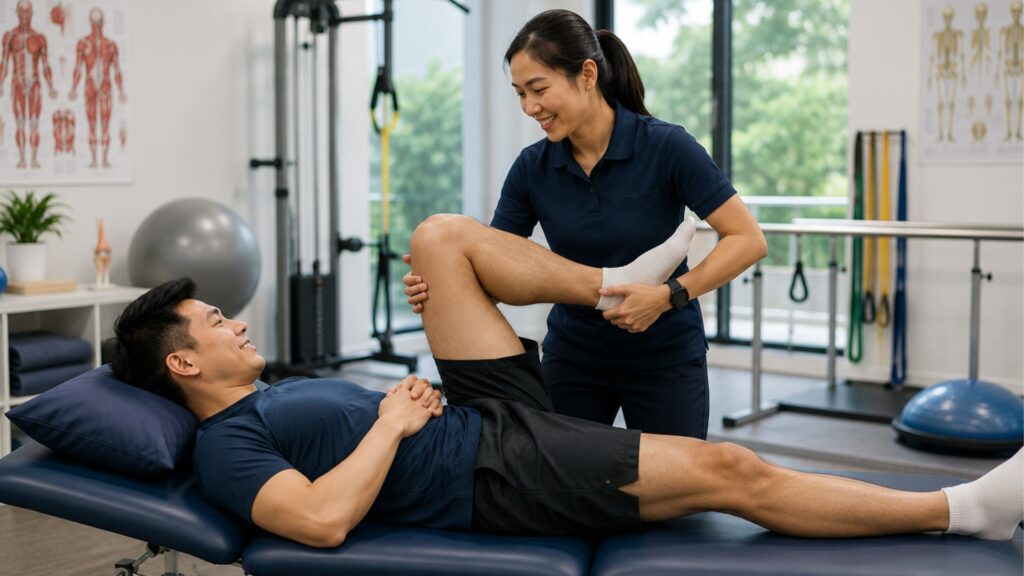
Manual handling injuries are the single most common category of work-related musculoskeletal disorder in Singapore. In Singapore, work-related musculoskeletal disorders of the upper limb are a reportable occupational disease under the WSH (Incident Reporting) Regulations, meaning employers must submit a report to MOM within 10 days of a worker being diagnosed by a registered medical practitioner.
Beyond the regulatory exposure, the business cost of manual handling injuries is substantial:
- Medical expenses
Treatment, physiotherapy, and specialist referrals that can run into thousands of dollars per claim under the updated WICA limits, effective November 2025
- Medical leave wages
Full average monthly earnings for the first 14 days of outpatient MC or light duty, and full Average Monthly Earnings (AME) for the first 60 days of hospitalisation leave
- Lost productivity
The injured worker’s output is lost or reduced, while colleagues absorb additional workload
- Replacement costs
Recruiting and training a replacement worker, particularly for skilled roles, can cost three to six months of salary
- Lump-sum compensation
If a manual handling injury results in permanent incapacity, employers face compensation of up to $346,000 under WICA 2026 limits
Perhaps most significantly, manual handling injuries are chronic rather than acute, they do not always appear in incident statistics immediately, but their cumulative impact on workforce health, productivity, and morale is among the highest of any workplace hazard category.
What Singapore Law Requires
The WSH Act
Under the Workplace Safety and Health Act, employers must take all reasonably practicable steps to ensure the safety and health of workers, including identifying and managing risks associated with manual handling tasks. This obligation applies to all industries and all company sizes.
Under the WSH (Risk Management) Regulations, manual handling tasks must be included in your risk assessment wherever they pose a foreseeable risk of injury. For logistics, manufacturing, construction, healthcare, and any other industry where workers regularly lift, carry, or move loads, manual handling is a non-negotiable component of the Risk Management Plan.
Singapore Standard SS569: 2011 Code of Practice for Manual Handling
The primary reference standard for manual handling in Singapore is SS569: 2011, the Code of Practice for Manual Handling. You can refer to the Singapore Standard SS569: 2011 (Code of Practice for manual handling) as a reference standard for acceptable practices for manual handling in Singapore. It provides recommended lifting limits and practical guidance on risk assessment and control measures.
Key guidance from SS569 includes:
- Recommended maximum loads for lifting and lowering, taking into account load weight, lift zone, frequency, and individual worker factors
- Task design principles for reducing manual handling risk
- Safe work procedures for common manual handling activities
- Guidance on the use of mechanical aids and handling equipment
MOM Reporting Requirements
Work-related musculoskeletal disorders of the upper limb are classified as a reportable occupational disease under the WSH (Incident Reporting) Regulations. When an employee is diagnosed with a reportable occupational disease, the employer must submit the written diagnosis to the Commissioner for WSH no later than 10 days after receiving it. At the same time, any registered medical practitioner who diagnoses any employee with an occupational disease must also submit a report to the Commissioner for WSH no later than 10 days after diagnosis.
How to Identify Manual Handling Hazards
The first step in managing manual handling risk is identifying which tasks in your workplace involve manual handling and what makes them hazardous. A systematic workplace walkthrough should observe workers performing their actual tasks, not staged demonstrations, and look for the following risk factors:
Load characteristics
- Heavy loads, particularly those above recommended lifting limits for the lift zone and frequency
- Bulky, awkward, or unstable loads that are difficult to grip or that shift during handling
- Loads with sharp edges, surfaces that are too hot or cold to handle, or that carry chemical contamination risk
- Loads with no handholds or grip points
Task characteristics
- Frequent repetition of the same movement, particularly lifting, reaching, or gripping
- Prolonged duration of a handling task without adequate rest
- Lifting from floor level or above shoulder height, the two most hazardous lift zones
- Twisting or bending while handling a load
- Carrying loads over long distances, up stairs, or slopes
- Sudden or unpredictable force requirements
Working environment
- Constrained space that forces awkward postures during handling
- Slippery, uneven, or obstructed floors that increase fall and drop risk
- Poor lighting that reduces visibility of the load or the path
- Extreme temperatures that affect grip, fatigue rate, and concentration
- Vibration from equipment or vehicles that compounds musculoskeletal load
Individual worker factors
- Workers who are new or returning from leave, unaccustomed to the physical demands
- Workers with pre-existing musculoskeletal conditions
- Pregnant workers
- Older workers whose recovery capacity is reduced
- Workers who have not received manual handling training
Manual Handling Risk Assessment: What to Assess
Once hazards are identified, each manual handling task must be evaluated using Singapore’s risk matrix framework, assessing the likelihood of injury and the severity of potential consequences to determine the overall risk level.
For manual handling specifically, the risk assessment should address the following factors in combination rather than in isolation:
- Weight of load
As a starting point for assessment, not as the only factor. SS569 provides recommended limits based on lift zone and frequency, but weight alone does not determine risk. A 10kg load lifted from floor level with a twisted back hundreds of times per shift carries far higher risk than a 25kg load lifted from a good position occasionally.
- Frequency and duration
How many times is the task performed per shift? How long is each handling episode? Cumulative exposure is the primary driver of musculoskeletal injury in manual handling.
- Posture
Does the task require bending, twisting, reaching overhead, or working in a confined position? Posture is one of the strongest predictors of injury risk in manual handling.
- Grip and coupling
Can the worker achieve a firm, comfortable grip on the load? Poor coupling significantly increases the load on the muscles and joints.
- Distance and height
How far is the load carried? What is the vertical range of the lift? Carrying distance and lift zone interact with weight and frequency to determine total biomechanical loading.
- Environmental factors
Do floor conditions, space, temperature, or lighting increase the risk beyond what the task alone would suggest?
Control Measures: The Hierarchy of Controls Applied to Manual Handling
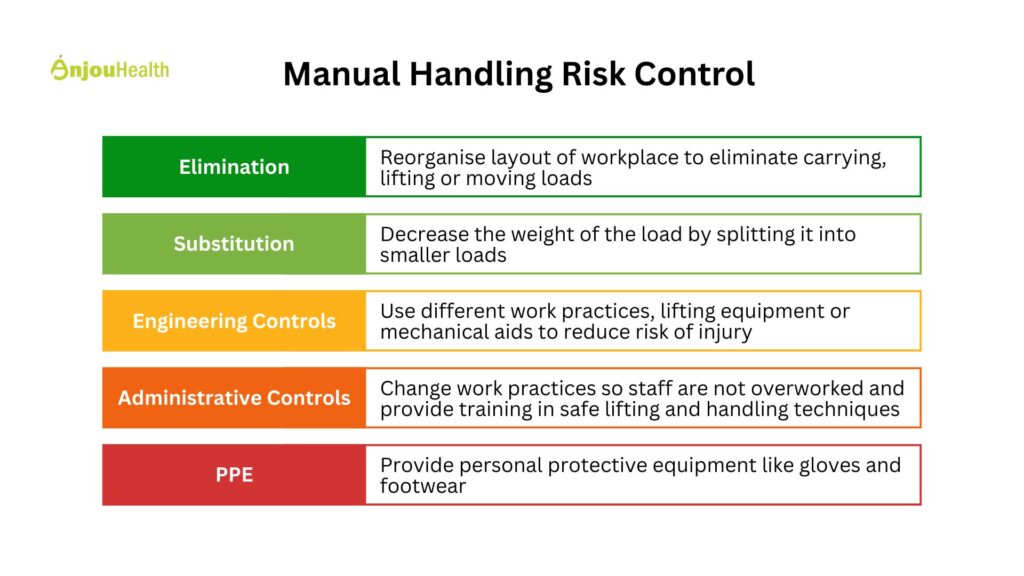
For every manual handling task assessed as medium risk or above, control measures must be implemented following the hierarchy of controls:
- Elimination
Can the manual handling task be eliminated entirely? Example: redesigning a production process so that goods move on conveyor belts rather than being carried by hand; using vacuum lifters to move products between machines rather than lifting by hand.
- Substitution
Replace the hazardous handling task with a less risky alternative. Example: packing goods in smaller, lighter boxes to reduce the weight of each unit handled; using wheeled trolleys instead of carrying by hand; switching to pallets that can be moved by forklift rather than by manual stacking.
- Engineering Controls
Physical modifications that reduce manual handling demands without relying on worker behaviour:- Pallet trucks, hand trucks, trolleys, and sack trucks for moving loads
- Height-adjustable workbenches that eliminate floor-level lifting
- Hoists, lifts, and mechanical lifting aids for heavy or awkward loads
- Conveyor systems that eliminate carrying
- Vacuum lifters for fragile or irregularly shaped loads
- Improved packaging with handles or grip points
- Administrative Controls
Changes to how work is organised that reduce individual exposure:- Job rotation: Rotating workers between high manual handling tasks and lighter duties to reduce cumulative exposure
- Rest breaks: Scheduled breaks during high-demand manual handling tasks
- Two-person lifts: For loads that exceed recommended single-person limits
- Revised work schedules: Concentrating demanding manual handling tasks in shorter, more frequent bursts rather than sustained periods
- Visible labelling: Clear demarcation of maximum load weights with visible labelling
- Training: Ensuring all workers understand the risks and apply safe techniques
- Personal Protective Equipment
- Anti-fatigue matting for workers standing on hard surfaces during manual handling tasks
- Gloves that improve grip and protect against load surface hazards
- Safety footwear that protects against dropped loads and provides traction on slippery surfaces
- Back support belts, note that these are NOT a substitute for proper training and engineering controls; their effectiveness in preventing back injury is not conclusively supported, and they should not give workers a false sense of security
Safe Lifting Techniques: What Every Worker Should Know
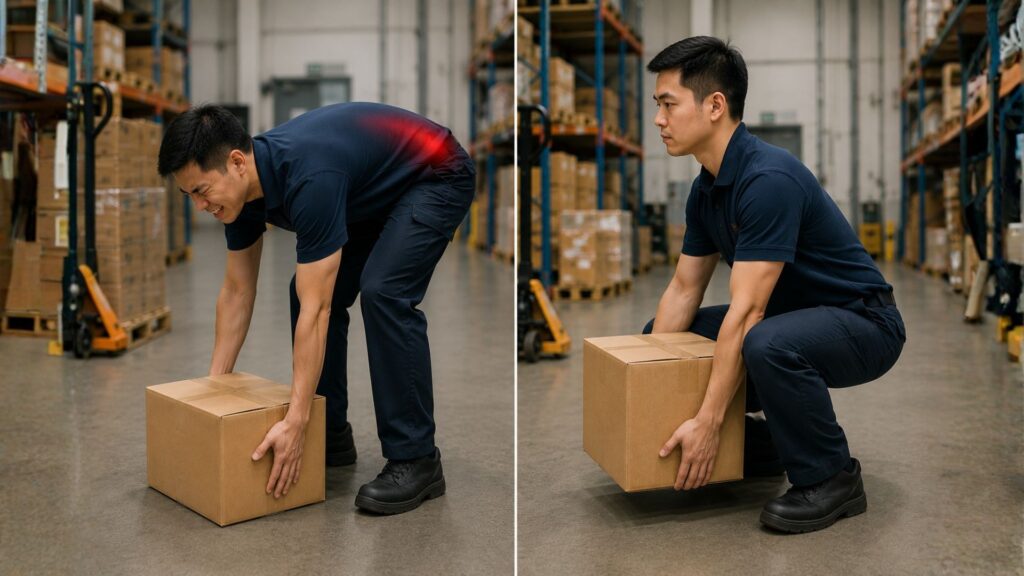
While engineering and administrative controls are more effective than training alone, all workers who perform manual handling tasks should be trained in safe lifting techniques. The following principles apply to most lifting tasks:
Before lifting
- Assess the load: Check its weight, size, shape, and whether it has adequate grip points
- Plan the lift: Identify the destination, check the path is clear, and decide whether a mechanical aid or a second person is needed
- Position close to the load: The closer the load is to the body’s centre of gravity, the lower the biomechanical strain
The lift
- Start with feet shoulder-width apart, one foot slightly forward for stability
- Bend at the knees and hips, not at the waist, to get down to the level of the load
- Grip the load firmly, use the whole hand, not just the fingers
- Keep the load close to the body throughout the lift, and avoid extended arms
- Lift with the leg muscles, not the back, straighten the knees and hips together, keeping the back straight
- Keep the head up and look forward, not down
During carrying
- Keep the load close to the body
- Avoid twisting the trunk, turn with the feet, not the waist
- Keep the path clear of obstacles before moving
- Take rest breaks if carrying over long distances
Lowering the load
- Use the same technique in reverse, bend at the knees and hips, keep the back straight, and lower with the legs
- Do not drop the load, control the descent throughout
Which Industries Are Most at Risk
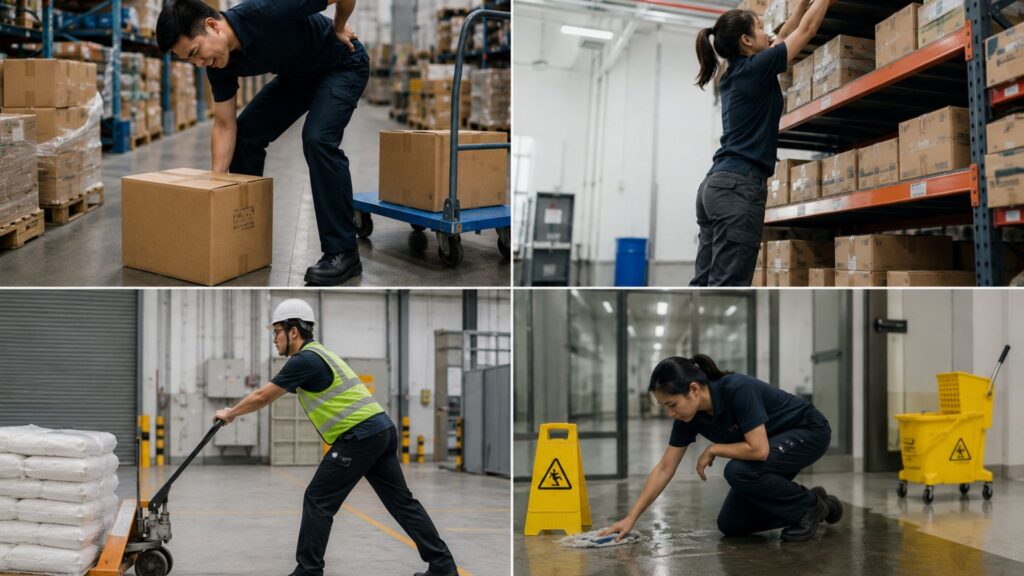
Manual handling injury risk is present across virtually all industries, but is highest in:
| Industry | Key Manual Handling Risks |
| Construction | Carrying materials, lifting at height, handling heavy equipment |
| Logistics and Warehousing | Repetitive lifting and carrying, stacking, loading, and unloading vehicles |
| Manufacturing | Assembly line repetition, machine loading and unloading, handling raw materials |
| Healthcare and Eldercare | Patient handling is one of the highest-risk manual handling activities |
| Retail | Stock handling, shelf stocking, receiving deliveries |
| Food and Beverage | Carrying kitchen equipment and supplies, repetitive food preparation movements |
| Cleaning and Facilities Management | Carrying equipment, pushing and pulling heavy trolleys |
For employers in these industries, manual handling should be a priority area in the Risk Management Plan and should be among the first tasks assessed during a Workplace Ergonomics Risk Assessment.
Manual Handling and Your bizSAFE Risk Management Plan
For companies pursuing or maintaining BizSAFE certification, manual handling must be included in the Risk Management Plan wherever it is a foreseeable hazard. For most industrial, logistics, and manufacturing workplaces, it is among the highest-priority hazard categories to document and control.
Your Risk Management Plan should include:
- All manual handling tasks are identified as medium risk or above
- Risk ratings with justification for each assessed task
- Control measures in place, engineering, administrative, and PPE
- Safe Work Procedures for high-risk manual handling tasks
- Training records showing workers have been trained in safe handling techniques
- Records of toolbox meetings where manual handling hazards were communicated
For companies that want to go further than documentation and take a more structured approach to reducing manual handling injury risk, a Workplace Ergonomics Risk Assessment (WERA) conducted by a qualified ergonomist provides the structured, technical evaluation of manual handling tasks that feeds directly into your control programme.
Looking to Protect Your Workers From Manual Handling Injuries?
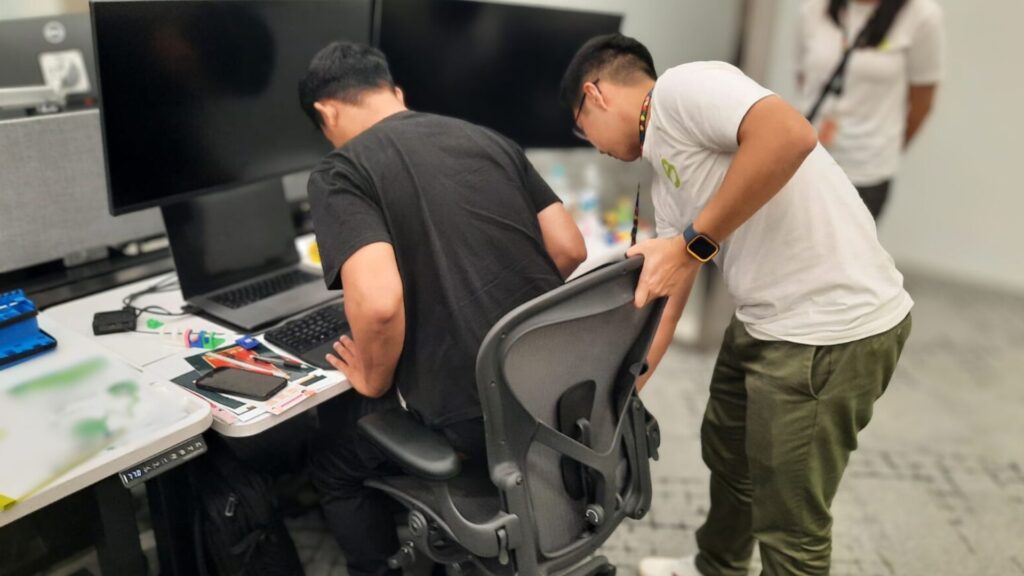
Manual handling injuries are preventable, but prevention requires more than a poster on the wall. At AnjouHealth, we are a trusted workplace health and safety partner in Singapore, with over 1,200 professionals trained and a client satisfaction rate exceeding 95%. We help businesses identify, assess, and control manual handling risks through evidence-based programmes that protect workers and reduce injury costs.
- Workplace Ergonomics Risk Assessment (WERA)
A structured, technical assessment of manual handling and other ergonomic hazards, conducted by qualified allied health professionals using REBA and RULA methodology
- Workplace Safety Campaigns
Interactive, hands-on campaigns that embed safe handling techniques across your entire workforce, not just during induction
- Occupational Health Programmes
On-site health screenings that identify workers with early signs of musculoskeletal strain before injuries become serious
- Customised WSH Solutions
Tailored manual handling programmes built around your industry, task profile, and workforce
Frequently Asked Questions
- What is the maximum weight a worker can lift in Singapore?
Singapore Standard SS569: 2011 provides recommended lifting limits for manual handling in Singapore. However, there is no single fixed maximum weight, the recommended limit depends on the lift zone (floor, waist, or shoulder level), lifting frequency, the worker’s individual characteristics, and task duration. A load that is acceptable for an occasional lift from waist height may be unacceptable when lifted from floor level repeatedly throughout a shift. Always assess the full combination of risk factors, not just the weight.
- Are manual handling training and safe lifting techniques legally required?
Under the WSH Act, employers must provide adequate instruction, information, training, and supervision so that workers can perform their work without unnecessary risk. For roles involving significant manual handling tasks, providing safe lifting training is part of this obligation. During investigations and audits, lack of appropriate training is frequently cited as a contributing factor to manual handling injuries.
- Does manual handling need to be included in my bizSAFE Risk Management Plan?
Yes. For any workplace where workers regularly lift, carry, push, pull, or move loads, manual handling is a foreseeable hazard that must be identified, assessed, and controlled in your Risk Management Plan. Your Level 3 auditor will review whether your plan reflects the actual hazards present in your workplace, for most industrial, logistics, or manufacturing operations, a plan that does not include manual handling will not pass.
- What is the difference between a manual handling risk assessment and a WERA?
A manual handling risk assessment is a component of your broader Risk Management Plan. It identifies the specific manual handling tasks in your workplace, evaluates their risk level, and documents the controls in place. A Workplace Ergonomics Risk Assessment (WERA) is a more comprehensive, technical assessment conducted by a qualified ergonomist using structured tools such as REBA and RULA, providing a detailed, quantified analysis of ergonomic risk across multiple body areas and task dimensions. A WERA typically produces more detailed and defensible documentation than an in-house risk assessment, and can identify risks that are not visible through standard RA methods.
- Are musculoskeletal disorders from manual handling reportable to MOM?
Yes. Work-related musculoskeletal disorders of the upper limb are a reportable occupational disease under the WSH (Incident Reporting) Regulations. Employers must report to MOM within 10 days of receiving a written diagnosis from a registered medical practitioner. The diagnosing doctor is also required to submit a report independently within 10 days.
- What should I do if a worker reports pain from a manual handling task?
Act immediately, do not wait for a formal injury claim. Arrange medical assessment, review the task’s risk assessment, consider temporary redeployment to lighter duties, and investigate whether the control measures in place are adequate. Early intervention significantly improves recovery outcomes and reduces the likelihood of a WICA claim. Document all actions taken.