
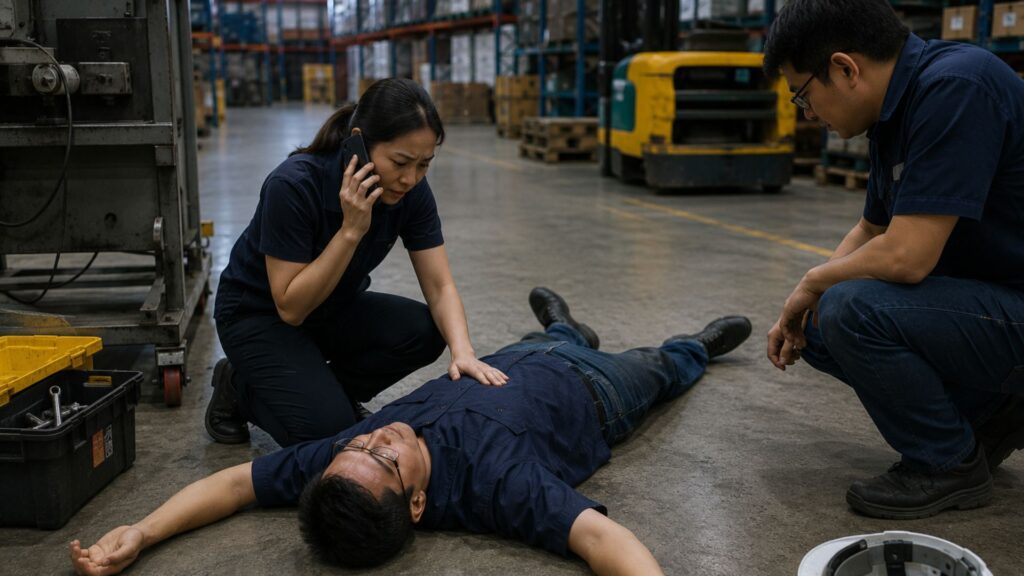

Written by
Bryan Sim, Business Development at AnjouHealth
An OHS programme developer at AnjouHealth focused on designing workplace health and safety initiatives that help organisations create safer, healthier, and more engaged environments. He works on translating ergonomic assessments and workplace risk insights into practical initiatives such as safety campaigns, wellbeing programmes, and workplace interventions that are impactful, sustainable, and aligned with operational needs.
Overview
When Singapore employers think about the cost of a workplace accident, most think about the compensation payout. A figure on a WICA claim. An insurance premium increase. A fine from MOM if reporting deadlines were missed.
The reality is significantly more expensive and significantly more damaging than any single line item suggests.
In 2025, Singapore recorded 36 workplace fatalities and 586 major injuries, rates that, while at historic lows, represent real people, real families, and real businesses that bore the full financial and operational consequences of those incidents.
From 1 November 2025, MOM implemented substantial increases to Work Injury Compensation Act (WICA) limits, with some categories seeing up to 19% higher payouts, the most significant adjustment since 2020. For employers who have not reviewed their insurance coverage or their safety investment since 2020, the financial exposure is now considerably higher than they may realise.
This guide by AnjouHealth breaks down every cost a workplace accident actually creates, direct, indirect, and hidden, so Singapore employers can make an informed decision about what workplace safety is really worth.
In This Guide
- The two types of workplace accident costs: direct and indirect
- Direct costs: WICA compensation, medical expenses, fines and penalties
- Updated WICA limits from November 2025
- Indirect costs, the ones most employers do not budget for
- The hidden costs that never appear on an invoice
- A real cost scenario: what a single serious injury actually costs
- How workplace safety investment compares
- How bizSAFE reduces your financial exposure
- Frequently asked questions
The Two Types of Workplace Accident Costs

Every workplace accident creates two categories of cost, and most employers drastically underestimate the second.
Direct costs are the visible, quantifiable expenses that arise immediately after an accident, such as compensation payouts, medical bills, fines, and insurance increases. These are the figures that appear on claims and invoices.
Indirect costs are the operational, reputational, and human costs that do not appear on any single invoice but are often significantly larger than the direct costs. Industry research consistently shows that indirect costs can be four to ten times higher than direct costs for any given workplace incident.
Understanding both is essential for any Singapore employer assessing the true return on investment of workplace safety programmes.
Direct Costs: What WICA Requires You to Pay

Updated WICA Compensation Limits (From 1 November 2025)
From November 1 2025, MOM implemented substantial increases to WICA limits. Maximum death compensation rose to $269,000, and permanent incapacity benefits reached $346,000.
Here is the full breakdown of updated WICA compensation limits:
- Medical Expenses
The maximum amount claimable for medical expenses, including hospital bills, medication, physiotherapy, occupational therapy, TCM, and emergency transport, increased from $45,000 to $53,000 per accident, or one year from the accident date, whichever is reached first.
- Permanent Incapacity
Lump-sum compensation for permanent incapacity is calculated using the formula: Average Monthly Earnings × Age Multiplying Factor × % Permanent Incapacity. The minimum compensation changed from $97,000 × (% PI) to $116,000 × (% PI). The maximum compensation changed from $289,000 × (% PI) to $346,000 × (% PI). Where a doctor awards 100% permanent incapacity, an additional 25% is added to the compensation amount.
- Fatal Accidents
Maximum death compensation rose to $269,000. The actual payout depends on the employee’s average monthly earnings and age at the time of the accident, calculated using MOM’s prescribed age-multiplying factors.
- Medical Leave Wages
When an injured employee is placed on medical certificate, hospitalisation leave, or light duties, employers must pay medical leave wages based on their Average Monthly Earnings, calculated over the 12 months prior to the accident and generally including overtime and bonuses, but excluding transport allowances. For outpatient MC or light duties: full Average Monthly Earnings (AME) for the first 14 days, then 2/3 AME from Day 15 to one year after the accident. For hospitalisation leave: full AME for the first 60 days, then 2/3 AME from Day 61 to one year after the accident.
MOM Fines and Penalties
Beyond WICA compensation, employers who breach WSH Act obligations face significant financial penalties:
| Offence | Maximum Penalty |
| Failure to ensure workplace safety (first offence) | Fine up to $500,000 |
| Failure to ensure workplace safety (repeat offence) | Fine up to $1,000,000 and/or 2 years imprisonment |
| Failure to report accident within required timeframe | Fine up to $10,000 |
| Failure to maintain risk assessment records | Fine up to $10,000 |
| Contravening risk management regulations (first offence) | Fine up to $50,000 and/or 2 years imprisonment |
For serious incidents, particularly fatalities or major injuries, MOM invariably conducts a stop-work order and investigation. The cost of a work stoppage on a construction site or production facility can dwarf the fine itself.
Insurance Premium Increases
A workplace accident claim almost always triggers an insurance premium increase at renewal, typically 20% to 50%, depending on claim severity, claim frequency, and the insurer’s assessment of your workplace safety record. For companies with multiple incidents in a short period, some insurers may decline to renew coverage entirely, forcing employers into higher-cost specialist markets.
Indirect Costs, The Ones Most Employers Do Not Budget For

Lost Productivity
When a worker is injured, the productivity loss extends far beyond that individual’s absence:
- The injured worker’s output is lost, entirely or partially, for the duration of their medical leave, light duty period, or rehabilitation
- Colleagues who witnessed the accident or were involved in the response are psychologically affected, research consistently shows productivity drops across the affected team for days to weeks after a serious incident
- Supervisors spend significant time on incident investigation, reporting, worker interviews, and liaison with MOM, time taken entirely away from productive work
- Replacement workers, if hired, take time to reach the productivity level of the injured employee, particularly for skilled or experienced roles
For a serious injury requiring three to six months of medical leave, lost productivity across the team, not just the injured worker, can easily exceed the direct compensation cost.
Recruitment and Replacement Costs
Replacing an injured worker costs more than most employers realise:
- Advertising, agency fees, and interviewing time
- Onboarding and induction, including WSH induction, which must be repeated for all new workers
- Training time before the replacement reaches full productivity
- Knowledge loss, experienced workers carry institutional knowledge about processes, hazards, and safe practices that is not captured in any document
For skilled workers in construction, manufacturing, or specialised industrial roles, replacement costs can exceed three to six months of salary.
Management Time
The administrative burden of a workplace accident is substantial and falls almost entirely on management:
- Immediate response and first aid coordination
- Emergency services liaison
- MOM iReport submission within required timeframes
- Internal investigation and root cause analysis
- Corrective action implementation and documentation
- Insurance claim management
- Worker’s family communication and support
- Legal advice if the claim escalates to litigation
For a major injury or fatality, senior management time consumed can run to hundreds of hours over the following weeks and months.
Hidden Costs, What Never Appears on an Invoice
- Reputational Damage
A serious workplace accident can damage any company’s reputation with clients, partners, and prospective employees in ways that are difficult to quantify but entirely real:
- Government agencies and large corporations increasingly check bizSAFE status and WSH records before awarding contracts. An accident investigation, stop-work order, or MOM enforcement action is visible in public records
- Prospective employees, particularly skilled workers, should research employer safety records. A company with a history of serious incidents struggles to attract quality talent
- Existing employees may seek to leave following a serious accident, particularly if they believe management failed to take safety seriously
- Government agencies and large corporations increasingly check bizSAFE status and WSH records before awarding contracts. An accident investigation, stop-work order, or MOM enforcement action is visible in public records
- Tender Disqualification
For companies holding or pursuing government or GLC tenders, a serious workplace accident can result in immediate disqualification or suspension from tender eligibilit, regardless of bizSAFE certification status. The revenue impact of losing a government contract can far exceed any direct accident cost.
- Mental Health and Morale Impact
The psychological impact on colleagues who witness a serious accident or who work alongside an injured colleague is real and measurable. Anxiety, reduced concentration, presenteeism, and increased absenteeism are well-documented consequences of workplace trauma. These costs are almost never captured in accident cost analyses but have a direct and lasting impact on productivity and team performance.
- Legal Costs
While WICA is a no-fault system that limits employer liability, injured workers retain the right to pursue civil claims under common law where employer negligence can be demonstrated. Legal defence costs for a civil claim can run to tens of thousands of dollars, regardless of outcome.
A Real Cost Scenario, What a Single Serious Injury Actually Costs
To illustrate the full picture, here is a realistic cost breakdown for a single major workplace injury involving a 35-year-old warehouse worker with a monthly salary of $2,500, who suffers a back injury requiring surgery and six months of medical leave:
| Cost Item | Estimated Amount (SGD) |
| Medical expenses (surgery, physiotherapy, follow-up) | $25,000 – $40,000 |
| Medical leave wages (Up to 60 days at full AME; beyond 60 days up to 1 year at 2/3 AME ) | $15,000 |
| Permanent partial incapacity (if assessed at 20%) | $23,200 – $69,200 |
| Insurance premium increase (20% for 3 years) | $3,000 – $8,000 |
| Replacement worker recruitment and training | $5,000 – $10,000 |
| Lost productivity — injured worker and team | $15,000 – $30,000 |
| Management time — investigation, reporting, claims | $5,000 – $10,000 |
| MOM investigation and potential fine | $0 – $50,000 |
| Total estimated cost | $91,200 – $232,200 |
This is a single non-fatal injury. For a fatality or a major injury with full permanent incapacity, total costs can exceed $500,000 to $1,000,000 when all direct, indirect, and hidden costs are factored in.
How Workplace Safety Investment Compares

The most important number in the table above is the comparison with what workplace safety programmes actually cost.
A comprehensive bizSAFE Level 3 certification, including the RM Champion course, Risk Management Plan development, and independent audit, typically costs between $1,200 and $5,300 for an SME, depending on whether a consultant is engaged. It is valid for 3 years.
A Workplace Ergonomics Risk Assessment to identify and address musculoskeletal injury risks, one of the leading causes of work injury claims in Singapore, typically costs a fraction of a single WICA claim.
A workplace safety campaign that embeds safe behaviours across an entire workforce costs less than the management time consumed by a single accident investigation.
The arithmetic is not complicated. The question is not whether workplace safety is worth investing in, it is whether your company is making that investment efficiently and at the right level for your risk profile.
How bizSAFE Reduces Your Financial Exposure
bizSAFE certification does more than satisfy tender requirements. It directly reduces the financial risk of a workplace accident in several ways:
- Lower insurance premiums
Insurers view bizSAFE-certified companies as lower risk and often offer preferential Work Injury Compensation Insurance rates to certified employers.
- Reduced incident frequency
The structured risk management process required at bizSAFE Level 3 identifies and addresses hazards before they cause injuries. Companies with properly implemented Risk Management Plans have demonstrably lower incident rates.
- Stronger legal position
In the event of a workplace accident, a well-documented risk management system demonstrates that the employer took all reasonably practicable steps to ensure safety. This is the due diligence defence under the WSH Act and can significantly affect the outcome of MOM investigations and civil claims.
- Tender protection
Maintaining a valid bizSAFE certification protects contract eligibility. A lapsed certificate at the time of an accident compounds the financial exposure significantly.
Looking to Strengthen Your Workplace Safety Culture?
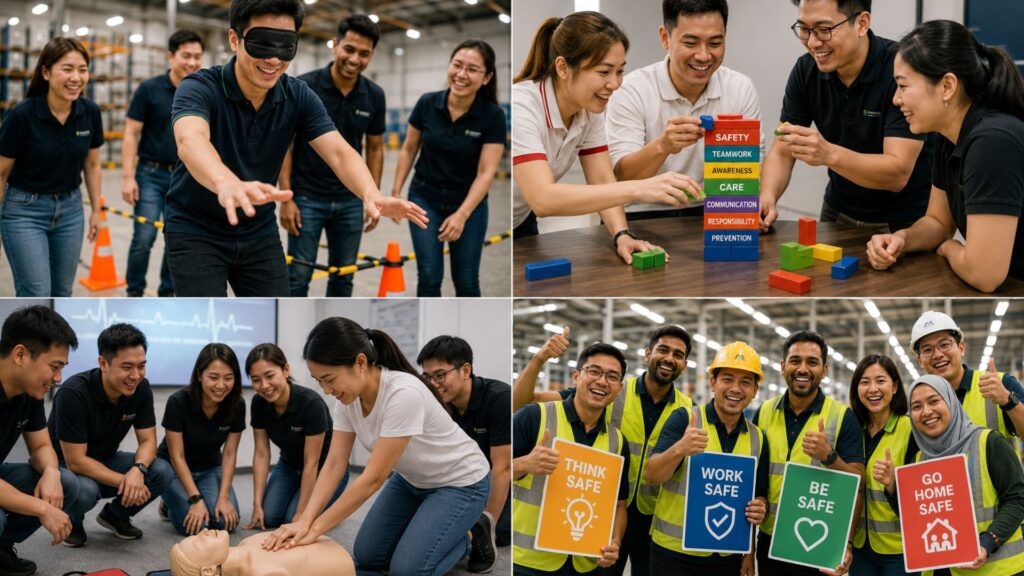
The best time to invest in workplace safety is before an accident happens. At AnjouHealth, we are a trusted workplace health and safety partner in Singapore, with over 1,200 professionals trained and a client satisfaction rate exceeding 95%. We help businesses build lasting WSH cultures through evidence-based programmes that reduce incident risk and protect your people, your reputation, and your bottom line.
- Workplace Safety Campaigns
Interactive, hands-on campaigns that embed safe behaviours across your entire workforce before incidents occur
- Workplace Ergonomics Risk Assessment (WERA)
Identify and mitigate ergonomic hazards that are among the leading causes of work injury claims in Singapore
- Occupational Health Programmes
Onsite health screenings that identify health risks before they become workplace injuries
- Customised WSH Solutions
Tailored programmes built around your industry, workforce size, and specific risk profile
Frequently Asked Questions
- What is the maximum WICA compensation payout in Singapore in 2026?
Following the November 2025 WICA amendments, the maximum compensation for permanent incapacity is $346,000, with an additional 25% added where 100% permanent incapacity is assessed. The maximum medical expenses claimable is $53,000 per accident. For fatal accidents, the maximum death compensation is $269,000. Actual payouts depend on the employee’s average monthly earnings and age at the time of the accident.
- Does WICA insurance cover all workplace accident costs?
WICA insurance covers the statutory compensation components, medical expenses, medical leave wages, and lump-sum compensation for permanent incapacity or death. It does not cover indirect costs such as lost productivity, replacement worker expenses, management time, reputational damage, MOM fines, or legal costs from civil claims. These indirect and hidden costs are typically borne entirely by the employer.
- Can an injured worker sue me even if I have WICA insurance?
Yes. WICA is a no-fault compensation system, but it does not prevent workers from pursuing civil claims under common law where employer negligence can be demonstrated. Workers must elect between WICA and common law; they cannot pursue both, but the right to pursue civil litigation exists. Legal defence costs for a civil claim can be substantial regardless of the outcome.
- How quickly must I report a workplace accident to MOM?
Report to MOM within 10 calendar days of the accident if the employee is hospitalised for 24+ hours, OR within 10 days from the 4th day of medical leave (4+ calendar days total, whether consecutive or not). Report immediately within 24 hours if the employee is hospitalised for 24 hours or more, suffers a dangerous occurrence, or if the accident is fatal. Accidents must be reported via MOM’s iReport system. Failure to report is an offence.
- Does bizSAFE certification reduce my WICA insurance premiums?
Many insurers view bizSAFE-certified companies as lower risk and offer preferential premiums to certified employers, particularly those at Level 3 and above with documented risk management systems. The extent of premium reduction varies by insurer, industry, and claims history. Speak directly with your insurer about the impact of bizSAFE certification on your premium calculation.
- What happens to my government tender eligibility after a workplace accident?
A serious workplace accident that triggers an MOM stop-work order, enforcement action, or prosecution can result in suspension or disqualification from government tender eligibility, regardless of your bizSAFE certification status. The reputational and commercial impact of losing tender eligibility typically far exceeds the direct compensation costs of the accident itself.