


Quick Summary
A toolbox meeting runs out of things to say long before it runs out of hazards. Employers have been asking for help with this for years: in a 2018 Workplace Safety and Health Institute study, one employer suggestion was for WSH bodies to produce "a monthly safety slide deck that could be used in their toolbox meeting."
A topic rotation fixes the blank-page problem. It doesn't replace the job a toolbox meeting is actually for, which is briefing workers on today's work. This post gives you a 12-week rotation weighted by what actually injured workers in Singapore in 2025. It also sets out when to drop the rotation for the day, and how to stop it hardening into a script.
It builds on our complete guide to toolbox meetings, which covers what they are, who runs them, and how. This one covers what to talk about.
Why do toolbox meetings run out of things to say?
Because the topic ends up doing the whole job, when it should be one small part of the meeting. The WSH Council's Guide to Effective Toolbox Meeting sets out six steps: fitness to work, PPE, the day's tasks and their hazards, "Look. Think. Do", reporting unsafe acts or conditions, and housekeeping. Only the third step is about today's work, and the rest have a fixed shape.
A meeting that follows those six steps always has something to say, because the tasks change every day. A meeting that swaps them for a monthly theme ends up reciting "safety topic of the week" to people who stopped listening in week three.
So a rotation only works if it sits inside that structure. Use it for the few minutes you'd otherwise spend improvising a general reminder, and keep the task briefing as the main part of the meeting.
What should decide which topics come up most often?
Your own risk assessment first. National injury data second. The hazards in your risk assessment are the ones your workers actually face, and those should set the rotation. Where you have no better data, MOM's national figures are a reasonable guide to which topics deserve more than one slot.
The MOM Workplace Safety and Health Report 2025 points to areas where most toolbox rotations fall short:
- Slips, trips and falls were the top cause of major injuries in 2025. Together with falls from height and machinery incidents, they made up 61% of the 586 major injuries that year
- Minor injuries were led by slips, trips and falls, machinery incidents, and over-exertion or strenuous movements. Together, these made up half of all minor injuries
- Fatal injuries were led by vehicular incidents, falls from height, and collapse or failure of structures and equipment
- Occupational disease was led by noise-induced hearing loss, followed by work-related musculoskeletal disorders
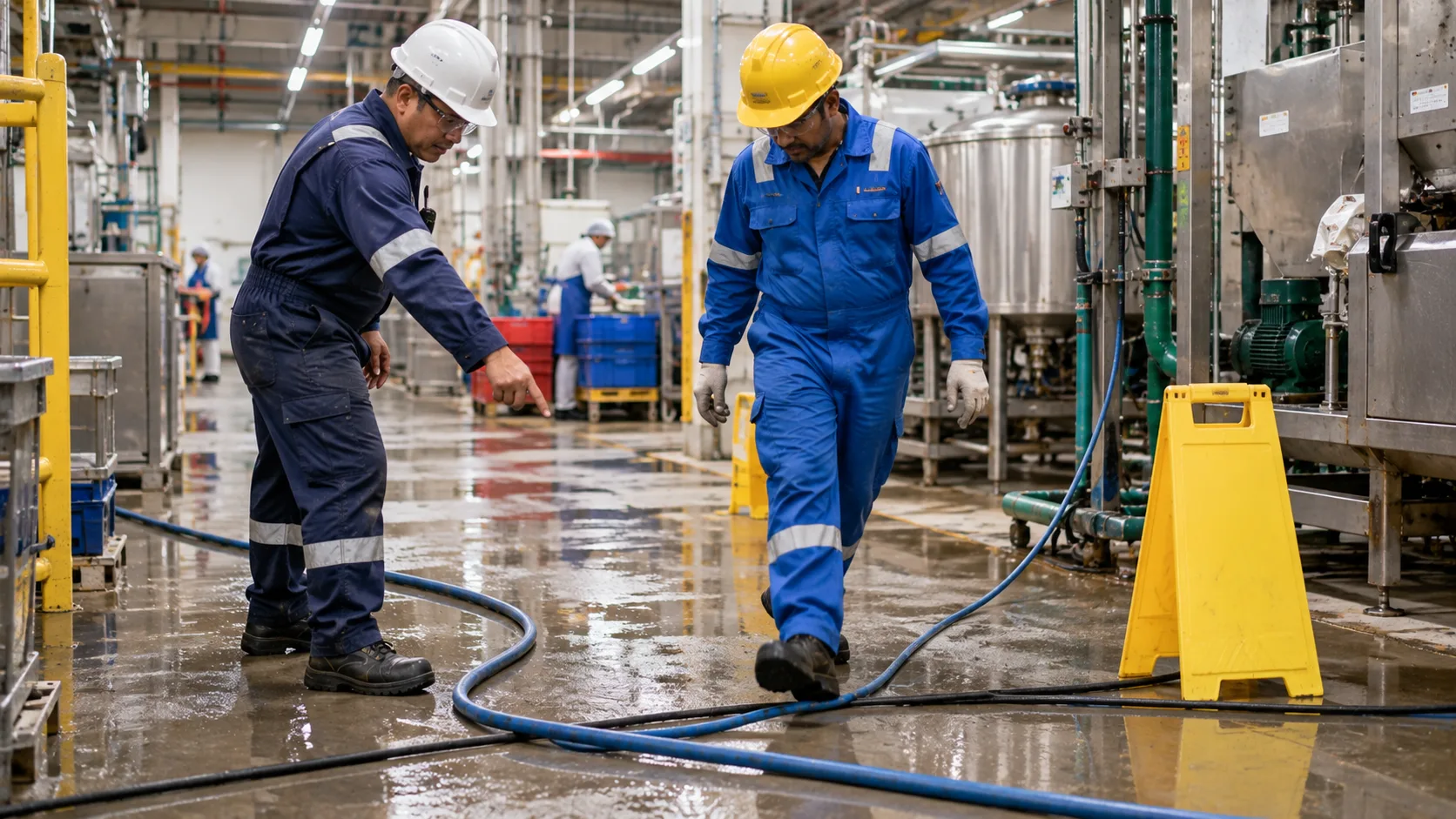
Slips and trips sound too ordinary to need a toolbox topic, which is why they get skipped. The data says they need more airtime than work at height, not less.
What does a 12-week rotation look like?
Twelve themes, weighted towards the causes that injure the most people, each with one question for the workers. The question matters more than the theme. The WSH Council's Effective Toolbox Meetings checklist includes "Workers are encouraged to ask questions". Starting with a question for the workers gets them talking far more reliably than finishing with "any questions?".
| Week | Theme | Ask the workers | Most relevant to |
|---|---|---|---|
| 1 | Slips and trips: walkways | "Where on today's route is something lying across the floor?" | Every workplace |
| 2 | Falls from height: access | "How are you getting up there today, and is it the right ladder for a two-handed job?" | Construction, marine, maintenance |
| 3 | Machinery: guards and isolation | "Which machine today needs locking out before anyone reaches in?" | Manufacturing, F&B processing |
| 4 | Manual handling and over-exertion | "What's the heaviest or most awkward thing anyone is moving today?" | Logistics, warehousing, healthcare |
| 5 | Vehicles and moving equipment | "Where do people and vehicles share the same space today?" | Transport, logistics, construction |
| 6 | Slips and trips: wet and changing floors | "Which floor will be wet today, and what's on your feet?" | F&B, cleaning, manufacturing |
| 7 | Struck by falling objects | "What's stored or stacked above head height near where you'll work?" | Warehousing, construction |
| 8 | Heat | "Where is today's hottest job, and when are the breaks?" | Outdoor and hot-process work |
| 9 | Noise and hearing | "Where do you have to raise your voice to be heard?" | Manufacturing, construction |
| 10 | Electrical | "What equipment are you plugging in or opening up today?" | Maintenance, engineering |
| 11 | Housekeeping at end of shift | "What did we leave out yesterday that someone tripped over or had to move?" | Every workplace |
| 12 | Near-miss review | "What nearly went wrong in the last three months, and did we fix it?" | Every workplace |
Slips and trips appear twice because the national data puts them first. If your risk assessment gives a different ranking, move the weight to match it. After week 12, start again with the same themes and new questions. Workers remember a question they had to answer much better than a reminder they sat through.
A few of these themes have their own post on this blog if the person running the meeting wants more depth: manual handling, work at height, heat stress and PPE.
Where do the questions come from?
From the reasons MOM gives for how these injuries actually happened. The 2025 report lists the common root causes behind manufacturing injuries. Each one tells you what a supervisor should ask about:
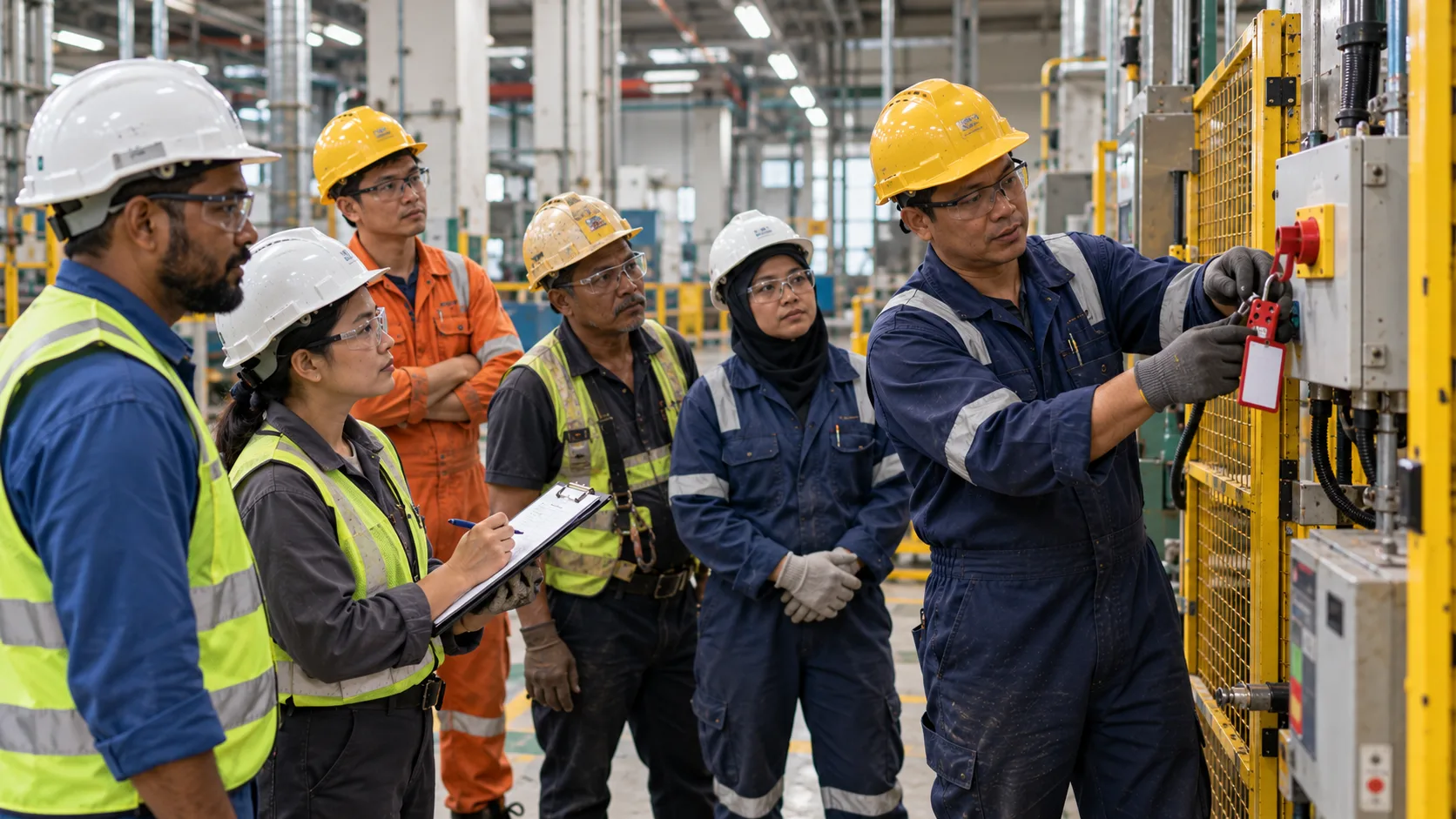
- For machinery incidents, MOM lists "Not following LOTO procedures; Bypass of safety interlocks", and guarding "removed without reinstating"
- For slips, trips and falls, it lists "electrical cables, compressed air hoses running across workplaces" and failing to provide or enforce "slip-resistant safety shoes or boots"
- For falls from height, it lists "Use of incorrect ladder type (e.g. using A-frame ladders instead of platform ladders for work that requires both hands"
- For struck-by-falling-objects, it lists "Unsecured items placed at height" and materials "stored without any means of securing"
These come from MOM's manufacturing section, so they fit a factory floor most closely. The approach works anywhere, though. Find the cause and ask about it before it happens on your site.
When should you drop the rotation for the day?
Whenever the day's work, a revised risk assessment or a recent incident gives you something more specific to say. The legal duty behind this is not a topic calendar. Regulation 6 of the WSH (Risk Management) Regulations requires employers to take "all reasonably practicable steps" to ensure anyone who may be exposed is informed of "the nature of the risk involved" and of the measures and safe work procedures in place. The same regulation says this applies again "whenever any risk assessment referred to in regulation 3(1) is revised, or where any measure or safe work procedure implemented under regulation 4(2) is changed."
That regulation does not mention toolbox meetings by name. Toolbox meetings are simply a common way of meeting the duty. A rotation theme that has nothing to do with the day's work does little to meet it.
Drop the rotation, or shorten it, when:
- The task is new or non-routine. Brief the actual job and its safe work procedure instead
- The risk assessment or procedure has just changed. Regulation 6(2) is written for exactly this
- Something went wrong recently. The WSH Council checklist asks that "Recent incidents or near misses are shared"
- Conditions have changed. Weather, a new layout, different equipment or a new subcontractor on site
The rotation is what you fall back on when nothing specific is happening. It shouldn't take over on days when something is.
How do you stop a rotation becoming a script?
Change who speaks, how they learn it, and what gets written down. The WSH Council's checklist and guide set out the basics:
- Language. The checklist asks that the meeting be "conducted in language(s) understood by all workers", which "can be done by having a representative from each nationality to help with translation"
- Demonstration. "Workers are involved in the demonstration of safe work methods." Having a worker demonstrate the lock-out or the correct ladder beats describing it
- Group size. The guide's tips include "Keep the group small e.g. 20"
- Follow-up. "Action items are assigned to the appropriate person or team and noted for follow-up at the next meeting"
That last point turns a rotation into a loop. A hazard raised in week 1 gets an owner and comes back in week 2 as either "fixed" or "still open".
What should the record show?
Both the rotation theme and the day-specific hazards, so the record shows the meeting was about that day's work. The checklist's last item is "Key points of the toolbox meeting are properly recorded and filed." A record that shows the same theme with nothing added for the day looks like a script, because it was one.
A useful line in the record looks like: Week 3, machinery isolation. Today: conveyor belt cleaning on Line 2, LOTO before reaching in. Raised: guard on Line 4 loose, assigned to maintenance. That line shows what was said, what was specific to the day, and what happens next.
Where does an outside safety talk fit, and where doesn't it?
An outside talk can go deeper into one theme. It cannot run your toolbox meeting. We should be upfront here: AnjouHealth sells safety talks and campaigns, so we have a reason to say they help. The honest version is narrower.
A toolbox meeting has to be run by someone who knows today's work: which machine, which floor, which lift. An outside facilitator doesn't, and shouldn't pretend to. A daily briefing isn't something to outsource.
Where an outside session helps is with the few themes that deserve more than five minutes. That might be hands-on manual handling practice, a proper heat-stress session before the hot months, or delivering a theme in Mandarin or Bahasa Melayu for a mixed workforce. Your supervisors then pick those themes up again in their own toolbox meetings. The talk gives the theme depth, and the daily meeting keeps reminding people of it.
If you're unsure whether you need a safety talk or a health workshop at all, we've compared the two in Health Workshop or Safety Talk: Which One Do You Actually Need?.
The rotation is the fallback, not the plan
A topic list solves the problem of the supervisor standing in front of workers with nothing prepared. It doesn't solve the problem that toolbox meetings exist for. That problem is making sure the people doing today's work know today's hazards before they start. Use the rotation on quiet days, drop it on busy ones, and make sure the record shows which kind of day it was.
Going Deeper on One Theme
When a rotation theme needs more than five minutes, such as hands-on manual handling practice, heat stress before the hot months, or a session in Mandarin or Bahasa Melayu, our workplace safety campaigns and educational talks can build it around your own site's risks. Your supervisors then keep reinforcing it in their daily toolbox meetings.
Need Help With Workplace Safety?
Talk to our team about a tailored workplace safety, ergonomics, or wellness programme for your organisation.
Frequently Asked Questions
Start with the hazards in your own risk assessment. Where you have no better data, weight towards the causes MOM reports most often. In 2025, the top causes of major injuries were slips, trips and falls, falls from height, and machinery incidents. Minor injuries were led by slips, trips and falls, machinery incidents, and over-exertion. Vehicular incidents were the leading cause of fatal injuries.
The day's task briefing should change every day, because the work does. A background theme can rotate weekly. A 12-week cycle gives enough variety without losing the high-priority topics, which can appear more than once.
The WSH (Risk Management) Regulations require employers to take all reasonably practicable steps to inform workers of the risks they face and the measures in place, and to do so again whenever the risk assessment or safe work procedure changes. The regulations do not name toolbox meetings. They are a common way of meeting that duty, not the only one. Check the requirements that apply to your own sector with your WSH officer or MOM.
No. The WSH Council's guide puts the day's tasks and their hazards at the centre of the meeting. A rotation theme is a background reminder, and it should be cut short on any day with a new task, a changed procedure or a recent near miss.
Ask the workers a question instead of reading out a reminder. Get a worker to demonstrate the safe method. Keep the group small and hold the meeting in a language everyone understands. Then report back on last week's issues so workers can see that raising something led to action.